The Complete Guide to U.S. Federal Income Tax (2026)
Table of contents
- The one formula everything reduces to
- Income is not one thing (stages 1–2)
- Filing status decides more than you think (stage 3)
- The deduction: a coin you flip every year (stage 4)
- The 2026 brackets (stage 5)
- One example, traced fully
- Credits hit the tax, not the income (stage 6)
- Reconciling what you owe against what you paid (stage 7)
- The taxes the brackets never touch
- Self-employment tax stacks on top
- Capital gains follow a different schedule
- A quick map of where the money actually goes
- State tax sits beside the federal return, not inside it
- Where you save changes the math
- Two households, side by side
- The errors that actually cost money
- Key 2026 deadlines
- Dependents are a credit story, not an income one
- A word on the Alternative Minimum Tax
- How withholding goes wrong, specifically
- Estimating your own bill in five minutes
- Frequently asked questions
- Does moving into a higher bracket cut my take-home pay?
- What is the difference between AGI and taxable income?
- Is a credit really better than a deduction?
- Why do I owe even though my employer withholds?
- Are these 2026 numbers final?
- Which guide should I read next?
- Sources & methodology
- Run the numbers
- How the result moves with income
- The same runs seen through after-tax income
- Where the total comes from
- Assumptions behind these figures
Here is the short answer most people want before anything else: your federal income tax is not a flat slice of your salary, and it is not a single rate off a chart. It is the output of one chain of arithmetic that runs from everything you earned down to a refund or a check you write. Learn the chain once and the rest of the code stops feeling random.
I have prepared and reviewed enough returns to know where this goes wrong, and it is almost never the brackets. People miss a filing status, double-count a deduction as a credit, or forget that payroll tax is a separate animal that does not care about any of the brackets at all. So this guide does two things. It lays out the chain in plain order, with the 2026 projected numbers, and it points you to the deeper guide for each link when you want to go past the summary. Treat it as the map. The detailed routes branch off it.
The one formula everything reduces to
Strip away the jargon and a personal return is this:
(Gross income − adjustments) − your deduction = taxable income. Then: tax on that − credits − what you already paid = refund or balance due.
That is the whole machine. Seven recognizable stages sit inside it:
- Gross income — every taxable dollar you received: wages, self-employment profit, interest, dividends, capital gains, retirement distributions, and more.
- Adjustments — specific subtractions ("above-the-line" deductions) like deductible IRA contributions, student loan interest, and half of self-employment tax. What is left is adjusted gross income (AGI).
- The deduction — the standard deduction or your itemized total, whichever is bigger.
- Taxable income — AGI minus that deduction. This, not your salary, is what the brackets touch.
- Tax before credits — the progressive rates applied band by band.
- Credits — subtracted from the tax itself, dollar for dollar. A few pay out beyond what you owed.
- Payments — withholding plus estimated payments, netted against the tax. Overpaid means a refund; underpaid means a balance.
The two stages that quietly cost people money are stage 3 (confusing a deduction with a credit) and stage 5 (assuming one rate hits everything). Both get their own guide below. To run all seven on your real numbers, the Federal Income Tax Calculator does the full sequence.
Income is not one thing (stages 1–2)
"Gross income" is wider than your paycheck and narrower than your bank deposits, and that distinction is the first thing a preparer sorts out. Wages, 1099 profit, taxable interest, dividends, capital gains, rents, taxable retirement and Social Security, unemployment — all in. Most gifts you receive, child support, qualified Roth withdrawals, loan proceeds — out.
The subtler point is that "in" does not mean "taxed the same." Wages and self-employment profit are ordinary income, taxed at the bracket rates. Long-term capital gains and qualified dividends ride a separate 0/15/20 schedule. Municipal bond interest is generally federally tax-free. Bucketing income correctly comes first because it decides which rate table even applies — get this wrong and every later number is wrong too.
Then come adjustments, and these are underrated. Deductible traditional IRA contributions, HSA contributions, student loan interest, educator expenses, half of SE tax — all reduce income before you ever reach the standard deduction, and you keep them even if you take the standard deduction. There is a second-order kicker worth knowing: because dozens of credit and deduction limits key off AGI, a single adjustment can both cut your tax and pull you back under a phaseout you were about to lose. That double effect is the heart of how to reduce taxable income legally.
Filing status decides more than you think (stage 3)
Before any deduction or rate, your filing status sets your standard deduction, your bracket boundaries, and eligibility for a long list of credits. Five exist:
| Filing status | Who it covers |
|---|---|
| Single | Unmarried, not eligible for another status |
| Married filing jointly (MFJ) | Married couples, one combined return |
| Married filing separately (MFS) | Married, filing individually |
| Head of household (HOH) | Unmarried, paying over half the cost of a home for a qualifying person |
| Qualifying surviving spouse | A widow(er) with a dependent child, time-limited |
Head of household is the one people leave on the table. Single parents and some relatives who support a household default to "single" and quietly forfeit a bigger deduction and wider brackets — often a four-figure mistake. Married couples should usually compare joint against separate rather than assume; joint wins in most cases, but not all (large medical expenses or income-driven student loan payments are the classic exceptions where separate can win).
The deduction: a coin you flip every year (stage 4)
You subtract the standard deduction or itemized deductions — never both, always the larger. The 2026 standard deduction (projected):
| Filing status | 2026 standard deduction |
|---|---|
| Single | $16,100 |
| Married filing jointly | $32,200 |
| Married filing separately | $16,100 |
| Head of household | $24,150 |
Itemized deductions cover state and local taxes (capped), mortgage interest, charitable gifts, and out-of-pocket medical above an AGI floor. Most filers take the standard deduction because it now beats what they could itemize; homeowners in high-tax states and heavy donors often go the other way. It is pure arithmetic — total your itemizable items, compare to the standard figure for your status, take the bigger one. And it is a fresh decision every year. Someone who itemizes in a big medical or charitable year takes the standard deduction the next, with no penalty for switching. Standard vs itemized deductions shows the comparison and the "bunching" trick for filers parked right at the line.
One add-on people forget: filers 65 or older, or blind, get an extra standard deduction amount stacked on the table above. For a retiree with modest mortgage interest and state tax, that extra amount frequently tips the standard-versus-itemized math back toward standard.
The 2026 brackets (stage 5)
This is the part everyone misreads, so read it slowly. The U.S. uses a progressive schedule: taxable income is sliced into bands, each band taxed at its own rate. Only the income sitting inside a band is taxed at that band's rate — never your whole income. The rate on your last dollar is the marginal rate; total tax divided by income is the effective rate, and it is always lower. The full treatment is in marginal vs effective tax rate explained.
Projected 2026 brackets, four common statuses:
Single
| Rate | Taxable income |
|---|---|
| 10% | $0 – $12,400 |
| 12% | $12,400 – $50,400 |
| 22% | $50,400 – $105,700 |
| 24% | $105,700 – $201,775 |
| 32% | $201,775 – $256,225 |
| 35% | $256,225 – $640,600 |
| 37% | $640,600+ |
Married filing jointly
| Rate | Taxable income |
|---|---|
| 10% | $0 – $24,800 |
| 12% | $24,800 – $100,800 |
| 22% | $100,800 – $211,400 |
| 24% | $211,400 – $403,550 |
| 32% | $403,550 – $512,450 |
| 35% | $512,450 – $768,700 |
| 37% | $768,700+ |
Head of household
| Rate | Taxable income |
|---|---|
| 10% | $0 – $17,700 |
| 12% | $17,700 – $67,450 |
| 22% | $67,450 – $105,700 |
| 24% | $105,700 – $201,775 |
| 32% | $201,775 – $256,200 |
| 35% | $256,200 – $640,600 |
| 37% | $640,600+ |
Married filing separately runs the Single thresholds through the 35% band; its 37% rate starts at $384,350.
One example, traced fully
A single filer, $75,000 gross, standard deduction:
- Gross income: $75,000
- Standard deduction: −$16,100
- Taxable income: $58,900
Fill the bands from the floor up:
| Band | Calculation | Tax |
|---|---|---|
| 10% on first $12,400 | 0.10 × $12,400 | $1,240 |
| 12% on $12,400–$50,400 | 0.12 × $38,000 | $4,560 |
| 22% on $50,400–$58,900 | 0.22 × $8,500 | $1,870 |
| Total | $7,670 |
Marginal rate: 22% (the rate on the next dollar). Effective rate on gross income: about 10.2% ($7,670 ÷ $75,000). That two-to-one gap between the bracket someone names and the rate they actually pay is the entire reason a raise can never leave you poorer overall — worked out in full in how federal tax brackets work in 2026. Swap in other incomes and statuses with the tax bracket calculator.
Credits hit the tax, not the income (stage 6)
A credit comes off the tax bill itself, dollar for dollar, after the brackets have done their work. A $1,000 credit saves a flat $1,000. A $1,000 deduction only shrinks taxable income, saving you your marginal rate — $220 at 22%. That gap is wide enough to merit its own guide: tax credits vs tax deductions.
Two flavors:
- Nonrefundable credits can zero out your tax but stop there.
- Refundable credits can push past zero and pay you the difference.
The heavy hitters: Child Tax Credit, Earned Income Tax Credit, education credits, Child and Dependent Care Credit, the Saver's Credit, and energy/EV credits. Amounts and eligibility track income and family situation, and most phase out as income climbs.
Practitioner habit worth copying: hunt credits before you polish deductions. A missed $1,000 credit costs you $1,000; a missed $1,000 deduction at 22% costs you $220. Households leave real money unclaimed every year by overlooking a credit they qualified for, especially refundable ones. The Tax Refund Estimator folds credits straight into the projected refund.
Reconciling what you owe against what you paid (stage 7)
Most employees prepay through payroll withholding, set by the Form W-4 on file with their employer. People with self-employment or investment income prepay through quarterly estimated payments instead. At filing you reconcile: total tax minus total prepaid equals refund or balance.
The accuracy of withholding is where surprises live. Too little and you may face an underpayment penalty; too much and you have handed the Treasury an interest-free loan for a year. The W-4 Calculator tunes it, and how to fill out the W-4 form in 2026 walks each section. Side income? See estimated tax payments: when and how and the Estimated Tax Payment Calculator. To preview a refund before filing, the Tax Refund Estimator runs all seven stages, and the tax refund process and how long it takes covers what happens after you hit submit.
The taxes the brackets never touch
Here is the part that blindsides people: federal income tax is not the only federal tax on a paycheck. FICA funds Social Security and Medicare, runs on its own rules, and ignores every bracket above.
| Tax | Employee rate | Combined rate | 2026 wage cap |
|---|---|---|---|
| Social Security | 6.2% | 12.4% | First $184,500 of wages |
| Medicare | 1.45% | 2.9% | No cap |
| Additional Medicare | 0.9% | 0.9% | Wages over $200,000 single / $250,000 MFJ |
Social Security tax stops once wages hit the $184,500 base for the year. Medicare has no ceiling, and high earners pay the extra 0.9% above the thresholds shown. Because FICA is computed entirely apart from the income brackets, two people with identical income can owe very different total federal tax depending on whether that income is wages, self-employment profit, or investment returns.
Self-employment tax stacks on top
Work for yourself and you pay both halves of FICA, bundled into self-employment (SE) tax: 15.3% on 92.35% of net self-employment earnings. You then deduct half of the SE tax as an adjustment back at stage 2.
A freelancer with $50,000 of net profit owes SE tax on $46,175 (92.35% of $50,000) — roughly $7,065 — and deducts about $3,532 against income. The part new freelancers miss: this SE tax is on top of ordinary income tax on the same profit. A $50,000 contract is not a $50,000 salary once the employer's payroll half becomes yours. Compare a contract rate against an equivalent salary, and budget for both layers — that is exactly what 1099 vs W-2 tax implications and the 1099 vs W-2 Comparison Calculator do. Full mechanics in self-employment tax explained for 2026; run it with the Self-Employment Tax Calculator.
Capital gains follow a different schedule
Not all income meets the ordinary brackets. Long-term capital gains (held more than a year) and qualified dividends are taxed at 0%, 15%, or 20% depending on taxable income. Short-term gains (a year or less) are ordinary income. The difference can move a tax bill by thousands and sits at the center of investment planning — see capital gains tax: short-term vs long-term and the Capital Gains Tax Calculator.
The mechanic that trips people: long-term gains stack on top of ordinary income when deciding which capital-gains rate applies, but they are not pushed through the ordinary brackets themselves. A couple with modest ordinary income can have a large long-term gain partly taxed at 0% — a planning opportunity that is invisible if you assume all income runs the same gauntlet. Selling a winner the year you retire, before pensions and Social Security ramp up, can land that gain in the 0% or 15% band instead of 20%. The holding-period line — one year and a day — is the difference between ordinary-rate and preferential-rate treatment on the same dollar of profit, which is why "just hold it another month" is sometimes the single highest-return tax decision an investor makes all year.
A quick map of where the money actually goes
It helps to see the layers on one income at once. A single filer earning $90,000 of wages in 2026, taking the standard deduction, faces three separate federal levies that have nothing to do with each other:
| Layer | Base it applies to | Rough 2026 amount |
|---|---|---|
| Federal income tax | $73,900 taxable income | ~$11,357 |
| Social Security (employee) | $90,000 wages (under the $184,500 cap) | $5,580 |
| Medicare (employee) | $90,000 wages | $1,305 |
| Total federal, this worker | ~$18,242 |
The income-tax effective rate here is about 12.6% of gross, but the total federal bite — once payroll tax is added — is closer to 20%. This is why "what's my tax rate" has no single honest answer until you say which taxes you are counting. The Federal Income Tax Calculator handles the income-tax layer; the payroll layers are governed by the FICA rules above.
State tax sits beside the federal return, not inside it
Federal is only part of the picture. Most states levy their own income tax with their own rates and rules; a handful levy none. State tax is computed separately and does not change your federal bands. The state income tax guide for all 50 states summarizes each one, and the State Income Tax Calculator estimates the state side. (Sales tax is a separate consumption tax with nothing to do with any of this — the Sales Tax Calculator handles that.)
Where you save changes the math
Retirement choices feed straight back into stage 2 and stage 4. Traditional 401(k) and IRA contributions are generally deductible now and taxed on withdrawal; Roth contributions are taxed now and come out tax-free later. For most people this is one of the highest-leverage tax decisions they will make. See retirement account tax benefits and the head-to-head in traditional vs Roth IRA tax.
Two households, side by side
To watch the stages interact, here are two 2026 households, each on the standard deduction:
| Single, $75,000 | MFJ, $150,000 (two earners) | |
|---|---|---|
| Gross income | $75,000 | $150,000 |
| Standard deduction | $16,100 | $32,200 |
| Taxable income | $58,900 | $117,800 |
| Tax in 10% band | $1,240 | $2,480 |
| Tax in 12% band | $4,560 | $9,120 |
| Tax in 22% band | $1,870 | $3,740 |
| Total federal income tax | $7,670 | $15,340 |
| Effective rate (gross) | ~10.2% | ~10.2% |
The couple earns double and lands at essentially the same effective rate, because at these income levels the MFJ brackets and standard deduction are roughly twice the single figures. That symmetry breaks at higher incomes, where the so-called marriage penalty or bonus appears depending on how income splits between spouses. Compare your own with the Federal Income Tax Calculator.
The errors that actually cost money
Careful filers still lose money to the same short list every year. Knowing it beats any single clever deduction:
- Filing single when head of household applies. A bigger deduction and wider bands, forfeited by default.
- Taking the standard deduction without totaling itemized. Costs nothing to check; a big mortgage, state-tax, charitable, or medical year can flip it.
- Skipping above-the-line deductions. IRA, HSA, and student loan interest survive even on the standard deduction, yet get overlooked routinely.
- Leaving refundable credits unclaimed. These can pay you with zero tax owed; some low-income filers skip filing entirely and abandon the money.
- Letting an old W-4 ride. Marriage, a child, a second job, or a spouse's income can make stale withholding badly wrong in either direction.
- Forgetting estimates on side income. Withholding only covers wages; gig, freelance, and investment income usually need quarterly estimates, and missing them triggers a penalty even if you pay in full by April.
A December check against this list — while there is still time to act before year-end — recovers more for most households than any exotic strategy.
Key 2026 deadlines
| Event | Typical timing |
|---|---|
| Q4 prior-year estimated payment | Mid-January |
| Filing season opens | Late January |
| W-2s and most 1099s issued to you | By end of January |
| Tax return and balance due | Mid-April |
| Q1 estimated payment | Mid-April |
| Q2 estimated payment | Mid-June |
| Q3 estimated payment | Mid-September |
| Extended return deadline | Mid-October |
An extension to file is not an extension to pay. If you expect to owe, pay the estimate by April even when you file in October.
Dependents are a credit story, not an income one
Claiming a dependent — a child or a qualifying relative you support — no longer cuts your income the way the old personal exemption did. What it does is unlock some of the most valuable credits in the code: the Child Tax Credit, the Earned Income Tax Credit, the Child and Dependent Care Credit, and head of household status for unmarried supporters. Eligibility turns on age, relationship, residency, and support tests. Because one dependent can swing a return by thousands through credits, this is one of the highest-stakes lines on a family's return — and a common one to get wrong when custody or support is shared.
A word on the Alternative Minimum Tax
A small slice of filers also runs the Alternative Minimum Tax (AMT): a parallel calculation with its own large, inflation-adjusted exemption and a narrower set of allowed deductions. You compute regular tax, compute AMT, and pay the higher. Most middle-income filers never trip it. The ones who should watch for it have very high state taxes, large incentive stock option exercises, or certain other preference items. This is one of the few spots where software or a preparer clearly earns the fee.
How withholding goes wrong, specifically
The phrase "I always get a big refund" is usually told as good news. It is not. A $4,000 refund means you overpaid by about $333 every month and the Treasury held it interest-free until spring. The opposite error — a surprise April bill plus an underpayment penalty — happens to the same people for the same reason: a W-4 that no longer matches reality.
Four life events break a W-4 quietly, and none of them prompt you to update anything:
- A second job. Each employer withholds as if its salary is your only income, so both withhold at low brackets and the combined total under-withholds badly.
- A working spouse. Two W-4s set independently almost always under-withhold for a married couple, because each assumes the other earns nothing.
- Significant side or investment income. Withholding covers wages only. A 1099, dividends, or capital gains have no withholding behind them at all unless you arrange it.
- A child aging out of the Child Tax Credit. The credit that was sized into your withholding disappears, and the W-4 does not notice.
The fix is never to turn down income or refuse a job — it is to redo the W-4 with current numbers. The W-4 Calculator does the arithmetic; how to fill out the W-4 form in 2026 explains each line. For income with no employer behind it, the answer is quarterly estimates instead — see estimated tax payments: when and how and the Estimated Tax Payment Calculator.
Estimating your own bill in five minutes
- Total every taxable dollar for the year — that is gross income.
- Subtract the adjustments you qualify for to reach AGI.
- Subtract the larger of your standard or itemized deduction for taxable income.
- Apply your status's 2026 brackets band by band.
- Subtract credits, then compare to withholding and estimated payments.
Doing it by hand builds the intuition; the Federal Income Tax Calculator does it instantly and is a good check on your arithmetic.
Frequently asked questions
Does moving into a higher bracket cut my take-home pay?
No. Only the income inside the higher band is taxed at that higher rate; every dollar below the threshold stays at the lower rates. More gross income always means more after-tax money. How federal tax brackets work in 2026 proves it with numbers.
What is the difference between AGI and taxable income?
AGI is gross income minus adjustments. Taxable income is AGI minus your standard or itemized deduction. Brackets apply to taxable income, but a lot of credit and deduction limits key off AGI — which is why AGI is worth managing.
Is a credit really better than a deduction?
Per dollar, almost always. A credit cuts tax dollar-for-dollar; a deduction only cuts taxable income and returns your marginal rate. Tax credits vs tax deductions lays out the side-by-side.
Why do I owe even though my employer withholds?
Withholding is an estimate driven by your W-4. A second job, investment gains, side income, or a stale W-4 can leave you under-withheld. The W-4 Calculator corrects it.
Are these 2026 numbers final?
They are projected 2026 figures, consistent with the permanent statutory rate structure and annual inflation indexing. They get reconciled to the official IRS releases at year-end. Use them as solid estimates, not filed-return certainty.
Which guide should I read next?
If brackets confuse you, start with how federal tax brackets work in 2026. If you are weighing a deduction or a credit, go to tax credits vs tax deductions. If you want your "real" rate, marginal vs effective tax rate explained is the one.
Sources & methodology
A fair question for any site quoting next year's numbers: where do these come from, and how confident should you be? The rate structure itself — 10, 12, 22, 24, 32, 35, 37 percent — is fixed in statute and does not move year to year. What moves is the set of dollar boundaries between those rates and the standard deduction, both of which the IRS recalculates annually using a statutory inflation measure and publishes in a Revenue Procedure late in the prior year. The 2026 thresholds here apply that indexing method to the permanent rate schedule, which is why they differ from 2025 and why they should not be reused for a different tax year.
Payroll figures come from a separate place. The Social Security wage base and the FICA and Additional Medicare rates follow the Social Security Administration's annual figures and IRS guidance on FICA and Schedule SE. Filing status, deduction, and credit mechanics track Form 1040 and its instructions, Schedule A for itemized deductions, and Schedule 1 for adjustments. State references draw from each state's Department of Revenue.
When the IRS publishes the official 2026 numbers, the figures on this site are reconciled against them; until then, treat everything here as a careful projection rather than a filed-return certainty. One last point, said plainly: this guide explains how the system works, not what you personally should do. Tax outcomes turn on details — dependents, residency, the exact mix of income — that a general article cannot see. SmartTaxCalcs is an educational resource. For a decision with real money attached, run it past a CPA or an Enrolled Agent who can look at your full picture.
Run the numbers
Everything below came out of this site's own Federal Income Tax Calculator. The figures are not quoted from anywhere else: each row is one run of the same calculation the tool page performs, using August 2026 rules. Put the same inputs in and you will get the same output.
How the result moves with income
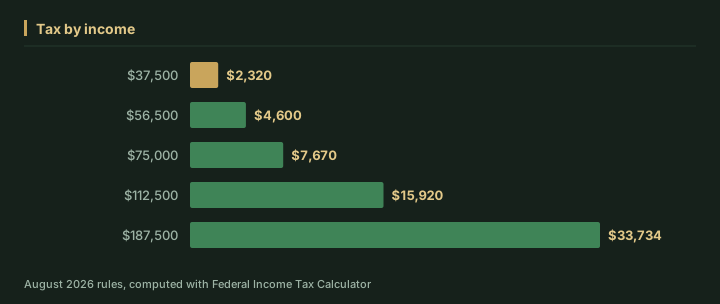
We ran 5 values of income through the calculator and left every other input at its default. As of August 2026, the output was:
| Income ($) | Tax ($) | After-tax income ($) | Taxable income ($) |
|---|---|---|---|
| 37,500 | 2,320 | 35,180 | 21,400 |
| 56,500 | 4,600 | 51,900 | 40,400 |
| 75,000 | 7,670 | 67,330 | 58,900 |
| 112,500 | 15,920 | 96,580 | 96,400 |
| 187,500 | 33,734 | 153,766 | 171,400 |
Running income from $37,500 up to $187,500 moves tax from $2,320 to $33,734 — a spread of $31,414. That gap is the part a single headline rate never shows.
The same runs seen through after-tax income
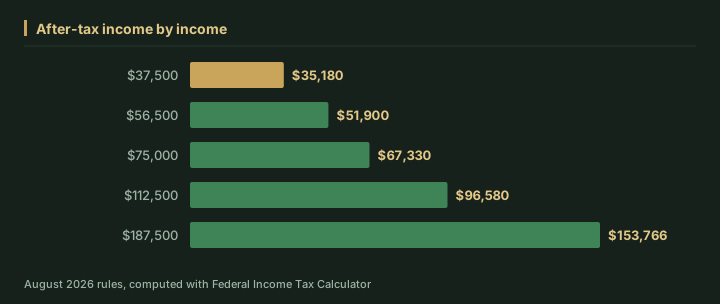
At $37,500, after-tax income works out to $35,180; at $187,500 it is $153,766. Looking only at tax tends to understate how much the outcome shifts across that range.
Where the total comes from
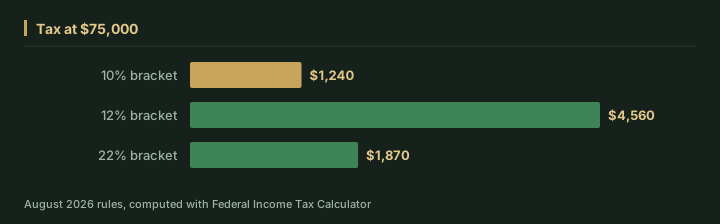
Holding income at $75,000, we ran the same calculation again and kept the breakdown it returns. The total is not one rate applied once — for the 2026 tax year it is built from 3 parts:
| Part | Tax |
|---|---|
| 10% bracket | $1,240 |
| 12% bracket | $4,560 |
| 22% bracket | $1,870 |
Assumptions behind these figures
| Input | Value |
|---|---|
| Income | $75,000 |
| Status | Single |
| Deduction type | Standard |
| Itemized | $0 |
| Year | 2026 |
| As of | August 2026 |
| Method | identical to /tools/federal-income-tax-calculator |
Brackets, thresholds and rates change from year to year, so treat these as August 2026 figures for the 2026 tax year. For your own situation, open the Federal Income Tax Calculator and enter your real numbers — the calculator runs the same code that produced every figure on this page.
Try the related calculators
Related guides
Retirement Account Tax Benefits: 401(k), IRA, and Roth (2026)
Whether a retirement account saves you tax now or later depends on which type you pick — here is how 401(k)s,...
The Tax Refund Process: How Long Does It Take? (2026)
You filed and the money still has not landed. Here is the realistic 2026 timeline, what the tracker stages act...
How to Fill Out a W-4 Form: 2026 Edition
A practical 2026 walkthrough of the IRS Form W-4 — filing status, the multiple-jobs step people skip, dependen...