Capital Gains Tax: Short-Term vs Long-Term (2026)
Table of contents
- The asset, the basis, the realization
- The line: one year, measured to the day
- Short-term: whatever your ordinary bracket is
- Long-term: 0%, 15%, or 20% — and which one depends on your income
- The opening number, worked out
- Stacking: the quirk that lets some people pay 0%
- Cost basis: the number that decides how big the gain is
- The partial-lot edge case people botch
- Losses, and the wash-sale trap
- The 3.8% NIIT, where it actually bites
- Crypto, real estate, the home, and the state line
- Three sellers, same stock, three very different bills
- When the calendar should — and shouldn't — drive the sale
- Related guides
- Questions people ask
- Does one day really change the rate?
- Can I actually pay 0% on a gain?
- Why does my reinvested-dividend basis matter so much?
- What does the wash-sale rule stop me from doing?
- Is selling my house taxable?
- About these numbers
- Run the numbers
- How the result moves with income
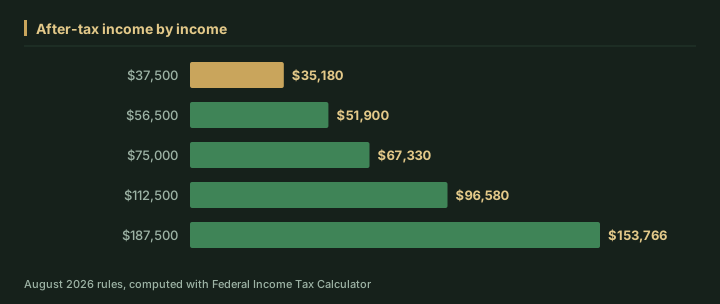
- The same runs seen through after-tax income
- Where the total comes from
- Assumptions behind these figures
Sell a $25,000 gain at the 11-month mark and a typical middle-income filer hands the IRS about $6,000. Hold the exact same shares two more months — to 13 months — and the bill on the identical profit drops to roughly $3,750. Nothing about the investment changed. The only difference is which side of a one-year line the sale date fell on. That one date is the most expensive calendar decision most investors never think about, and this guide is built around it: the rule, the 2026 rates, the stacking quirk that lets some people pay zero, and the cost-basis details that decide how big the gain even is.
The asset, the basis, the realization
A capital gain is your profit when you sell a capital asset — stock, a fund, real estate, crypto — for more than your cost basis (what you paid, including commissions and certain adjustments). A capital loss is the mirror image. Critically, gains are taxed only when you realize them by selling. Paper appreciation on something you still hold is invisible to the IRS until you sell it.
How much that realized gain costs you comes down, more than anything else, to a single variable: how long you owned the asset first.
The line: one year, measured to the day
- Short-term — held one year or less. Taxed as ordinary income at your regular 2026 federal brackets.
- Long-term — held more than one year (a year and a day, or longer). Taxed at the preferential 0% / 15% / 20% schedule.
The clock runs from the day after you acquired the asset to the day you sell. It is a hard cliff, not a slope: one day on the short-term side throws the entire gain into the more expensive ordinary-income column. There is no partial credit for "almost a year."
Short-term: whatever your ordinary bracket is
Short-term gains pile on top of your other income and are taxed at the 2026 ordinary brackets. Single filer:
| Taxable income (single) | Marginal rate |
|---|---|
| $0 – $12,400 | 10% |
| $12,400 – $50,400 | 12% |
| $50,400 – $105,700 | 22% |
| $105,700 – $201,775 | 24% |
| $201,775 – $256,225 | 32% |
| $256,225 – $640,600 | 35% |
| $640,600+ | 37% |
A single filer with $95,000 of other taxable income pays 22% on a short-term gain — and a large enough gain can shove its own top slice into the 24% bracket. Married-filing-jointly brackets are wider but work identically. The Tax Bracket Calculator shows which bracket a short-term gain lands in for your numbers.
Long-term: 0%, 15%, or 20% — and which one depends on your income
Long-term gains get a separate, gentler rate schedule, and which rate applies depends on your total taxable income:
- 0% while your income sits in the lower range — plenty of modest-income taxpayers pay literally nothing on long-term gains.
- 15% across the broad middle, where most filers land.
- 20% only at high income.
High earners also owe an extra 3.8% Net Investment Income Tax (NIIT) on investment income above set thresholds, which is what pushes the true top long-term rate to about 23.8%.
| Type of gain | 2026 federal treatment |
|---|---|
| Short-term (≤ 1 year) | Ordinary rates, 10%–37% |
| Long-term (> 1 year) | 0% / 15% / 20% |
| Long-term, high earner | + 3.8% NIIT (top ≈ 23.8%) |
Complete Guide to U.S. Federal Income Tax (2026) covers ordinary-income taxation in full. The single point that matters here: long-term treatment is dramatically cheaper than short-term, and the gap is almost never small.
The opening number, worked out
Back to the $25,000 from the first line. Priya, single, $95,000 of ordinary taxable income in 2026, holds a stock with a $25,000 gain. Sell now (11-month hold, short-term) or wait two months (13-month hold, long-term)?
Sell at 11 months — short-term. The $25,000 stacks on top of $95,000 as ordinary income, landing in the 22% bracket:
- Tax ≈ $25,000 × 22% = $6,000 (rounded; a sliver may reach 24%, so call it roughly $6,000)
Sell at 13 months — long-term. With $95,000 of income, her long-term gain falls in the 15% long-term band:
- Tax ≈ $25,000 × 15% = $3,750
| Scenario | Holding period | Rate | Tax on $25,000 |
|---|---|---|---|
| Sell at 11 months | Short-term | 22% ordinary | ≈ $6,000 |
| Sell at 13 months | Long-term | 15% long-term | $3,750 |
Two months of patience saves Priya about $2,250 on the same profit — better than a third of the tax, for doing nothing but waiting. The honest caveat: the price can move while she waits, and the tax tail should not wag the investment dog. But a $2,250 swing is large enough to plan around, not ignore. Run your own version in the Capital Gains Tax Calculator and cross-check the income layering with the Federal Income Tax Calculator.
Stacking: the quirk that lets some people pay 0%
This trips up experienced investors. Long-term gains stack on top of your ordinary income to decide which long-term band applies — but they do not push your ordinary income into higher ordinary brackets. Picture ordinary income filling the bottom of a glass; the long-term gain pours in above it. Where the top of that gain settles is what determines 0%, 15%, or 20%.
That creates a powerful low-income-year window. A single filer on a sabbatical with only $22,000 of ordinary income in 2026 can have a long-term gain stacked above it fall largely inside the 0% long-term band — meaning a substantial gain realized that year is taxed at 0% federally. The identical gain realized in a $220,000-income year is taxed at 15% or more.
| Year type | Ordinary income | Long-term gain realized | Approx. LT rate on the gain |
|---|---|---|---|
| Sabbatical / low-income year | $22,000 | $35,000 | Largely 0% |
| Normal working year | $95,000 | $35,000 | 15% |
| High-income year | $260,000 | $35,000 | 15%–20% + possible 3.8% NIIT |
Same asset, same gain, three rows — only the year you choose to sell changes the tax, sometimes from five figures to zero. Deliberately realizing gains in low-income years (early retirement, between jobs, a slow business year) is one of the most underused legal moves in investing. The broader timing playbook is in How to Reduce Your Taxable Income Legally (2026), and Marginal vs Effective Tax Rate explains why the band the gain lands in is the only thing that matters.
Cost basis: the number that decides how big the gain is
Your gain is sale price minus cost basis, so a wrong basis means a wrong — usually inflated — tax bill.
- Purchase price plus commissions and fees is the starting basis.
- Reinvested dividends raise basis. Each reinvestment is a fresh purchase you already paid tax on. Forgetting them is one of the most common ways investors overpay.
- Inherited assets generally get a stepped-up basis to fair market value at death, often erasing decades of unrealized gain.
- Gifted assets generally carry over the giver's basis.
- Lot selection. When you sell part of a holding bought at different times and prices, specific identification lets you choose which lots go — sell high-basis lots to shrink the gain.
That last point is concrete enough to deserve its own example. Suppose you bought the same stock three times and now sell 100 shares at $90 ($9,000 of proceeds):
| Lot | Shares | Price paid | Basis | Holding period |
|---|---|---|---|---|
| A | 100 | $30 | $3,000 | 4 years (long-term) |
| B | 100 | $70 | $7,000 | 2 years (long-term) |
| C | 100 | $85 | $8,500 | 5 months (short-term) |
Sell Lot A: a $6,000 long-term gain. Sell Lot B: only a $2,000 long-term gain. Sell Lot C: a $500 short-term gain at ordinary rates. If this year's goal is minimum tax, specifically identifying Lot B produces the smallest gain while staying long-term — $4,000 less reported gain than Lot A, purely from telling your broker which shares to sell. The default method (often first-in, first-out) would have sold Lot A and the bigger gain automatically. Specify the lot before the trade settles; you generally cannot rewrite it afterward.
The partial-lot edge case people botch
Lot selection has a sharp edge most articles skip. If you sell only part of a holding and do nothing, the broker's default method (frequently first-in, first-out, sometimes average cost for funds) picks the lots for you — and FIFO almost always sells your oldest, lowest-basis shares first, maximizing the gain. Worse, once a fund position is on average-cost basis, you generally cannot switch that holding back to specific identification retroactively; the election is sticky per holding. The practical rule: decide the cost-basis method before your first sale of a position, and for any tax-sensitive partial sale, specifically identify the lots with your broker and get the written confirmation before settlement. After settlement you are generally stuck with whatever the default did, and "I meant to pick Lot B" is not a fix the IRS recognizes.
Losses, and the wash-sale trap
Capital losses first offset capital gains of the same type, then the other type. Net losses left over can offset a limited amount of ordinary income each year, with the remainder carried forward indefinitely. Deliberately selling losers to cancel winners is tax-loss harvesting — but the wash-sale rule disallows the loss if you buy the same or a substantially identical security within 30 days before or after the sale.
| Situation | Result |
|---|---|
| $10,000 LT gain, $4,000 LT loss | Net $6,000 long-term gain taxed |
| $3,000 gain, $9,000 loss | Gain wiped out; limited net loss vs ordinary income; rest carried forward |
| Loss, then rebuy within 30 days | Loss disallowed (wash sale) |
The fuller harvesting playbook is in How to Reduce Your Taxable Income Legally (2026).
The 3.8% NIIT, where it actually bites
The NIIT is easy to forget because it is calculated separately and never appears in the headline capital-gains rate. It adds 3.8% to net investment income (gains, dividends, interest) once modified AGI clears set thresholds — specifically on the lesser of your net investment income or the amount of MAGI over the threshold.
A single filer with $235,000 of MAGI, $45,000 of it a long-term gain, sits above the high-income threshold. The 20% long-term rate may not apply yet, so the gain itself is taxed at 15% — but NIIT layers 3.8% onto the investment income over the threshold, lifting the effective rate on much of that gain to about 18.8%. At the very top, 20% plus 3.8% produces the roughly 23.8% federal ceiling on long-term gains. For most middle-income investors the NIIT simply never fires; it's a high-earner surcharge worth modeling once income is well into six figures. Complete Guide to U.S. Federal Income Tax (2026) shows how these layers stack.
Crypto, real estate, the home, and the state line
The short/long framework is broad, but a few asset notes keep you from over-assuming the friendly 0/15/20% rate:
- Cryptocurrency is property for federal tax. Every sale, trade, or spend is a taxable disposal with its own holding period, and the one-year rule still decides short vs long. Trading one coin for another is taxable even though no cash moved.
- Investment real estate held over a year is long-term, but depreciation taken over the years is generally "recaptured" and taxed differently from the rest of the gain — these sales are rarely a clean single calculation.
- Collectibles (art, certain metals) held long-term face a higher maximum long-term rate than stock — a real exception to the 0/15/20% schedule.
- Your main home is a special case: own and live in it for at least two of the five years before the sale and you can generally exclude up to $250,000 of gain if single, $500,000 if married filing jointly, entirely. Gain above the exclusion is taxed as a long-term gain. The exclusion has eligibility and frequency limits — confirm the specifics before relying on it.
One more layer: most states tax capital gains too, usually as ordinary income at the state level without the federal 0/15/20% preference. Washington notably has no wage income tax but does tax certain high-value long-term gains, so a "no income tax" state is not automatically a no-capital-gains state. See State Income Tax Guide: All 50 States Explained (2026) and estimate the state piece with the State Income Tax Calculator.
Three sellers, same stock, three very different bills
Pull the threads together with one comparison. Three people each hold the identical position: a $40,000 gain on shares bought at different times, sold in 2026. The only differences are holding period and the year's income.
| Seller | Holding period | Other taxable income | Rate path | Tax on the $40,000 |
|---|---|---|---|---|
| Held 10 months, $95k income | Short-term | $95,000 | 22% ordinary | ≈ $8,800 |
| Held 3 years, $95k income | Long-term | $95,000 | 15% long-term | $6,000 |
| Held 3 years, $30k sabbatical income | Long-term | $30,000 | Largely 0% long-term | ≈ $0 |
Same shares, same $40,000 profit, and the tax runs from roughly $8,800 down to essentially nothing — a swing driven entirely by two free variables, the holding period and the year you choose to sell. The first seller could have erased $2,800 by waiting two months for long-term treatment. The third effectively erased the entire bill by realizing the gain in a low-income year. Neither move requires touching the investment itself; both are pure calendar decisions. This is the whole argument of the guide in one table: with capital gains, when you sell is often a bigger lever than what you sell.
When the calendar should — and shouldn't — drive the sale
Holding two extra months to convert short-term into long-term is usually the right call: the rate gap is large and predictable, and the opening example is exactly that case. But tax alone should never dictate an investment decision. If a position is overvalued or no longer fits your plan, the risk of the price sliding while you wait for the one-year mark can dwarf the tax saving. A workable rule: optimize the holding period when you're already neutral or mildly inclined to hold anyway; do not take real market risk solely to chase a rate differential. The tax saving is a bonus on a sound decision, never the reason for an unsound one.
Related guides
- Complete Guide to U.S. Federal Income Tax (2026) — how ordinary income (and short-term gains) are taxed.
- How to Reduce Your Taxable Income Legally (2026) — loss harvesting and income timing in depth.
- State Income Tax Guide: All 50 States Explained (2026) — state treatment, including Washington's capital gains tax.
- Marginal vs Effective Tax Rate — why the band a gain lands in is what counts.
Questions people ask
Does one day really change the rate?
It does. The cutoff is "more than one year," measured from the day after you bought to the day you sell. Sell at exactly one year or less and the whole gain is short-term, taxed at your ordinary rate — no partial long-term credit for being close.
Can I actually pay 0% on a gain?
Yes, when your total taxable income is low enough that the stacked long-term gain stays inside the 0% band — common in a sabbatical, gap, or early-retirement year. The same gain in a high-income year would be taxed at 15% or more.
Why does my reinvested-dividend basis matter so much?
Each reinvested dividend is a purchase you already paid tax on, so it raises your basis. Leave it out and you report a larger gain than you actually have and overpay — one of the most frequent self-inflicted capital-gains errors.
What does the wash-sale rule stop me from doing?
Selling a security at a loss and buying the same or a substantially identical one within 30 days before or after; the loss is disallowed for that year. Wait past the 30-day window or use a genuinely different security to keep it.
Is selling my house taxable?
Often not. If it was your main home and you owned and lived in it for at least two of the prior five years, you can generally exclude up to $250,000 of gain ($500,000 married filing jointly). Only gain above the exclusion is taxed, as a long-term gain.
About these numbers
Holding-period rules, the long-term rate structure, the NIIT, cost-basis and step-up rules, the wash-sale rule, and the home-sale exclusion all derive from the Internal Revenue Code and IRS instructions, with gains and losses reported on Form 8949 and Schedule D. The 2026 ordinary brackets used for short-term gains are projected figures reconciled to the IRS's official year-end numbers; state capital-gains treatment is set by each state's revenue agency. These are educational 2026 estimates, not tax advice — for a real sale-timing or large-position decision, especially in real estate or crypto, have a CPA or Enrolled Agent run your actual numbers first.
Run the numbers
Everything below came out of this site's own Federal Income Tax Calculator. The figures are not quoted from anywhere else: each row is one run of the same calculation the tool page performs, using August 2026 rules. Put the same inputs in and you will get the same output.
How the result moves with income
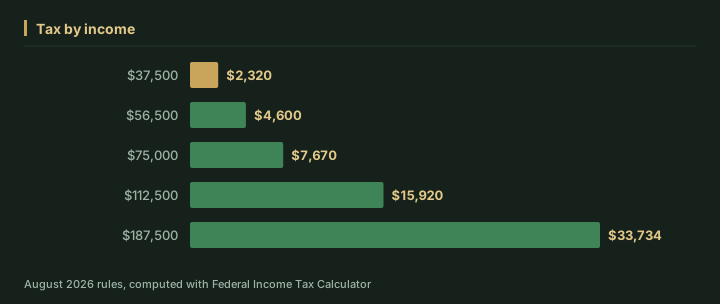
We ran 5 values of income through the calculator and left every other input at its default. As of August 2026, the output was:
| Income ($) | Tax ($) | After-tax income ($) | Taxable income ($) |
|---|---|---|---|
| 37,500 | 2,320 | 35,180 | 21,400 |
| 56,500 | 4,600 | 51,900 | 40,400 |
| 75,000 | 7,670 | 67,330 | 58,900 |
| 112,500 | 15,920 | 96,580 | 96,400 |
| 187,500 | 33,734 | 153,766 | 171,400 |
Running income from $37,500 up to $187,500 moves tax from $2,320 to $33,734 — a spread of $31,414. That gap is the part a single headline rate never shows.
The same runs seen through after-tax income
At $37,500, after-tax income works out to $35,180; at $187,500 it is $153,766. Looking only at tax tends to understate how much the outcome shifts across that range.
Where the total comes from
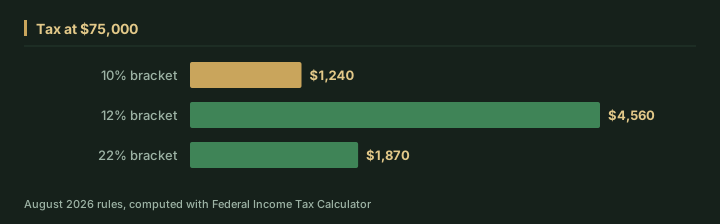
Holding income at $75,000, we ran the same calculation again and kept the breakdown it returns. The total is not one rate applied once — for the 2026 tax year it is built from 3 parts:
| Part | Tax |
|---|---|
| 10% bracket | $1,240 |
| 12% bracket | $4,560 |
| 22% bracket | $1,870 |
Assumptions behind these figures
| Input | Value |
|---|---|
| Income | $75,000 |
| Status | Single |
| Deduction type | Standard |
| Itemized | $0 |
| Year | 2026 |
| As of | August 2026 |
| Method | identical to /tools/federal-income-tax-calculator |
Brackets, thresholds and rates change from year to year, so treat these as August 2026 figures for the 2026 tax year. For your own situation, open the Federal Income Tax Calculator and enter your real numbers — the calculator runs the same code that produced every figure on this page.
Frequently Asked Questions
What's the difference between short-term and long-term capital gains tax?
Short-term capital gains come from assets held one year or less and are taxed as ordinary income at your regular federal tax brackets. Long-term capital gains come from assets held more than one year (a year and a day or longer) and are taxed at generally lower preferential rates of 0%, 15%, or 20% depending on your income. The holding period is measured precisely, so even one extra day can shift a sale from short-term to long-term treatment.
How much can holding an investment longer actually save on taxes?
It can save a meaningful amount, because long-term rates are generally well below ordinary income tax rates for most filers. In one illustrative example, waiting two extra months to cross the one-year holding threshold cut the tax on an identical gain by roughly a third. The exact savings depend on your income and filing status, so check the current IRS figures for your situation.
Can I really pay 0% tax on long-term capital gains?
Yes, it's possible — long-term capital gains have a 0% bracket that applies when your total taxable income, including the gain, falls in the lower range for your filing status. This is most relevant in a low-income year, such as a sabbatical or a year with reduced earnings, since the same gain realized in a high-income year would be taxed at a higher long-term rate. Check the current IRS income thresholds to see where you fall.
What is the Net Investment Income Tax (NIIT) and who pays it?
The Net Investment Income Tax is an additional 3.8% federal tax that applies to investment income, including capital gains, for higher-income taxpayers above certain income thresholds. It stacks on top of the regular long-term capital gains rate, which is why the effective top long-term rate for high earners can run close to 23.8% instead of the headline 20%.
Does a capital gain get taxed even if I don't sell the asset?
No, generally a capital gain is only taxed when you realize it by actually selling the asset for more than your cost basis. Paper gains on investments you continue to hold are not taxed by the IRS until a sale occurs.
Try the related calculators
Related guides
Retirement Account Tax Benefits: 401(k), IRA, and Roth (2026)
Whether a retirement account saves you tax now or later depends on which type you pick — here is how 401(k)s,...
The Tax Refund Process: How Long Does It Take? (2026)
You filed and the money still has not landed. Here is the realistic 2026 timeline, what the tracker stages act...
How to Fill Out a W-4 Form: 2026 Edition
A practical 2026 walkthrough of the IRS Form W-4 — filing status, the multiple-jobs step people skip, dependen...