How to Fill Out a W-4 Form: 2026 Edition
Table of contents
- What the form is really controlling
- The five steps, by what they do
- The situations that actually trip people
- Why the two-earner gap happens, in numbers
- A mid-2026 self-check you can actually run
- When to redo it during the year
- A few situations the standard walkthrough doesn't cover
- Common questions
- Does the W-4 still use "allowances"?
- Do I have to complete every step?
- What's the single most effective lever to fix withholding?
- Why do two-earner couples so often owe in April?
- Can I handle side income through the W-4 instead of quarterly payments?
- Run the numbers
- How the result moves with income
- The same runs seen through projected tax
- Assumptions behind these figures
It's your first morning at a new job. HR slides a folder across the desk: direct-deposit form, an I-9, a benefits packet you'll ignore until open enrollment, and a single page titled Form W-4. You're told to "just fill it out." You spend maybe ninety seconds on it, check whatever looks roughly right, sign, and hand it back. That ninety seconds quietly sets how much federal tax leaves every paycheck for the rest of the year — and if your situation is anything other than one job and a standard deduction, the odds you guessed right are not good.
The modern W-4 dropped the old "allowances" and replaced them with plain-language questions built on real dollars. That makes it more honest but not more forgiving — a wrong filing status or a skipped multiple-jobs step still produces a steady, invisible error every payday until you notice it in April. This guide walks the form by what each step does, the situations that actually trip people, and a self-check you can run mid-2026 with concrete numbers before the mistake compounds.
What the form is really controlling
Your employer must withhold federal income tax from your wages and forward it to the IRS. The W-4 tells payroll how much. It does not change the tax you owe — that's settled on your return. It changes only the timing and accuracy of what's prepaid through the year.
Balance is the goal. Withhold too little and you owe at filing, possibly with a penalty. Withhold too much and the refund is just money you lent the government interest-free while living on less than you needed to. A well-set W-4 lands you near zero in either direction — that's the entire job of the form.
A new form is warranted whenever something material shifts: a new job, marriage or divorce, a child, a spouse starting or stopping work, meaningful side income. Leave a stale form in place and it keeps producing the wrong number every payday with perfect consistency.
The five steps, by what they do
Five steps. Only 1 and 5 are mandatory for everyone; 2 through 4 sharpen accuracy and apply only if they fit your situation.
Step 1 — personal info and filing status. Name, address, SSN, and a filing status: single (or married filing separately), married filing jointly (or qualifying surviving spouse), or head of household. Status sets the baseline standard deduction and bracket structure payroll uses. Picking a status that won't match how you actually file is the single most common root cause of a wildly wrong refund or bill — it poisons every paycheck calculation downstream.
Step 2 — multiple jobs or a working spouse. The step people skip and regret. Complete it if you hold more than one job at once, or you're married filing jointly and your spouse also works. Here's the mechanism: each employer withholds as though its paycheck is your only income, handing the full standard deduction and the lowest brackets to that one job. Two incomes double-count the cheap low-bracket space and systematically under-withhold — the textbook reason two-earner couples owe in April. The form offers three accuracy tiers: the IRS online estimator (most accurate), a multiple-jobs worksheet, or a checkbox if there are exactly two similarly paid jobs. Any of them works; the point is to stop each job from pretending it's the only one. The W-4 calculator does the multi-job math for you.
Step 3 — dependents and credits. Where the Child Tax Credit and the credit for other dependents get translated into a dollar figure that lowers withholding across the year. These credits phase out at higher income, so a high-income household may need to scale this down or skip it to avoid under-withholding. In a two-earner couple, only one spouse should claim the dependents here — put it on both forms and the credit gets counted twice.
Step 4 — other adjustments (optional, and the strongest controls). Three independent lines: 4(a) reports expected income with no withholding — interest, dividends, retirement, modest self-employment — so payroll withholds extra to cover it (a clean alternative to separate quarterly estimates for small side income). 4(b) enters the amount by which expected itemized deductions exceed the standard deduction, so payroll withholds less. 4(c) is a flat extra dollar amount per paycheck — the most direct lever there is, and the cleanest way to fix a known shortfall or build a deliberate cushion.
Step 5 — sign and date. The form is invalid unsigned. An unsigned W-4 can't be processed, and the employer must withhold as single with no adjustments — usually the highest rate. There's a related default worth knowing: if you never submit any W-4 at a new job, the employer is required to treat you as single with no Step 2–4 entries, which over-withholds for many people. "I'll fill it out later" is not a neutral choice; it picks the most conservative setting by omission, and you only get that money back the following spring.
The situations that actually trip people
Two earners in a married household. Default risk: under-withholding. Complete Step 2 accurately, have only the higher earner do Step 3 for dependents, and consider a modest 4(c) amount on the higher-paying job as a buffer. Check the math after one full paycheck under the new form, not in December.
A W-2 job plus side income. Two clean options: report the expected side income on 4(a) so payroll over-withholds enough to cover it, or make separate quarterly estimated payments. The W-4 route is simpler for modest, predictable side income; estimates are better for larger or lumpy self-employment — see estimated tax payments: when and how to pay and, for the SE-tax mechanics underneath, self-employment tax explained.
You always get a huge refund. That's over-withholding all year. Reduce it by claiming the dependents and credits you're actually entitled to in Step 3, entering expected itemized excess in 4(b), or — if you used 4(c) — trimming or removing that extra amount. The aim is keeping the money in each paycheck instead of lending it interest-free until spring. Sanity-check the projected outcome with the tax refund estimator.
You owed a lot last April. The mirror fix: increase withholding. The most reliable method is a specific dollar amount on 4(c) — take last year's shortfall, divide by remaining pay periods, enter that. Then confirm filing status and Step 2 are right, since a wrong status there is a frequent hidden culprit behind the bill in the first place.
Multiple jobs at once, single filer. Use Step 2. Without it each job withholds at the lowest brackets and you almost certainly under-withhold. Concentrating any extra withholding on the highest-paying job is generally the cleanest approach — and if one job ends partway through the year, revisit the form on the remaining one, because the Step 2 math was built assuming both ran simultaneously and now over-withholds.
You itemize but it varies year to year. Step 4(b) takes the amount by which expected itemized deductions exceed the standard deduction. The trap is volatility: a year with a large charitable gift or heavy medical costs may itemize, the next may not. Entering last year's excess into a year that won't actually itemize under-withholds. When deductions are lumpy, leaving 4(b) blank and truing up through 4(c) is often steadier than chasing a moving itemized number.
| Your situation | Steps to complete |
|---|---|
| One job, single, no dependents, standard deduction | 1 and 5 only |
| Married, one spouse works, has children | 1, 3, 5 |
| Married, both spouses work | 1, 2, (3 on one spouse), 5 |
| One job plus untaxed side income | 1, 4(a), 5 |
| Plan to itemize significantly | 1, 4(b), 5 |
| Owed tax last year / want a cushion | 1, 4(c), 5 |
Why the two-earner gap happens, in numbers
The Step 2 warning is abstract until you see the dollars. Take a married-filing-jointly couple in 2026, each earning $60,000, each having submitted a bare Step 1 form with no Step 2.
Employer A withholds on $60,000 as if it's the household's only income. It applies the full $32,200 MFJ standard deduction to that one paycheck stream, leaving roughly $27,800 taxable, which falls entirely inside the 10% and low-12% MFJ space — so it withholds something like $3,000 for the year. Employer B does the exact same thing independently on its $60,000. Combined, payroll withheld for about $6,000.
Now the actual joint return: $120,000 gross − $32,200 standard deduction = $87,800 taxable. Against the 2026 MFJ brackets that's $24,800 × 10% = $2,480, plus ($87,800 − $24,800) × 12% = $63,000 × 12% = $7,560 → ≈ $10,040 of real tax. Withheld ≈ $6,000, owed ≈ $10,040, so the couple is roughly $4,000 short in April — purely because each employer gave the household a full standard deduction and a fresh run up the low brackets that only exists once. Step 2 (or concentrating extra 4(c) on one job) is what closes that $4,000 gap before it becomes a penalty. The tax bracket calculator makes the doubled-low-bracket effect visible if you want to see it move.
A mid-2026 self-check you can actually run
You can test whether withholding is on track at any point in the year. Take a single filer, Jordan, paid biweekly, checking on June 30, 2026:
- Pull year-to-date federal income tax withheld from a recent stub. Jordan's reads $5,100 through June 30.
- Project full-year withholding. Half the year is gone, so $5,100 ÷ 0.5 = $10,200 projected for 2026.
- Estimate full-year tax from expected taxable income against the 2026 single brackets. Jordan expects ~$70,000 taxable income. Tax: $12,400 × 10% = $1,240, plus ($50,400 − $12,400) × 12% = $38,000 × 12% = $4,560, plus ($70,000 − $50,400) × 22% = $19,600 × 22% = $4,312 → ≈ $10,112.
- Compare. Projected withholding $10,200 vs. tax ≈ $10,112 → on pace for an ~$88 refund. Close to ideal; no change needed.
If step 4 had shown a gap of, say, $2,000 too little, Jordan would divide $2,000 by the remaining pay periods (about 13 biweekly checks after June 30) ≈ $154 and enter that on 4(c). For reference, the 2026 single standard deduction is $16,100 and the first two brackets are 10% to $12,400 and 12% to $50,400 — enough to ballpark Step 3 by hand. The W-4 calculator and federal income tax calculator do this projection precisely.
When to redo it during the year
The W-4 is not set-and-forget. Re-run it:
- After any raise, bonus-structure change, or new job
- After marriage, divorce, or a new dependent
- When a spouse starts or stops working
- As a routine checkpoint around June or July, while enough pay periods remain to spread a correction smoothly
A revised W-4 takes effect on a future paycheck, never retroactively — so the earlier in the year you fix a problem, the gentler the per-paycheck adjustment. A small tweak in July beats a large forced one in November. For the bracket mechanics under all of this, see how federal tax brackets work and the complete guide to U.S. federal income tax.
A few situations the standard walkthrough doesn't cover
- Starting a job mid-year. A new hire in September has only a handful of pay periods left, so payroll's default assumption — that this salary runs the full year — over-applies the standard deduction and under-withholds for someone who also worked Jan–Aug elsewhere. The clean fix is the IRS estimator (it accounts for income already earned) or a deliberate 4(c) amount; don't trust the bare Step 1 form to get a partial year right.
- Two jobs that pay very differently. The simple Step 2 checkbox assumes roughly equal pay. With a $90,000 job and a $20,000 job, the checkbox over-withholds. The estimator or worksheet, with extra withholding parked on the higher earner, is more accurate — the smaller job is the one to leave alone.
- A large one-time bonus. Supplemental wages are often withheld at a flat statutory rate that may not match your real marginal rate. If the bonus is big relative to salary, a temporary 4(c) bump (or a reduction, if the flat rate over-withholds you) for the rest of the year squares it up.
- Exempt status. You can claim exempt from withholding only if you owed no tax last year and expect none this year — a genuinely rare situation, and one that has to be re-filed annually. Claiming it loosely is a reliable way to manufacture an April bill plus a penalty.
- Pension or Social Security alongside wages. Retirees who work part-time often under-withhold because the wage job doesn't know about the pension. Reporting that other income on 4(a) is usually cleaner than starting separate estimated payments.
The recurring theme across all of these: the W-4's defaults assume one job, the full year, the standard deduction, and no outside income. Every step beyond 1 and 5 exists to correct one of those assumptions, and the cost of leaving a wrong assumption in place is a small steady error multiplied by every paycheck.
Common questions
Does the W-4 still use "allowances"?
No. The current form replaced allowances with plain-language steps built on real dollar figures — status, multiple jobs, dependents, specific adjustments. If you remember claiming a number of allowances, that system is gone; the dollar-based form is more transparent and usually more accurate.
Do I have to complete every step?
No. Steps 1 and 5 are required for everyone. Steps 2, 3, and 4 apply only if they fit — multiple jobs, dependents/credits, other adjustments. Skipping a step that does apply, especially Step 2, is the usual cause of a surprise bill.
What's the single most effective lever to fix withholding?
Line 4(c), extra withholding. A flat dollar amount per paycheck, precise control. To clear a known shortfall, divide the expected gap by the remaining pay periods and enter that.
Why do two-earner couples so often owe in April?
Each employer withholds as if its paycheck is the household's only income, applying the standard deduction and lowest brackets to both jobs independently. That double-counts the low-tax space and under-withholds overall. Step 2 corrects it.
Can I handle side income through the W-4 instead of quarterly payments?
Yes, for modest, predictable side income — report it on 4(a) and payroll withholds the extra. For larger or uneven self-employment income, separate quarterly estimates are usually the better route.
The steps and behavior here follow the current IRS Form W-4 (Employee's Withholding Certificate) and its instructions, the employer withholding methods in IRS Publication 15-T, and the IRS annual inflation Revenue Procedure that publishes the brackets and standard deductions; the form is described by function rather than line number because exact layout and worksheet detail can shift between revisions, and the 2026 figures used — the $16,100 single standard deduction and the federal brackets — are 2026 projections to be reconciled with the official IRS releases at year-end. None of this is tax advice for your return; it's a working explanation. Withholding tangles with credits, multiple incomes, and your full filing picture, so for anything layered — several jobs, large side income, significant credits — have a CPA or IRS Enrolled Agent confirm your W-4 entries before you rely on them.
Run the numbers
Everything below came out of this site's own W-4 Calculator. The figures are not quoted from anywhere else: each row is one run of the same calculation the tool page performs, using August 2026 rules. Put the same inputs in and you will get the same output.
How the result moves with income
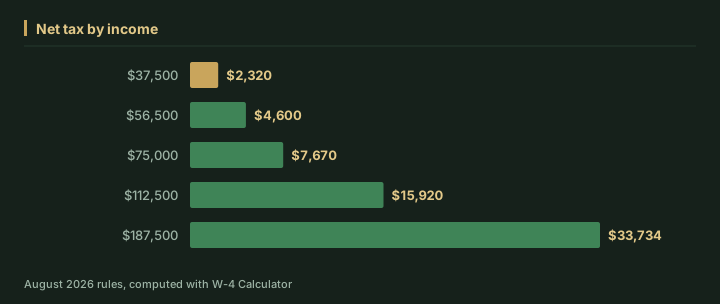
We ran 5 values of income through the calculator and left every other input at its default. As of August 2026, the output was:
| Income ($) | Net tax ($) | Projected tax ($) | Per paycheck ($) |
|---|---|---|---|
| 37,500 | 2,320 | 2,320 | 89.23 |
| 56,500 | 4,600 | 4,600 | 176.92 |
| 75,000 | 7,670 | 7,670 | 295 |
| 112,500 | 15,920 | 15,920 | 612.31 |
| 187,500 | 33,734 | 33,734 | 1,297.46 |
Running income from $37,500 up to $187,500 moves net tax from $2,320 to $33,734 — a spread of $31,414. That gap is the part a single headline rate never shows.
The same runs seen through projected tax
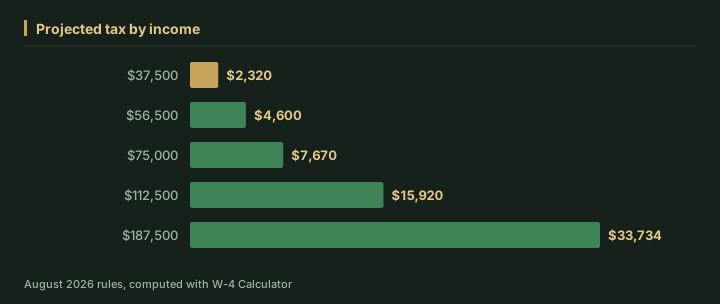
At $37,500, projected tax works out to $2,320; at $187,500 it is $33,734. Looking only at net tax tends to understate how much the outcome shifts across that range.
Assumptions behind these figures
| Input | Value |
|---|---|
| Income | $75,000 |
| Status | Single |
| Pay periods | $26 |
| Dependents under 17 | $0 |
| Other dependents | $0 |
| Extra | $0 |
| Year | 2026 |
| As of | August 2026 |
| Method | identical to /tools/w-4-calculator |
Brackets, thresholds and rates change from year to year, so treat these as August 2026 figures for the 2026 tax year. For your own situation, open the W-4 Calculator and enter your real numbers — the calculator runs the same code that produced every figure on this page.
Frequently Asked Questions
What does the W-4 form actually control?
The W-4 tells your employer how much federal income tax to withhold from each paycheck — it does not change the total tax you actually owe, only the timing and accuracy of what gets prepaid throughout the year. Filling it out incorrectly can lead to a larger-than-expected refund (an interest-free loan to the government) or an unexpected balance due at filing.
Which steps of the W-4 do I actually need to fill out?
Steps 1 and 5 (personal information and signature) are mandatory for everyone, while Steps 2 through 4 are optional and only apply if they fit your situation — multiple jobs or a working spouse (Step 2), dependents and credits (Step 3), and other adjustments like extra income or extra withholding (Step 4). Skipping a step that applies to you, especially Step 2 for two-earner households, is one of the most common causes of under-withholding.
Why do two-income married couples often end up owing tax at filing?
This typically happens because each employer withholds as though its paycheck is the only income the household has, giving the full standard deduction and lowest tax brackets to each job separately. When both incomes are combined on the actual tax return, they land in higher brackets than either job withheld for, causing systematic under-withholding unless the couple completes the multiple-jobs section (Step 2) of the W-4.
What happens if I never submit a W-4 at a new job?
If you don't submit any W-4, your employer is generally required to withhold federal income tax as if you were single with no additional adjustments, which is usually the most conservative, highest withholding setting. This can result in over-withholding for many people, meaning you'd only get that extra money back the following year when you file your return.
When should I fill out a new W-4?
You should generally submit a new W-4 whenever something material changes in your financial life, such as starting a new job, getting married or divorced, having a child, a spouse starting or stopping work, or picking up meaningful side income. Leaving a stale W-4 in place after such a change tends to keep producing the wrong withholding amount every payday.
Try the related calculators
Related guides
Retirement Account Tax Benefits: 401(k), IRA, and Roth (2026)
Whether a retirement account saves you tax now or later depends on which type you pick — here is how 401(k)s,...
The Tax Refund Process: How Long Does It Take? (2026)
You filed and the money still has not landed. Here is the realistic 2026 timeline, what the tracker stages act...
1099 vs W-2: Tax Implications and Comparison (2026)
Same $120,000, three outcomes in 2026: a W-2 employee, a 1099 with no expenses, and a 1099 with $25,000 of exp...