Retirement Account Tax Benefits: 401(k), IRA, and Roth (2026)
Table of contents
- Tax now or tax later — pick your timing
- A number that makes the trade-off concrete
- The benefit hiding behind the deduction
- The 401(k), and why the match comes before everything
- Vesting: the asterisk on free money
- What the match looks like with numbers
- Traditional IRA versus Roth IRA
- The HSA: the account almost nobody talks about enough
- The account types side by side
- Required Minimum Distributions
- Pulling money out early: the 10% penalty
- The cost you cannot see
- Rollovers: moving money without a tax bill
- A funding order that works for most people
- If your income is self-employed or 1099
- Where state tax enters
- Where this sits in your whole tax picture
- Common questions
- Traditional or Roth — which should I pick?
- Is the employer match genuinely free money?
- What exactly is a Required Minimum Distribution?
- What does an early withdrawal actually cost?
- Why do people call the HSA the best account?
- What are the 2026 contribution limits?
- Run the numbers
- How the result moves with income
- The same runs seen through after-tax income
- Where the total comes from
- Assumptions behind these figures
Yes — a retirement account lowers your taxes, but the bigger question is when it lowers them: a Traditional 401(k) or IRA cuts your tax bill this year and taxes the money when you withdraw it, while a Roth does the opposite, taxing the money now so it comes out tax-free later. Either way, nothing inside the account is taxed while it grows, and that quiet feature is usually worth more than the deduction everyone fixates on.
That is the whole guide in two sentences. The rest is the detail that decides how much money this is actually worth to you — which can run into the tens of thousands over a working life, more if you fund the right accounts in the right order.
Tax now or tax later — pick your timing
Strip away the jargon and every tax-advantaged retirement account is answering one question: at what point does the IRS take its share?
Traditional accounts — the Traditional 401(k), the Traditional IRA — hand you the break up front. Your contribution comes out of taxable income this year, the balance compounds with no annual tax, and you pay ordinary income tax on what you pull out in retirement.
Roth accounts — Roth 401(k), Roth IRA — flip that. No break today; you fund them with money you have already paid tax on. The growth is untaxed, and qualified withdrawals later are entirely tax-free.
Both versions shield the years in between from tax on interest, dividends, and capital gains. Hold that thought, because it is the part that does the heavy lifting.
A number that makes the trade-off concrete
Picture a single filer with $80,000 of taxable income in 2026. Under the 2026 brackets, income from $50,400 to $105,700 is taxed at 22%, so the next dollars sit squarely in the 22% bracket.
Drop $12,000 into a Traditional 401(k): taxable income falls to $68,000, trimming roughly $2,640 off this year's federal tax (22% of $12,000). You will owe tax on it when you withdraw.
Drop the same $12,000 into a Roth 401(k): no deduction, so you pay that $2,640 now — but everything those dollars grow into comes out tax-free.
If your retirement tax rate ends up below 22%, the Traditional deduction tends to come out ahead. If it lands above 22%, or you simply want the certainty of a known answer, Roth tends to win. The federal income tax calculator and the tax bracket calculator show how a contribution moves your bracket.
The benefit hiding behind the deduction
Everyone argues about the deduction. Fewer people notice the larger prize: inside these accounts, growth is never taxed while it happens. In an ordinary brokerage account, dividends and realized gains get taxed every single year, and that drag compounds against you for decades.
Run the numbers. Ten thousand dollars left alone for 30 years at a 7% return grows to roughly $76,000. Subject that same money to a yearly tax drag that effectively pulls the return down to about 5.5%, and you land near $50,000 instead. That ~$26,000 gap exists in both Traditional and Roth accounts. It is the reason filling tax-advantaged space matters even before anyone raises the deduction question. See how to reduce taxable income legally for where this sits in the bigger plan.
The 401(k), and why the match comes before everything
A 401(k) is an employer plan funded through payroll deferrals, often offered in Traditional, Roth, or both flavors.
Its single most valuable feature has nothing to do with tax timing — it is the employer match. A widespread formula reads "100% of the first 3% of pay, plus 50% of the next 2%." Contribute enough to capture all of it and you collect an immediate, guaranteed return no market investment can reliably promise.
Contributing enough to grab the full employer match is, for almost everyone, the very first retirement dollar that should go anywhere. A match left unclaimed is part of your pay you simply chose not to take.
Annual 401(k) contribution limits are set by the IRS, run higher than IRA limits, and include a catch-up amount for savers 50 and up — with an enhanced catch-up band for people in their early 60s under current law. Because those dollar limits move every year, pull the exact 2026 figures from IRS.gov or your plan documents instead of trusting a number that may be stale.
Vesting: the asterisk on free money
Your own contributions are 100% yours from the moment they go in. The employer's portion may ride a vesting schedule — you stay employed for a defined period before it is fully yours. A "cliff" schedule might grant nothing until three years of service, then 100% at once. A "graded" schedule might vest 20% a year over five years. None of this touches the tax treatment, but it absolutely affects how much of that free money survives a job change, so the plan's summary description is worth ten minutes of your time. The conclusion does not change — partial free money still beats none, so capture the match regardless.
What the match looks like with numbers
Salary $72,000, match of 100% on the first 3% plus 50% on the next 2%.
Contribute 5% of pay — that is $3,600 of your own money. The match adds 100% of 3% ($2,160) plus 50% of 2% ($720), for $2,880. Total into the account: $6,480 in exchange for your $3,600. That is an 80% return before the market does anything at all.
Stop at a 2% contribution and you walk away from about $2,160 of match every year. Compound that forfeited match over a career and the lost ground runs well into six figures.
Traditional IRA versus Roth IRA
An IRA is an account you open on your own, with no employer involved.
A Traditional IRA contribution may be deductible. If neither you nor a spouse is covered by a workplace plan, the deduction is generally available no matter your income. If you (or a spouse) are covered, the deduction phases down as income climbs and can vanish entirely at higher incomes. Withdrawals in retirement are taxed as ordinary income.
A Roth IRA contribution is never deductible, but qualified withdrawals are tax-free, and the ability to contribute directly phases out above certain income levels.
Those phase-out ranges are re-indexed every year, so this guide intentionally avoids printing specific 2026 dollar thresholds. Confirm your eligibility through IRS Publication 590-A (contributions) and Publication 590-B (distributions), or with a professional. For the full side-by-side, see Traditional vs Roth IRA: tax implications compared.
The HSA: the account almost nobody talks about enough
Enrolled in a qualifying high-deductible health plan? Then a Health Savings Account gives you something no other account does — a triple tax break:
- The contribution is deductible (or pre-tax through payroll).
- The balance grows tax-free.
- Withdrawals for qualified medical expenses come out tax-free.
Untaxed at all three points. Nothing else in the tax code matches that. And after age 65, non-medical withdrawals are simply taxed as ordinary income — identical to a Traditional IRA — so a well-funded HSA doubles as a stealth retirement account with the best tax mechanics available to anyone who will eventually have health costs, which is to say everyone.
The account types side by side
| Account | Tax going in | Growth | Tax on qualified withdrawal | RMDs for original owner | Defining feature |
|---|---|---|---|---|---|
| Traditional 401(k) | Pre-tax (deductible) | Untaxed | Ordinary income | Yes | Employer match; high limit |
| Roth 401(k) | After-tax | Untaxed | Tax-free | None under current law | Match plus tax-free growth |
| Traditional IRA | Often deductible | Untaxed | Ordinary income | Yes | Deduction may phase out if plan-covered |
| Roth IRA | After-tax | Untaxed | Tax-free | None for original owner | Tax-free; eligibility phases out by income |
| HSA | Pre-tax / deductible | Untaxed | Tax-free (medical) | None | Triple tax advantage |
Required Minimum Distributions
The IRS will not let pre-tax money compound untaxed forever. Required Minimum Distributions force owners to start withdrawing — and paying tax on — a slice of Traditional 401(k) and Traditional IRA balances each year once they reach the age set in current law (somewhere in the early-to-mid 70s, depending on birth year). Skip an RMD and the penalty is harsh.
A Roth IRA carries no RMD for the original owner. That makes it unusually good for anyone who does not need the money to live on and wants it to keep compounding tax-free or pass cleanly to heirs. Roth 401(k)s are no longer subject to lifetime RMDs for the original owner under current law, though it is wise to confirm the latest rule before leaning on it.
RMDs carry a knock-on effect savers routinely underestimate. A forced withdrawal stacks on top of your other retirement income; it can shove you into a higher bracket, pull more of your Social Security into taxable territory, and lift income-based Medicare premiums. A retiree sitting on a large Traditional balance can discover that "mandatory" income has manufactured a tax problem they never planned for. That is precisely why some people deliberately shift money to Roth accounts during lower-income years before RMDs start — a tactic covered in Traditional vs Roth IRA: tax implications compared.
Pulling money out early: the 10% penalty
These accounts exist for retirement, and the code enforces that intent. Withdraw before age 59½ and the taxable amount generally takes a 10% early-withdrawal penalty stacked on top of ordinary income tax.
Pull $12,000 from a Traditional account while in the 22% bracket and you are looking at roughly $2,640 in income tax plus a $1,200 penalty — about a third of the money gone before you spend a cent of it, and that is before counting the growth you just deleted from your future.
Common exceptions to the penalty (and they differ a bit between IRAs and 401(k)s) include total and permanent disability, certain unreimbursed medical expenses, a series of substantially equal periodic payments, a first-time home purchase (IRA, limited amount), qualified higher-education expenses (IRA), birth or adoption (limited amount), and separation from service in or after the year you turn 55 (401(k) only).
Roth IRA contributions — not earnings — can generally come out at any time tax- and penalty-free, since you already paid tax on them. That is one of the Roth's most underrated traits. Earnings still answer to the age and five-year rules. Verify any exception in IRS Publication 590-B before you act on it.
The cost you cannot see
The penalty and the tax are the visible price of an early withdrawal. The bigger, invisible price is the decades of compounding that money will now never do. A $15,000 withdrawal at 35 is not $15,000 minus tax and penalty — it is also the roughly $115,000 that $15,000 might have become by 65 at a 7% return. Treat retirement accounts as genuinely off-limits outside a real emergency, and build a separate taxable emergency fund first so the tax-advantaged money never has to be raided.
Rollovers: moving money without a tax bill
A job change does not force you to cash out a 401(k). A direct rollover sends the balance straight to a new employer's plan or an IRA with no tax and no penalty, and the shelter stays intact. The trap is the indirect rollover, where the check comes to you: the plan withholds 20%, and you have 60 days to redeposit the full amount — including the withheld portion, out of your own pocket — or the shortfall becomes a taxable, possibly penalized distribution. When unsure, request a trustee-to-trustee direct transfer. Botched rollovers are among the most common and expensive retirement tax mistakes, which is reason enough to confirm the steps with a professional before starting one.
A funding order that works for most people
For most savers, each dollar does the most good in roughly this sequence:
| Priority | Where the dollar goes | Why it ranks here |
|---|---|---|
| 1 | 401(k) up to the full employer match | Instant guaranteed return — unclaimed pay otherwise |
| 2 | HSA, if eligible | Triple tax advantage; nothing else competes |
| 3 | Roth or Traditional IRA | Wide investment menu; tax diversification |
| 4 | Back to the 401(k), up to the annual limit | More sheltered space |
| 5 | Taxable brokerage / other goals | Flexible, no contribution cap |
This is a starting framework, not a commandment. High earners blocked from a Roth IRA by income, savers with no employer match, the self-employed (who have SEP and solo 401(k) options — see self-employment tax explained), and anyone expecting a big tax-rate swing may reorder these steps on purpose.
If your income is self-employed or 1099
Self-employment income does not limit you to an IRA. A SEP IRA or a solo 401(k) lets you shelter a far larger share of self-employment profit than a regular IRA, which can cut the income exposed to both income tax and self-employment tax. The solo 401(k) is especially flexible because you contribute both as the "employee" and as the "employer." If your income mixes W-2 and 1099 work, the 1099 vs W-2 calculator and the self-employment tax calculator show how much room you actually have and how a contribution moves the bottom line. The mechanics diverge enough from a standard IRA that this is a sensible place to bring in professional input.
Where state tax enters
The federal treatment above is only half the picture. Most states track the federal lead — a Traditional 401(k) deduction usually trims state taxable income too, and many states treat retirement income favorably — but the specifics vary widely, and a handful of states do not tax wage income at all. If you expect to retire in a different state than the one you work in, that future state's rules can tip the Traditional-versus-Roth call. Check your situation with the state income tax calculator and the state income tax guide for all 50 states.
Where this sits in your whole tax picture
Filling tax-advantaged accounts is one of the most dependable ways to cut a tax bill — see how to reduce taxable income legally for the wider toolkit and tax credits vs tax deductions for how a deduction actually becomes savings. Because a deduction's value tracks your bracket, run scenarios with the federal income tax calculator, review how federal tax brackets work, and read the full complete guide to U.S. federal income tax. If a large pre-tax contribution changes how much you should withhold, revisit the W-4 calculator.
Common questions
Traditional or Roth — which should I pick?
It turns on your tax rate now versus in retirement. Expect a lower rate later and the Traditional deduction usually wins; expect a higher rate later, or want certainty, and Roth usually wins. Plenty of people split contributions to hedge both directions at once.
Is the employer match genuinely free money?
It is. The match is extra compensation deposited to your account when you defer enough of your own pay. Failing to contribute enough to capture it forfeits part of your total pay, which is why it sits at the top of the funding order.
What exactly is a Required Minimum Distribution?
A yearly amount the IRS forces you to withdraw from Traditional 401(k)s and Traditional IRAs starting at an age set in current law (early-to-mid 70s). Roth IRAs have no RMD for the original owner, which is what makes them efficient for legacy planning.
What does an early withdrawal actually cost?
Generally a 10% penalty plus ordinary income tax on the taxable amount. Exceptions exist — disability, certain medical costs, a first-home purchase from an IRA, others. Roth IRA contributions can usually come out anytime without tax or penalty since they were already taxed.
Why do people call the HSA the best account?
It is the only one with a triple tax advantage: deductible going in, untaxed growth, tax-free medical withdrawals. After 65 it behaves like a Traditional IRA for non-medical withdrawals too, making it a powerful hidden retirement account.
What are the 2026 contribution limits?
Limits for 401(k)s, IRAs, and HSAs are adjusted by the IRS each year and include catch-up amounts for older savers. Because they change annually, confirm the exact 2026 figures on IRS.gov, in IRS Publication 590-A, or through your plan administrator rather than assuming last year's number still holds.
The account mechanics here follow IRS rules for 401(k) plans, IRAs (Publication 590-A for contributions, 590-B for distributions), Health Savings Accounts, Required Minimum Distributions, and the 10% additional tax on early distributions and its exceptions; contribution and phase-out limits are described by how they work rather than as fixed dollar amounts because the IRS indexes them every year, so verify current figures on IRS.gov. The 2026 brackets and standard deduction in the examples are year-end-reconciled 2026 projections used only to show how the mechanics behave, and none of this is tax, investment, or financial advice — retirement decisions are deeply individual, so run yours past a CPA, Enrolled Agent, or qualified financial advisor before acting.
Run the numbers
Everything below came out of this site's own Federal Income Tax Calculator. The figures are not quoted from anywhere else: each row is one run of the same calculation the tool page performs, using August 2026 rules. Put the same inputs in and you will get the same output.
How the result moves with income
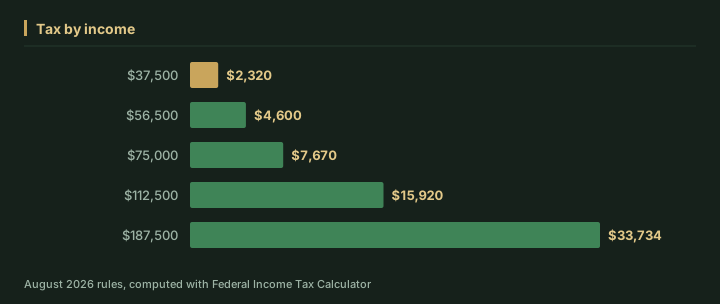
We ran 5 values of income through the calculator and left every other input at its default. As of August 2026, the output was:
| Income ($) | Tax ($) | After-tax income ($) | Taxable income ($) |
|---|---|---|---|
| 37,500 | 2,320 | 35,180 | 21,400 |
| 56,500 | 4,600 | 51,900 | 40,400 |
| 75,000 | 7,670 | 67,330 | 58,900 |
| 112,500 | 15,920 | 96,580 | 96,400 |
| 187,500 | 33,734 | 153,766 | 171,400 |
Running income from $37,500 up to $187,500 moves tax from $2,320 to $33,734 — a spread of $31,414. That gap is the part a single headline rate never shows.
The same runs seen through after-tax income
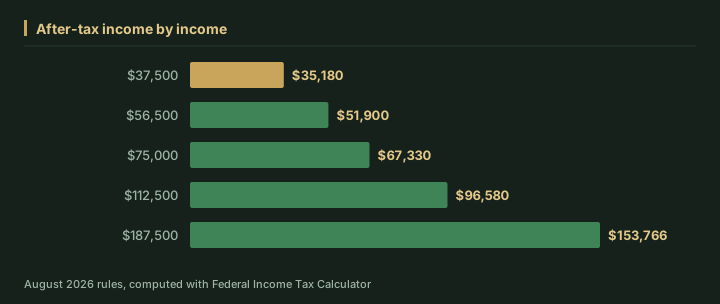
At $37,500, after-tax income works out to $35,180; at $187,500 it is $153,766. Looking only at tax tends to understate how much the outcome shifts across that range.
Where the total comes from
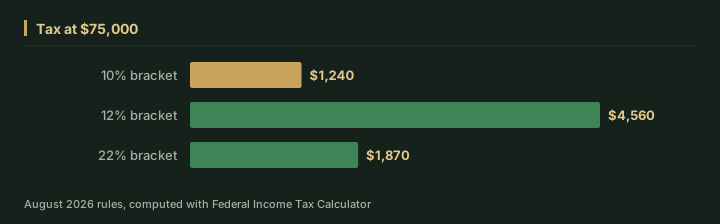
Holding income at $75,000, we ran the same calculation again and kept the breakdown it returns. The total is not one rate applied once — for the 2026 tax year it is built from 3 parts:
| Part | Tax |
|---|---|
| 10% bracket | $1,240 |
| 12% bracket | $4,560 |
| 22% bracket | $1,870 |
Assumptions behind these figures
| Input | Value |
|---|---|
| Income | $75,000 |
| Status | Single |
| Deduction type | Standard |
| Itemized | $0 |
| Year | 2026 |
| As of | August 2026 |
| Method | identical to /tools/federal-income-tax-calculator |
Brackets, thresholds and rates change from year to year, so treat these as August 2026 figures for the 2026 tax year. For your own situation, open the Federal Income Tax Calculator and enter your real numbers — the calculator runs the same code that produced every figure on this page.
Frequently Asked Questions
What's the tax difference between a traditional and a Roth retirement account?
A traditional 401(k) or IRA reduces your taxable income in the year you contribute, and you pay ordinary income tax when you withdraw the money in retirement. A Roth account offers no upfront deduction — you contribute with already-taxed money — but qualified withdrawals in retirement are completely tax-free. Both types shield investment growth from tax while the money stays in the account.
Should I choose Traditional or Roth if I'm not sure about my future tax rate?
Generally, if you expect your tax rate in retirement to be lower than your current rate, a traditional account tends to be more favorable, while if you expect a higher future rate, or simply want tax certainty, a Roth tends to be more favorable. If you genuinely aren't sure, many people split contributions between both account types for tax diversification, giving more flexibility to manage taxable income later.
Why should I contribute enough to get my full employer 401(k) match?
An employer match is essentially free money added on top of your own contribution, providing an immediate return that isn't dependent on investment performance. Failing to contribute enough to capture the full match generally means leaving part of your compensation unclaimed, and skipping it is widely considered one of the costliest mistakes an employee can make in retirement planning.
What does vesting mean for my 401(k) match?
Vesting refers to the schedule under which the employer-contributed portion of your 401(k) becomes fully yours, often requiring a certain number of years of employment. Your own contributions are typically 100% yours immediately, but unvested employer matching funds may be forfeited if you leave the job before the vesting period is complete, so it's worth checking your plan's specific vesting schedule.
Try the related calculators
Related guides
The Tax Refund Process: How Long Does It Take? (2026)
You filed and the money still has not landed. Here is the realistic 2026 timeline, what the tracker stages act...
How to Fill Out a W-4 Form: 2026 Edition
A practical 2026 walkthrough of the IRS Form W-4 — filing status, the multiple-jobs step people skip, dependen...
1099 vs W-2: Tax Implications and Comparison (2026)
Same $120,000, three outcomes in 2026: a W-2 employee, a 1099 with no expenses, and a 1099 with $25,000 of exp...