State Income Tax Guide: All 50 States Explained (2026)
Table of contents
- Two returns, two rulebooks
- The nine states that skip the wage tax — and the fine print nobody reads
- Pricing the trade-off: a side-by-side you can actually use
- Inside a progressive state
- Flat doesn't always mean simple
- What SmartTaxCalcs actually models — said plainly
- Conformity: why identical rates can still produce different bills
- The regional shape, without inventing rate tables
- Residency: the rule that actually decides who taxes you
- Remote work and multi-state income
- The SALT cap: where state and federal collide
- The full relocation comparison, end to end
- The retiree case, which breaks every rule of thumb
- A part-year move, costed end to end
- Finding your state's real rate
- Related guides
- Questions people ask
- I'm moving mid-year — do I file in both states?
- My company is headquartered in another state. Does that state tax me?
- Is a no-income-tax state actually cheaper for me?
- How good are the calculator's numbers for my state?
- Can a state still tax me after I move away?
- About these numbers
- Run the numbers
- How the result moves with income
- The same runs seen through marginal tax rate
- Where the total comes from
- Assumptions behind these figures
Picture two job offers landing in the same week. One is in Austin, the other in Sacramento, and the base salary on both is $130,000. On paper they look identical. They are not. By the time you account for what California's state return will pull out of that Sacramento paycheck and what Texas will not pull out of the Austin one, the gap can run well past $7,000 a year — before either state has touched your property or your shopping cart. That is the problem this guide solves: not "which state is cheapest" (a question with no honest single answer) but how to price a move yourself, state layer by state layer, so the offer letter stops lying to you.
I'll be upfront about one thing early. The slogan "no income tax" sells real estate and wins arguments at dinner parties, and it is true as far as it goes. It also leaves out two-thirds of the picture. We'll get there.
Two returns, two rulebooks
The first thing to internalize is that your federal tax and your state tax are computed by different governments under different statutes that happen to share a starting number. You file a 1040 with the IRS. You separately file a return with your state's revenue agency — confusingly named differently almost everywhere (Franchise Tax Board in California, Department of Taxation and Finance in New York, Department of Revenue in Illinois and most others). The IRS does not care which state you live in. Your federal bill on $130,000 is the same in Austin and Sacramento. Only the state layer moves, which is exactly the layer the State Income Tax Calculator isolates so you can see it on its own.
What links the two returns is the starting figure. Almost every state with an income tax begins from your federal adjusted gross income or federal taxable income, then bolts on its own additions, subtractions, deductions, and credits. The practical consequence: an error on your federal return usually metastasizes onto your state return automatically, and a deduction that helps you federally may do nothing for you at the state level (or vice versa). Keep that asymmetry in mind — it comes back in the SALT section.
States sort, very roughly, into three buckets.
| State system | Mechanic | Representative states |
|---|---|---|
| Progressive | Graduated brackets; the rate climbs as income climbs | California, New York, New Jersey |
| Flat | One rate applied to all taxable income | Illinois, Colorado, Kentucky |
| No broad income tax | Wages are not taxed by the state at all | Texas, Florida, Nevada |
To build the full federal-plus-state picture for a relocation, run the federal layer in the Federal Income Tax Calculator first (it does not change when you move), then stack the state layer on top with the State Income Tax Calculator.
The nine states that skip the wage tax — and the fine print nobody reads
Nine states impose no broad personal income tax on earned wages: Alaska, Florida, Nevada, New Hampshire, South Dakota, Tennessee, Texas, Washington, and Wyoming. SmartTaxCalcs models these as $0 on wage income, which is accurate for ordinary salary.
Three of them carry asterisks worth knowing before you build a relocation spreadsheet around them:
- New Hampshire has never taxed wages. It historically taxed certain interest and dividend income; that levy has been phased down.
- Washington taxes no wages but does impose a tax on certain high-value long-term capital gains. If your move is partly about selling a large appreciated position, Washington is not the blank check it looks like — see Capital Gains Tax: Short-Term vs Long-Term (2026).
- Tennessee finished eliminating its old interest-and-dividends tax, so wage earners there now owe genuinely nothing at the state level.
Here is the part the dinner-party version omits. A state still has to pave roads and staff schools. Drop the income tax and the money reappears somewhere else, almost always in one of three places: a higher combined sales tax (every purchase becomes a small taxable event), a heavier property tax (Texas is the textbook case — high effective rates that homeowners feel every year), or other levies entirely (fuel and tobacco excise, tourism taxes, and the severance taxes on oil, gas, and minerals that quietly fund a large slice of the Alaska and Wyoming budgets).
So the honest framing is not "no tax" but "the same revenue, collected through a different door." Whether that door is cheaper for you depends almost entirely on whether you rent or own and how much you spend. Use the Sales Tax Calculator to translate a higher combined rate into real annual dollars on your actual spending before you treat the move as a win.
There is also a residency trap people walk into here, so flag it now and we'll do it properly later: moving to Florida does not erase tax on income you physically earn somewhere that does tax it. The consultant who lives in Naples but spends a quarter of the year on a client site in New York still has a New York problem.
Pricing the trade-off: a side-by-side you can actually use
Abstract arguments about tax mix are useless. Numbers are not. Take a single filer with $90,000 of income deciding between a no-income-tax state and a moderate-income-tax state, who spends about $45,000 a year on taxable goods and owns a $400,000 home. Round numbers, illustrative effective rates, but the structure is exactly the one you should build for your own situation:
| Tax type | No-income-tax state (illustrative) | Moderate-income-tax state (illustrative) |
|---|---|---|
| State income tax on $90k | $0 | ≈ $3,800 |
| Sales tax on ≈ $45k spending | ≈ $3,600 (8% combined) | ≈ $2,700 (6% combined) |
| Property tax on $400k home | ≈ $7,200 (1.8% effective) | ≈ $4,400 (1.1% effective) |
| Rough annual total | ≈ $10,800 | ≈ $10,900 |
Read that bottom row twice. In this particular setup the income-tax savings are almost entirely eaten by higher sales and property tax — the two states land within $100 of each other. Now change one variable. Make the person a renter: the $7,200 property line largely disappears and the no-income-tax state pulls clearly, decisively ahead. Or triple the salary: the $0 income-tax cell now represents a five-figure annual saving that no sales tax can claw back. Same two states, opposite conclusions, depending entirely on inputs the slogan never mentions. This is why I won't give you a "best states" ranking. The ranking is yours, not mine.
Inside a progressive state
Progressive states run on the same engine as the federal brackets: income is sliced, each slice taxed at its own rate, and only the dollars inside a bracket pay that bracket's rate. If the mechanics feel shaky, How Federal Tax Brackets Work (2026) walks the engine in detail — states bolt on different numbers but turn the same crank.
A deliberately illustrative single-filer schedule (not any one state's real 2026 table — real schedules differ in every digit, which is why this guide refuses to print fake per-state rate charts):
| Income slice | Illustrative rate | Tax on the slice |
|---|---|---|
| First $10,000 | 1% | $100 |
| $10,000 – $40,000 | 3% | $900 |
| $40,000 – $90,000 | 5% | $2,500 |
| Above $90,000 | 6% | varies |
Add the first three slices and a $90,000 filer owes about $3,500 here — an effective state rate near 3.9%, well under the 6% top marginal rate. Same lesson as federal: your top bracket is a ceiling, not your average. Marginal vs Effective Tax Rate shows why that distinction decides more relocation math than the headline rate does. For an actual modeled number, use the State Income Tax Calculator and reconcile against your state's published schedule.
A relocation note that bites people specifically here: the top marginal rate is the number that travels in conversation, but it only touches the dollars above the top threshold. Comparing a state with a 9% top rate to one with a 5% top rate sounds like nearly a doubling — yet a $110,000 earner who never reaches the 9% bracket may face an effective rate gap closer to two or three points, not four. The bracket thresholds matter as much as the rates. A state can advertise a low top rate but reach it at a low income (so middle earners pay close to the top rate on most of their income), while a state with a scarier headline rate may not impose it until income clears several hundred thousand dollars. Always look at where the brackets start, not just where they end. This is the single most common way a relocation spreadsheet built on headline rates produces the wrong answer.
Flat doesn't always mean simple
A growing number of states apply one rate to everything. The pitch is predictability: a 5% flat state taxes the $40,000 earner and the $400,000 earner at the same marginal 5%. Clean — until you look at the base the 5% applies to. Some flat states start from federal AGI almost untouched; others layer in their own standard deduction or personal exemption, which quietly makes the effective rate progressive at the bottom.
| Filer | Flat 5% state, $5,000 exemption | Effective rate |
|---|---|---|
| $30,000 income | 5% × $25,000 = $1,250 | 4.2% |
| $75,000 income | 5% × $70,000 = $3,500 | 4.7% |
| $200,000 income | 5% × $195,000 = $9,750 | 4.9% |
A fixed exemption is a bigger share of a small income than a large one, so even a "flat" tax curves. The takeaway for relocation math: never compare two states on headline rate alone. The deduction and exemption architecture can swing the real bill as much as the rate does. The calculator bakes this in for the detailed states; for simplified states treat its output as a planning ballpark, which brings us to exactly what the tool does and does not do.
What SmartTaxCalcs actually models — said plainly
I would rather under-promise here than imply precision the tool does not have for every state. As of 2026:
- California, New York, and Illinois are modeled with detailed graduated brackets for both single and married-filing-jointly filers. They are the highest-traffic high-population states, so they get the granular treatment.
- Texas, Florida, and the other no-income-tax states are modeled as $0 on wages — accurate for salary.
- Every other state is a simplified estimate: a reasonable planning ballpark, explicitly not a substitute for your state's official forms or a professional's calculation.
| Coverage tier | States | Treatment |
|---|---|---|
| Detailed brackets | California, New York, Illinois | Single & MFJ graduated brackets |
| Zero-tax | AK, FL, NV, NH, SD, TN, TX, WA, WY | $0 on wages |
| Simplified estimate | All remaining states | Planning ballpark only |
If your state sits outside CA/NY/IL and a real filing decision rides on the number, verify with the state agency. The tool is a flashlight, not a surveyor.
Conformity: why identical rates can still produce different bills
States rarely copy the federal deduction system wholesale, and the differences are not cosmetic.
- Their own standard deduction or exemption. Many states set figures far smaller than the federal $16,100 single / $32,200 MFJ rather than mirroring them.
- AGI conformity, then divergence. Most start from federal AGI, add back items they tax that the IRS does not, and subtract items they exempt — frequently some retirement income, Social Security, or in-state municipal bond interest.
- State-only credits. Child care, earned income, education, 529 contributions, renewable energy, property tax paid — separate from federal credits and routinely missed. Tax Credits vs Tax Deductions covers why a credit usually beats a deduction of the same size.
- Retirement income, treated wildly differently. Some states fully exempt pensions and Social Security; others tax them like wages. For anyone moving in or near retirement this single line can outweigh the rate entirely — Retirement Account Tax Benefits explains how account type interacts with it.
Because of conformity differences, the same gross income produces different state taxable income in two states with identical rate schedules. Model it; don't estimate it from a rate.
The regional shape, without inventing rate tables
You can understand the broad terrain without fake numbers:
- Northeast — mostly progressive, several with relatively high top rates, and in a few places a local income tax stacked on top. New York is the high-population case the calculator models in detail.
- South and Southeast — a genuine mix: no-tax states (Florida, Tennessee, Texas) alongside moderate flat or progressive states.
- Midwest — flat-tax heavy, including Illinois (modeled in detail).
- Mountain West and Plains — several no-tax states (Wyoming, South Dakota, Nevada) plus low flat-rate states.
- West Coast — California's steep progressive schedule (modeled), Washington with no wage tax but a capital gains tax, Oregon progressive with no statewide sales tax. A clean reminder that states balance the income/sales/property triangle differently on purpose.
The thread through every region: a state low on one leg of that triangle is usually higher on another. Evaluate the whole shape, not one leg.
Residency: the rule that actually decides who taxes you
Here is where most expensive relocation mistakes happen. Your state tax obligation hinges on residency, not on where your employer's headquarters sits.
- Resident — you live in the state; it taxes essentially all your income wherever earned.
- Part-year resident — you moved mid-year; you typically file part-year returns in both states, splitting income by the period you lived in each.
- Nonresident — you earned income in a state you didn't live in (a project on-site elsewhere); you file a nonresident return there for the income sourced to that state.
Domicile is the legal anchor underneath all of this: your permanent home, the place you intend to return to. You can spend months physically in another state and remain domiciled — and fully taxable — in your old one. States that bleed high earners to no-tax states scrutinize domicile changes hard, looking at where you vote, register cars, hold a license, and actually spend your days.
High-tax states also run a separate statutory residency test. Keep a permanent place to live in the state and spend more than a set number of days there (commonly around 183, often counting any part of a day) and the state can tax you as a full-year resident regardless of your true domicile. The classic target is the person who "moved" but kept a fully available home in the old state and kept showing up. A defensible move means actually severing ties — and keeping a contemporaneous record of where you physically were, because in a residency audit the burden of proof effectively lands on you.
| Action | Why it carries weight |
|---|---|
| Register to vote in the new state | Direct evidence of intent |
| Get the new state's driver's license / ID | Routinely pulled in audits |
| Re-title and register vehicles there | Signals permanence |
| Move estate documents to the new state | Shows where your "home base" legally is |
| Shift primary banking and advisors | Anchors the center of financial life |
| Track days spent in the former state | Defends against the statutory-residency test |
| File a part-year return for the move year | Splits income between states correctly |
No single row wins the case; the pattern does. The single most common own-goal is keeping a fully available home in the high-tax state and spending real time in it.
Remote work and multi-state income
Hybrid and remote work turned multi-state taxation from a niche issue into a mainstream one.
- Live in one state, work remotely for an out-of-state employer. Usually your resident state taxes the income. Whether the employer's state also reaches it depends on that state's rules — a minority apply a "convenience of the employer" rule that taxes remote workers tied to an in-state employer even when they never set foot there.
- Credit for taxes paid to another state. When two states reach the same dollars, your resident state generally grants a credit for tax paid to the other, usually capped at the lower of the two states' tax on that income, so you are not fully double-taxed.
- Reciprocity agreements. Some neighboring state pairs let residents pay only their home state on cross-border wages. The pairs are specific; confirm with both states' agencies.
If you worked in more than one state in 2026, model each separately with the State Income Tax Calculator and seriously consider professional help. Multi-state returns are one of the single richest sources of filing errors.
A worked illustration shows why this matters financially, not just procedurally. Take someone who lives in a high-tax state and accepts a six-month remote contract nominally tied to an employer in another high-tax state that applies the convenience rule. Without planning, both states reach the same income; the resident state then grants a credit for tax paid to the other — but only up to the resident state's own tax on that income. If the source state's rate is higher, the difference is not refunded; you simply pay the higher of the two rates on those dollars overall:
| Income piece | Resident state tax | Source state tax | After resident-state credit |
|---|---|---|---|
| $60,000 reached by both states | ≈ $3,000 (5% effective) | ≈ $3,900 (6.5% effective) | Pay $3,900 total; credit caps at $3,000 |
The extra $900 is the cost of the convenience rule plus a rate mismatch — not double taxation in the textbook sense, but a real surcharge that a relocation or remote-work decision should price in. People assume the credit makes them whole. It makes them not double-taxed; it does not make them pay the lower of the two rates.
The SALT cap: where state and federal collide
If you itemize federally, you can deduct state and local taxes — but only up to $10,000, combined. That one cap reshapes the entire economics of living in a high-tax state. A married couple paying $14,000 of state income tax and $9,000 of property tax:
| Item | Amount |
|---|---|
| State income tax paid | $14,000 |
| Property tax paid | $9,000 |
| Total SALT actually paid | $23,000 |
| Federal SALT deduction allowed | $10,000 |
| Deduction lost to the cap | $13,000 |
That couple gets zero federal deduction for $13,000 of taxes they genuinely paid. The federal benefit of paying high state tax is capped, which raises the true cost of a high-tax state beyond the state bill itself. For residents of no-income-tax states with modest property tax, the $10,000 ceiling rarely bites. Whether itemizing even makes sense for you in 2026 is its own decision — Standard vs Itemized Deductions works it through; many filers now take the standard deduction precisely because the cap gutted the value of itemizing. Pressure-test the combined federal effect with the Tax Refund Estimator once you have a state estimate.
The full relocation comparison, end to end
Back to where we started — two offers, one decision. Take a single filer with $95,000 of taxable income in 2026.
Scenario A — no-income-tax state (Texas/Florida type): federal tax roughly $15,400 across the 10%–22% brackets; state income tax $0; but assume heavier property and sales tax costs an extra ≈ $4,500 a year.
Scenario B — progressive high-tax state: the same ≈ $15,400 federal (it does not move with the state); state income tax at an effective ≈ 5% → ≈ $4,750; lower property tax here offsets perhaps $1,500.
| No-tax state | Progressive state | |
|---|---|---|
| Federal tax | ≈ $15,400 | ≈ $15,400 |
| State income tax | $0 | ≈ $4,750 |
| Extra property/sales tax | ≈ $4,500 | ≈ $1,500 |
| Non-federal burden | ≈ $4,500 | ≈ $6,250 |
The no-tax state wins this round — but by roughly $1,750, not by the full headline "0% income tax" the slogan implies, because the other taxes close most of the gap. Make the person a renter with a paid-off car and modest spending, or double the income, and the margin widens dramatically. Make them a high-spending homeowner and it can vanish. There is no shortcut around running your own numbers: Federal Income Tax Calculator for the federal layer, then State Income Tax Calculator for the state.
The retiree case, which breaks every rule of thumb
Everything above assumes wage income. Retirees relocate on a completely different map, and the no-tax-state slogan misleads them more than anyone. Two reasons.
First, a state with an income tax can still be cheaper for a retiree than a no-income-tax state, because how a state treats retirement income varies far more than how it treats wages. Some income-tax states fully exempt Social Security and large slices of pension and IRA withdrawals; a retiree drawing $70,000 from a pension and Social Security in such a state might owe almost nothing at the state level, while a no-income-tax state's higher property tax on their long-owned, now-appreciated home costs them more every year than the income tax they "escaped."
Second, the timing of retirement-account withdrawals interacts with state residency in a way wage earners never face. A large Roth conversion or a one-time IRA withdrawal executed after a clean domicile change to a no-income-tax state can avoid state tax on that lump entirely — the same conversion done while still domiciled in a high-tax state is fully taxed there. A pre-move sabbatical year, or sequencing a conversion into the first full year of new-state residency, can be worth more than years of ordinary savings. The federal mechanics of that timing live in How to Reduce Your Taxable Income Legally (2026) and Retirement Account Tax Benefits; the point here is that the state layer of that decision is often larger than the federal one and is decided by where you are domiciled on the day the income is realized.
| Retiree profile | High-tax state that exempts retirement income | No-income-tax state, high property tax |
|---|---|---|
| State tax on $70k pension + Social Security | ≈ $0 (exempted) | $0 |
| Property tax on a long-owned $500k home | ≈ $5,500 (1.1% effective) | ≈ $9,000 (1.8% effective) |
| Annual state-and-local burden | ≈ $5,500 | ≈ $9,000 |
The "no income tax" state loses this comparison outright — the slogan pointed exactly the wrong way. Reverse the facts (a renting retiree, or a state that taxes pensions like wages) and it flips again. Same conclusion as every other section: the answer is in your numbers, not the headline.
A part-year move, costed end to end
Most relocation guides stop at "you file part-year in both states." Here is what that actually costs. A single filer earning $120,000 evenly across 2026 moves from a progressive high-tax state to a no-income-tax state exactly at mid-year, establishing a clean domicile change on July 1.
| Old high-tax state (Jan–Jun) | New no-tax state (Jul–Dec) | |
|---|---|---|
| Income attributed to the period | $60,000 | $60,000 |
| State income tax | ≈ $2,900 (≈ 4.8% effective on that half) | $0 |
| State tax for the year | ≈ $2,900 | + $0 |
Moved January 1, the old-state bill is roughly $0; moved December 31, it is the full ≈ $5,800. The move date is worth about $2,900 here — which is why people with discretion over the timing and a year-end bonus sometimes arrange the move to land the bonus on the no-tax side of the line. Legitimate planning, if the domicile change is genuine; a paper move dated to dodge the bonus while you keep living in the old state is precisely what statutory-residency audits exist to catch. Model each half separately with the State Income Tax Calculator and keep dated evidence of when ties actually moved.
Finding your state's real rate
- Search "[your state] Department of Revenue individual income tax." The official agency page is the authoritative source for current brackets and forms.
- Pull the current tax year's rate schedule. Confirm progressive vs flat and note the state's own standard deduction or exemption.
- Check for local income taxes — some cities and counties stack their own on top of the state rate.
- Model it with the State Income Tax Calculator, then reconcile to the official tables.
- For multi-state or residency questions, get a professional. That is where the costly mistakes cluster.
Related guides
State tax never stands alone. These connect the rest of the picture:
- Complete Guide to U.S. Federal Income Tax (2026) — the federal foundation your state return is built on.
- How Federal Tax Brackets Work (2026) — graduated brackets, which progressive states mirror.
- Standard vs Itemized Deductions — how the SALT cap changes the itemize decision.
- Marginal vs Effective Tax Rate — why your top bracket is not your average rate.
- How to Reduce Your Taxable Income Legally (2026) — levers that shrink the federal and state bill together.
- Capital Gains Tax: Short-Term vs Long-Term (2026) — relevant if you sell investments or move to Washington.
- Estimated Tax Payments: When and How — many states run their own quarterly system.
- 1099 vs W-2 Tax Implications — self-employment reshapes state obligations too.
- Tax Credits vs Tax Deductions — states offer their own credits worth claiming.
Questions people ask
I'm moving mid-year — do I file in both states?
Usually yes, as a part-year resident in each, splitting income by the months you actually lived in each state. The move-year return is where allocation mistakes are most common, so keep the date you established the new domicile well documented.
My company is headquartered in another state. Does that state tax me?
Generally your resident state taxes your wages, not your employer's headquarters state — unless that state applies a "convenience of the employer" rule, which a minority do. Where it applies, income tied to an in-state employer can be taxed even if you never physically work there.
Is a no-income-tax state actually cheaper for me?
Sometimes substantially, sometimes not at all. The savings depend on whether you rent or own and how much you spend, because the lost income-tax revenue resurfaces as higher property and sales tax. A high-earning renter typically wins big; a high-spending homeowner with modest income may break even.
How good are the calculator's numbers for my state?
For California, New York, and Illinois, detailed single and MFJ brackets — solid for planning. For the nine no-tax states, $0 on wages, which is correct. For everything else, a deliberately simplified estimate: fine for a ballpark, not for a binding filing decision.
Can a state still tax me after I move away?
Yes, if you keep ties or fail the statutory-residency test — a permanent home there plus enough days in the state can make you a full-year resident regardless of where you say you live. Income physically earned in that state can also be taxed even after a clean move.
About these numbers
The state structures here describe publicly documented systems for the 2026 projection window; the federal figures (brackets, the $10,000 SALT cap, the standard deduction) follow projected 2026 parameters and are trued up to the IRS's official year-end figures. Per-state brackets, deductions, credits, residency definitions, and reciprocity rules are set by each state's own statute and administered by its revenue agency — among them the California Franchise Tax Board, the New York State Department of Taxation and Finance, and the Illinois Department of Revenue. These are educational estimates for planning a move, not tax advice for filing one; for a residency dispute or a multi-state return, take it to a CPA or Enrolled Agent and confirm every figure with the state agency.
Run the numbers
Everything below came out of this site's own State Income Tax Calculator. The figures are not quoted from anywhere else: each row is one run of the same calculation the tool page performs, using August 2026 rules. Put the same inputs in and you will get the same output.
How the result moves with income
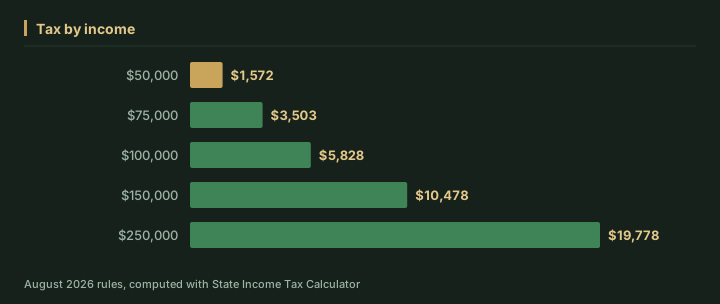
We ran 5 values of income through the calculator and left every other input at its default. As of August 2026, the output was:
| Income ($) | Tax ($) | Marginal tax rate (%) | Effective tax rate (%) |
|---|---|---|---|
| 50,000 | 1,572 | 6% | 3.14% |
| 75,000 | 3,503.3 | 9.3% | 4.67% |
| 100,000 | 5,828.3 | 9.3% | 5.83% |
| 150,000 | 10,478.3 | 9.3% | 6.99% |
| 250,000 | 19,778.3 | 9.3% | 7.91% |
Running income from $50,000 up to $250,000 moves tax from $1,572 to $19,778 — a spread of $18,206. That gap is the part a single headline rate never shows.
The same runs seen through marginal tax rate
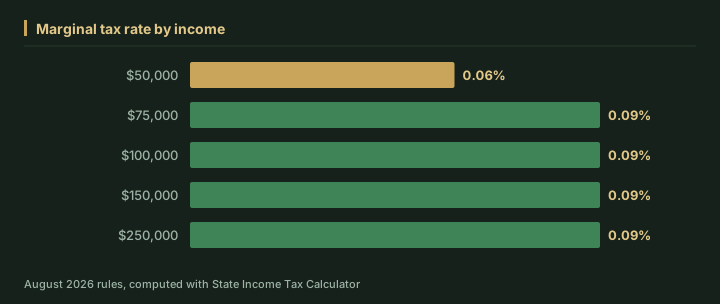
At $50,000, marginal tax rate works out to 6%; at $250,000 it is 9.3%. Looking only at tax tends to understate how much the outcome shifts across that range.
Where the total comes from
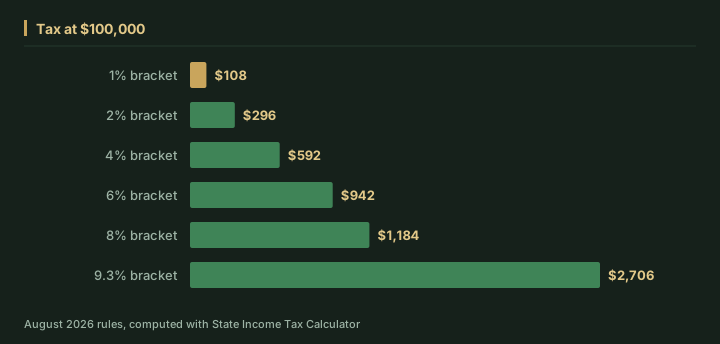
Holding income at $100,000, we ran the same calculation again and kept the breakdown it returns. The total is not one rate applied once — for the 2026 tax year it is built from 6 parts:
| Part | Tax |
|---|---|
| 1% bracket | $108 |
| 2% bracket | $296 |
| 4% bracket | $592 |
| 6% bracket | $942 |
| 8% bracket | $1,184 |
| 9.3% bracket | $2,706 |
Assumptions behind these figures
| Input | Value |
|---|---|
| Income | $100,000 |
| State | California |
| Status | Single |
| Year | 2026 |
| As of | August 2026 |
| Method | identical to /tools/state-income-tax-calculator |
Brackets, thresholds and rates change from year to year, so treat these as August 2026 figures for the 2026 tax year. For your own situation, open the State Income Tax Calculator and enter your real numbers — the calculator runs the same code that produced every figure on this page.
Frequently Asked Questions
Do all U.S. states charge income tax?
No, several states do not impose a broad personal income tax on wages, generally including states like Alaska, Florida, Nevada, New Hampshire, South Dakota, Tennessee, Texas, Washington, and Wyoming. However, states without an income tax typically make up the revenue through higher sales taxes, property taxes, or other levies, so no income tax does not necessarily mean lower overall taxes.
If I move to a state with no income tax, will I really pay less overall?
Not necessarily — it depends heavily on your income, whether you own a home, and how much you spend, since states without income tax generally collect more through sales and property taxes instead. In some comparisons the savings from no state income tax are largely or entirely offset by a higher property tax bill, so it's worth modeling all three tax types together rather than looking at income tax alone.
How does state income tax relate to my federal tax return?
Most states that levy an income tax start their calculation from your federal adjusted gross income or federal taxable income, then apply their own additions, subtractions, and deductions on top. Because of this link, an error on your federal return can carry over to your state return, and a deduction that helps federally may not help (or may help differently) at the state level.
What are the three main types of state income tax systems?
States generally fall into three categories: progressive systems with graduated brackets where the rate rises with income (like California or New York), flat-rate systems that apply one rate to all taxable income (like Illinois or Colorado), and states with no broad wage income tax at all (like Texas or Florida). Knowing which category your state falls into is the first step in estimating your state tax bill.
Does moving to a no-income-tax state eliminate tax on income I earn elsewhere?
No — moving your residence to a state without an income tax does not erase tax owed to another state where you physically earn income. Someone who lives in a no-tax state but regularly works on-site in a state that does tax wages can still owe that other state's income tax on the income earned there.
Try the related calculators
Related guides
Retirement Account Tax Benefits: 401(k), IRA, and Roth (2026)
Whether a retirement account saves you tax now or later depends on which type you pick — here is how 401(k)s,...
The Tax Refund Process: How Long Does It Take? (2026)
You filed and the money still has not landed. Here is the realistic 2026 timeline, what the tracker stages act...
How to Fill Out a W-4 Form: 2026 Edition
A practical 2026 walkthrough of the IRS Form W-4 — filing status, the multiple-jobs step people skip, dependen...