Standard vs Itemized Deductions: Which Should You Choose? (2026)
Table of contents
- You pick one, not both
- The 2026 standard deduction
- What actually counts on Schedule A
- Why the SALT cap is the whole story
- Three households, three different answers
- The move that flips a close call: bunching
- The edge cases that surprise people
- A few things that quietly change the answer
- If you do itemize, you have to prove it
- Quick answers
- What is the 2026 standard deduction?
- So should I itemize or not?
- Why did everyone stop itemizing?
- What is bunching, in one line?
- Can I cut taxable income even if I take the standard deduction?
- Does this choice carry over year to year?
- How we keep this accurate
- Run the numbers
- How the result moves with income
- The same runs seen through after-tax income
- Where the total comes from
- Assumptions behind these figures
You came here to ask one question: do I take the standard deduction or itemize? The short answer is take whichever number is larger — add up the four things that count as itemized deductions, compare that sum to your standard deduction from the table below, and pick the bigger one, because the bigger deduction means less taxable income and a smaller bill.
The rest of this guide is about the part that sentence hides. "Whichever is larger" is trivially true and almost useless until you know how brutally the SALT cap has trimmed the itemized side, which expenses people think count but don't, and why a household that loses the comparison this year can still win it over two years with one scheduling trick. If you only remember one sentence, it's the one above. If you want to be right about your own return, keep reading.
You pick one, not both
A deduction shrinks your taxable income — the number your brackets actually apply to. You may subtract either the flat standard deduction or your total itemized deductions, never both, never a blend. That's the entire rule. Everything else is just figuring out which sum is bigger for you this specific year.
Want to see the dollar consequence rather than the abstract one? Run your situation both ways through the Federal Income Tax Calculator and compare the refund or balance due each path produces.
The 2026 standard deduction
No receipts. No schedules. No proof. The number is fixed entirely by your filing status:
| Filing status | 2026 standard deduction |
|---|---|
| Single | $16,100 |
| Married filing jointly | $32,200 |
| Married filing separately | $16,100 |
| Head of household | $24,150 |
Those are large numbers by historical standards, and that single fact is why the answer to your question is, statistically, "take the standard deduction." Your itemized total has to clear that bar before itemizing buys you anything at all. A married couple filing jointly needs more than $32,200 of qualifying expenses just to break even with doing nothing.
One wrinkle that raises the bar further: taxpayers who are 65 or older, or blind, get an additional standard deduction on top of the base, and it stacks — a single filer who is both 65+ and blind gets two add-ons. That's a big reason a much larger share of retirees take the standard deduction, and it's why someone who itemized for two decades behind a mortgage often switches the year the mortgage is paid off and the age add-on kicks in. The bar they have to clear went up at the same moment their biggest itemized line disappeared.
What actually counts on Schedule A
Itemized deductions are specific, individually qualifying expenses. In 2026 the categories that matter for almost everyone:
- Mortgage interest — interest on a qualifying home loan, subject to the principal limits in current law.
- State and local taxes (SALT) — state income (or sales) tax plus property tax, but the combined total is capped at $10,000. This one line is why a huge number of former itemizers no longer clear the bar.
- Charitable contributions — cash and non-cash gifts to qualified organizations, with documentation and percentage-of-AGI limits.
- Medical and dental — only the slice above 7.5% of your adjusted gross income counts. AGI of $100,000 means only unreimbursed medical above $7,500 is deductible at all.
| Itemized category | The 2026 catch |
|---|---|
| Mortgage interest | Subject to mortgage principal limits |
| State & local taxes | Combined cap of $10,000 |
| Charitable gifts | Documentation; percentage-of-AGI ceilings |
| Medical / dental | Only the amount above 7.5% of AGI |
Now the part that quietly inflates people's estimates and occasionally invites an audit. Things that feel deductible but generally are not on a current federal return: unreimbursed job expenses for W-2 employees, most personal legal fees, your commute, and personal interest like credit card or auto loan interest. Counting any of these is how an itemized total gets overstated — and an overstated total that draws scrutiny is strictly worse than the standard deduction you could have taken with zero paperwork. When unsure, count only the four categories above and nothing else.
Why the SALT cap is the whole story
It is hard to overstate what the $10,000 SALT cap did to this decision. Before it, a homeowner in a higher-tax area deducted the full stack of state income tax plus property tax — frequently $20,000 to $40,000 — and sailed past the old, much lower standard deduction almost automatically. Today that same homeowner counts $10,000 of it, full stop, and the standard deduction is far larger. Itemizing now lives or dies on mortgage interest and charitable giving, because SALT alone almost never gets you there anymore.
| Household | SALT paid | SALT counted | Gap left to MFJ standard ($32,200) |
|---|---|---|---|
| High-tax state, $24k SALT | $24,000 | $10,000 | $22,200 to find in mortgage + charity |
| Moderate state, $9k SALT | $9,000 | $9,000 | $23,200 to find in mortgage + charity |
| No-income-tax state, $6k property | $6,000 | $6,000 | $26,200 to find in mortgage + charity |
Every row leaves a wide gap. That single pattern explains why a renter with no mortgage essentially never itemizes today, in any state. For how the cap interacts with living in a high-tax state specifically, see State Income Tax Guide: All 50 States Explained (2026).
Three households, three different answers
The framework is four steps: tally realistic itemized deductions (SALT capped at $10,000, plus mortgage interest, charitable gifts, and medical above the 7.5% floor); compare the sum to your standard deduction; take the larger; and if you're close to the line, look at bunching. Watching it run on real households teaches more than the steps do.
Household one — Renee, single, renting. Her itemizable items:
| Item | Amount |
|---|---|
| State income tax (capped portion) | $4,900 |
| Property tax | $0 (renter) |
| Mortgage interest | $0 |
| Charitable gifts | $1,800 |
| Medical above 7.5% of AGI | $0 |
| Itemized total | $6,700 |
$6,700 against a $16,100 standard deduction. She takes the standard deduction and shields $16,100 — nearly two and a half times what itemizing would give her, with no paperwork. For Renee, itemizing would actively lose money. This is the statistically typical case.
Household two — the Brennans, married filing jointly, mortgaged home in a higher-tax area:
| Item | Amount |
|---|---|
| State income tax | $12,500 |
| Property tax | $7,500 |
| SALT subtotal ($20,000 paid, capped) | $10,000 |
| Mortgage interest | $17,200 |
| Charitable gifts | $7,400 |
| Medical above 7.5% of AGI | $0 |
| Itemized total (after SALT cap) | $34,600 |
They paid $20,000 in state and property tax and count exactly $10,000 of it. Even so, $17,200 of mortgage interest plus $7,400 of charitable gifts pushes them to $34,600 — clear of the $32,200 MFJ standard deduction by $2,400. At a 22% marginal rate, that extra $2,400 of deduction is worth roughly $528 in tax. Model how a change like that flows to the refund with the Tax Refund Estimator.
Household three — the Okafors, married filing jointly, AGI $80,000, catastrophic medical year. Medical only counts above 7.5% of AGI, which makes it irrelevant in a normal year and decisive in a terrible one. A major surgery and rehab generated $27,500 of unreimbursed cost:
| Item | Amount |
|---|---|
| AGI | $80,000 |
| 7.5%-of-AGI floor | $6,000 |
| Medical paid | $27,500 |
| Deductible medical (above the floor) | $21,500 |
| SALT (capped) | $8,000 |
| Mortgage interest | $6,500 |
| Charitable gifts | $2,200 |
| Itemized total | $38,200 |
In any normal year the Okafors take the $32,200 standard deduction without a second thought. This year the medical line alone carries their itemized total to $38,200 — $6,000 over the standard deduction. At a 12% marginal rate that extra $6,000 saves about $720, and it vanishes entirely if they don't re-run the comparison. The rule that falls out of all three: re-test standard vs itemized every single year, and especially in any year with a large, unusual expense. Confirm the bottom line with the Tax Refund Estimator.
The move that flips a close call: bunching
Look back at the Brennans. They cleared the standard deduction by only $2,400. In a year their charitable giving runs lighter, they drop below $32,200 and lose the entire itemizing benefit. Bunching is the fix.
Bunching means deliberately concentrating discretionary deductible spending — primarily charitable gifts, occasionally elective medical procedures — into one tax year so that year clears the standard deduction decisively, then taking the plain standard deduction in the "off" years.
Concretely: a couple normally gives $8,000 a year. With $10,000 of capped SALT and $14,000 of mortgage interest, their annual itemized total is about $32,000 — just under the $32,200 standard deduction, so itemizing buys them nothing in any year.
| Approach | Year 1 itemized | Year 2 itemized | Two-year deduction total |
|---|---|---|---|
| $8,000 every year | ≈ $32,000 (use $32,200 standard) | ≈ $32,000 (use $32,200 standard) | $64,400 (two standard) |
| Bunch: $16,000 in Year 1, $0 in Year 2 | ≈ $40,000 (itemize) | ≈ $24,000 (use $32,200 standard) | $72,200 |
Same total charitable outlay, $7,800 more deducted across two years, purely from timing. A donor-advised fund is the usual vehicle: contribute and deduct a lump sum in the bunching year, then dole grants out to charities normally over the following years.
The edge cases that surprise people
A few situations don't fit the clean "add it up, pick the bigger" picture, and they're exactly the ones where filers leave money behind or trip an audit.
The first-year homeowner. Buying a house mid-year is the classic year a long-time standard-deduction taker should re-run the math, but the trap is the opposite mistake: assuming the purchase automatically makes itemizing win. It often doesn't in year one. If you close in October, you have only about three months of mortgage interest and one partial property-tax payment that year. A buyer who clears the standard deduction comfortably in their first full year of ownership may still fall well short in the partial purchase year. Run the actual numbers for the short year; don't assume the keys came with an itemized return.
The newly divorced or separated filer. Filing status drives the standard deduction, and a status change mid-life can swing the bar by thousands. Someone who itemized for years as married filing jointly against a $32,200 bar now faces a $16,100 single bar — the same itemized expenses that lost the comparison while married may clear the much lower single bar easily, or the SALT cap may now bite differently because the $10,000 ceiling is per return, not per person. The married-filing-separately interaction is its own minefield: if one separated spouse itemizes, the other generally must itemize too, even with nearly nothing to deduct, which can produce a worse combined result than coordinating.
The high-charitable, low-everything-else year. A single filer with no mortgage but a large one-time gift — say $20,000 to a qualified charity after a windfall — can clear the $16,100 single standard deduction on charity alone, a year where itemizing wins for someone who has taken the standard deduction their entire adult life. This is the case people miss most, because they have internalized "I always take the standard deduction" as a fact about themselves rather than a result that gets recomputed every year.
| Situation | Common wrong assumption | What actually happens |
|---|---|---|
| Bought a home in October | "I itemize now" | Partial-year interest often still loses to the standard deduction |
| Went from MFJ to single | "Nothing changed but my status" | Lower bar can flip a long-standing standard-deduction filer to itemizing |
| One big charitable year, no mortgage | "I never itemize" | A single large gift alone can clear the single standard deduction |
The unifying lesson across all three: the choice is not a personality trait. It is an arithmetic question with a fresh answer every April.
A few things that quietly change the answer
- Filing status interacts. Married filing separately complicates this: if one spouse itemizes, the other generally must too, even with almost nothing to itemize.
- It resets annually. Standard one year, itemized the next — entirely allowed. Reassess after buying a home, a big medical event, or a heavy giving year.
- Above-the-line deductions are separate and stack on either choice. Traditional retirement and HSA contributions cut taxable income whether or not you itemize. Don't confuse them with itemized deductions — How to Reduce Your Taxable Income Legally (2026) catalogs that whole menu.
- A deduction is not a credit. A deduction lowers taxable income; a credit lowers tax dollar for dollar. The gap is large and worth understanding — see Tax Credits vs Tax Deductions.
- Your state return may not follow your federal choice. Some states force the same method both places; some let you itemize on the state return after taking the federal standard deduction; some have their own standard deduction entirely. Because the SALT cap is federal-only, the federal-optimal choice isn't always state-optimal — model the state side with the State Income Tax Calculator before locking in.
If you do itemize, you have to prove it
The standard deduction needs zero documentation. Itemizing means being able to defend every figure: mortgage interest comes to you on Form 1098, charitable cash gifts need bank records or written acknowledgment from the charity (with stricter substantiation at $250 and up), property and state tax need payment records, and medical needs itemized receipts plus proof it was unreimbursed. A legitimate reason to take the standard deduction even when itemizing wins by a hair: the recordkeeping and audit exposure aren't worth a marginal saving. Weigh the dollar benefit against the effort honestly, not optimistically.
Quick answers
What is the 2026 standard deduction?
$16,100 single, $32,200 married filing jointly, $16,100 married filing separately, $24,150 head of household. Filers 65+ or blind add a stacking amount on top.
So should I itemize or not?
Add SALT (capped at $10,000), mortgage interest, charitable gifts, and medical above 7.5% of AGI. If that beats your standard deduction, itemize. If not, take the standard deduction — it's larger, simpler, and needs no proof. For most renters and many homeowners, the standard deduction wins.
Why did everyone stop itemizing?
The standard deduction is high and SALT is capped at $10,000. Together they pushed millions of former itemizers below the bar, so the standard deduction now gives them the bigger benefit.
What is bunching, in one line?
Concentrate discretionary giving into one year so that year clears the standard deduction, then take the standard deduction the off years — more total deduction for the same total spending.
Can I cut taxable income even if I take the standard deduction?
Yes. Traditional 401(k), deductible traditional IRA, and HSA contributions are above-the-line and reduce income regardless of this choice. They stack on top of whichever deduction you take.
Does this choice carry over year to year?
No — it's decided fresh every year on that year's expenses. Reassess after any major life or money event.
How we keep this accurate
The 2026 standard deduction figures, the $10,000 SALT cap, the 7.5%-of-AGI medical floor, and the itemized categories track projected 2026 federal parameters built on the IRS's annual inflation-adjustment procedure and the Internal Revenue Code as currently written, and they are trued up to the IRS's official numbers once those publish at year-end; itemized deductions are reported on Schedule A of Form 1040, and the marginal-rate effects shown use the projected 2026 brackets. Everything here is an educational 2026 estimate rather than tax advice — for the call on your own return, especially in an unusual-expense year, a CPA or Enrolled Agent should see the actual figures.
Run the numbers
Everything below came out of this site's own Federal Income Tax Calculator. The figures are not quoted from anywhere else: each row is one run of the same calculation the tool page performs, using August 2026 rules. Put the same inputs in and you will get the same output.
How the result moves with income
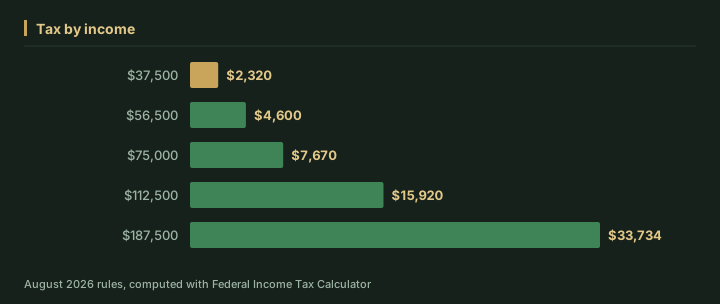
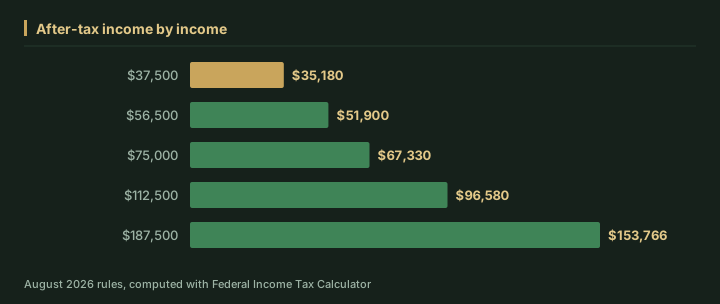
We ran 5 values of income through the calculator and left every other input at its default. As of August 2026, the output was:
| Income ($) | Tax ($) | After-tax income ($) | Taxable income ($) |
|---|---|---|---|
| 37,500 | 2,320 | 35,180 | 21,400 |
| 56,500 | 4,600 | 51,900 | 40,400 |
| 75,000 | 7,670 | 67,330 | 58,900 |
| 112,500 | 15,920 | 96,580 | 96,400 |
| 187,500 | 33,734 | 153,766 | 171,400 |
Running income from $37,500 up to $187,500 moves tax from $2,320 to $33,734 — a spread of $31,414. That gap is the part a single headline rate never shows.
The same runs seen through after-tax income
At $37,500, after-tax income works out to $35,180; at $187,500 it is $153,766. Looking only at tax tends to understate how much the outcome shifts across that range.
Where the total comes from
Holding income at $75,000, we ran the same calculation again and kept the breakdown it returns. The total is not one rate applied once — for the 2026 tax year it is built from 3 parts:

| Part | Tax |
|---|---|
| 10% bracket | $1,240 |
| 12% bracket | $4,560 |
| 22% bracket | $1,870 |
Assumptions behind these figures
| Input | Value |
|---|---|
| Income | $75,000 |
| Status | Single |
| Deduction type | Standard |
| Itemized | $0 |
| Year | 2026 |
| As of | August 2026 |
| Method | identical to /tools/federal-income-tax-calculator |
Brackets, thresholds and rates change from year to year, so treat these as August 2026 figures for the 2026 tax year. For your own situation, open the Federal Income Tax Calculator and enter your real numbers — the calculator runs the same code that produced every figure on this page.
Frequently Asked Questions
How do I decide whether to take the standard deduction or itemize?
Add up your qualifying itemized deductions — mainly state and local taxes (capped), mortgage interest, charitable contributions, and medical expenses above a certain income-based floor — and compare that total to your standard deduction amount for your filing status, then take whichever is larger. You make this comparison fresh every tax year, since your circumstances and the applicable numbers can change.
Why has itemizing become less common for the average homeowner?
Two structural factors are largely responsible: the standard deduction has grown substantially larger in recent years, and the deduction for state and local taxes (SALT) is now capped at a set dollar amount regardless of how much you actually pay. Together, these changes mean many homeowners who used to clear the itemizing threshold easily now find the standard deduction is larger even with a real mortgage.
What expenses do people mistakenly think are tax-deductible but generally aren't?
Common misconceptions include unreimbursed job expenses for W-2 employees, personal legal fees, commuting costs, and personal interest like credit card or auto loan interest — none of these are generally deductible on a current federal return. Counting items outside the standard itemized categories can inflate your estimate and increase audit risk.
What is bunching and how can it help someone close to the standard deduction threshold?
Bunching means concentrating deductible expenses, especially charitable donations, into a single tax year instead of spreading them evenly, so your itemized total clears the standard deduction in that concentrated year while you take the standard deduction in the other years. Over a multi-year period, this can produce a larger total deduction than spreading the same overall spending evenly, and using a donor-advised fund is one common way to implement it.
Try the related calculators
Related guides
Retirement Account Tax Benefits: 401(k), IRA, and Roth (2026)
Whether a retirement account saves you tax now or later depends on which type you pick — here is how 401(k)s,...
The Tax Refund Process: How Long Does It Take? (2026)
You filed and the money still has not landed. Here is the realistic 2026 timeline, what the tracker stages act...
How to Fill Out a W-4 Form: 2026 Edition
A practical 2026 walkthrough of the IRS Form W-4 — filing status, the multiple-jobs step people skip, dependen...