"Tax Credits vs Tax Deductions: What's the Difference?"
Table of contents
- The difference in one line
- $1,000 credit vs $1,000 deduction, at 22%
- The same comparison at a different bracket
- Why a deduction's value tracks your bracket
- Refundable vs nonrefundable: the part people misjudge
- Above-the-line vs itemized: deductions are not one thing
- When a benefit quietly shrinks: phaseouts
- A map of common 2026 federal credits and deductions
- The everyday decision this actually changes
- How both stack in a single return
- The mistakes that cost people money
- Run the numbers
- How the result moves with income
- The same runs seen through after-tax income
- Where the total comes from
- Assumptions behind these figures
"Is a tax credit better than a tax deduction?" Per dollar, almost always yes: a credit comes straight off the tax you owe, while a deduction only lowers the income that tax is calculated on, so it returns just your marginal rate. For a middle-income filer that can make a credit worth four or five times a deduction of the same headline size.
That two-sentence answer is the whole idea in miniature. The rest of this guide makes it concrete — the arithmetic at two different brackets, the difference between refundable and nonrefundable credits, where above-the-line deductions fit, and the specific places people lose money by treating the two as interchangeable. It builds on the complete guide to U.S. federal income tax (2026).
The difference in one line
A deduction reduces the income that gets taxed. A credit reduces the tax itself.
Recall the pipeline from the complete guide: income → deductions → taxable income → brackets → tax → subtract credits. A deduction acts early, shrinking the amount the brackets are applied to. A credit acts late, subtracting from the tax the brackets already produced. Because a deduction only hands back your marginal rate while a credit hands back the full face amount, the credit is the heavier lever per dollar.
$1,000 credit vs $1,000 deduction, at 22%
Take a 2026 head-of-household filer with $95,000 of gross income, taking the $24,150 HOH standard deduction. Taxable income is $70,850, which lands them in the 22% band.
Their tax before any of this, on $70,850 of HOH taxable income: 10% × $17,700 = $1,770, plus 12% × ($67,450 − $17,700) = $5,970, plus 22% × ($70,850 − $67,450) = $748 — total $8,488. Marginal rate: 22%.
Scenario A — a $1,000 deduction. Taxable income drops $1,000 to $69,850. That $1,000 was sitting in the 22% band, so tax falls by 22% × $1,000:
- Tax saved = $220
- New tax = $8,268
Scenario B — a $1,000 nonrefundable credit. Taxable income is untouched at $70,850, tax is still computed as $8,488, then the credit is subtracted from the tax directly:
- Tax saved = $1,000
- New tax = $7,488
| $1,000 deduction | $1,000 credit | |
|---|---|---|
| Reduces | Taxable income | Tax owed |
| Acts at | 22% marginal rate | 100%, dollar-for-dollar |
| Actual tax saved | $220 | $1,000 |
Identical headline number, 4.5x the value. Run your own version with the Federal Income Tax Calculator.
The same comparison at a different bracket
Now swap in a single filer at the 12% margin — $40,000 gross, 2026 standard deduction of $16,100, taxable income $23,900, comfortably inside the 12% band. The deduction is now worth even less, while the credit does not budge:
| $1,000 deduction (12% filer) | $1,000 credit (12% filer) | |
|---|---|---|
| Reduces | Taxable income | Tax owed |
| Acts at | 12% marginal rate | 100%, dollar-for-dollar |
| Actual tax saved | $120 | $1,000 |
For this filer the credit is worth 8.3x the deduction. Same two products, a much wider gap — purely because the deduction's value rides on the marginal rate while the credit's does not. That is the single most important pattern in this whole topic: a deduction's worth scales with your bracket; a credit's worth does not.
Why a deduction's value tracks your bracket
A deduction is only ever worth your marginal rate, so the identical deduction is worth different money to different people:
| Marginal rate | Value of a $1,000 deduction |
|---|---|
| 10% | $100 |
| 12% | $120 |
| 22% | $220 |
| 24% | $240 |
| 32% | $320 |
| 35% | $350 |
| 37% | $370 |
A $1,000 nonrefundable credit is worth $1,000 to every filer in that table (given at least $1,000 of tax to absorb it). This asymmetry is why deductions skew valuable to high earners while many credits are deliberately built to deliver equal or larger benefits to lower-income households. The marginal-rate mechanic is unpacked in marginal vs effective tax rate explained.
Refundable vs nonrefundable: the part people misjudge
Credits do not all behave the same once they exceed your tax bill.
- A nonrefundable credit cuts your tax to zero but not below. Anything left over is lost (some credits allow a carryforward to a future year).
- A refundable credit can push past zero — the excess is paid to you as part of your refund, even with no tax owed at all.
A filer owes $600 in tax and qualifies for a $1,000 credit:
| Credit type | Tax after credit | Refund from this credit |
|---|---|---|
| Nonrefundable | $0 | $0 (the extra $400 evaporates) |
| Refundable | $0 | $400 paid to you |
A worked version of the same point: two single filers, one owing $4,000 in tax and one owing $300, each qualifying for a $2,500 partially-refundable credit with a $1,000 refundable ceiling. The $4,000 filer absorbs the full $2,500 against tax and walks away $2,500 ahead. The $300 filer wipes out the $300, then collects only up to the $1,000 refundable cap on the remainder — so a credit with the same headline number delivers $2,500 to one filer and roughly $1,300 to the other. The number on the form is not the number you receive; the interaction with your tax and the refundable ceiling is.
Refundable credits are quietly the most powerful provisions in the code for lower-income taxpayers because they function as a direct payment. Because credits feed straight into the refund, they usually move the number the Tax Refund Estimator produces more than anything else; what happens to that refund afterward is covered in the tax refund process and how long it takes.
Above-the-line vs itemized: deductions are not one thing
Deductions split into structural types, and the difference matters more than people expect.
Above-the-line deductions (adjustments to income) are subtracted before AGI, and you get them whether or not you itemize. Deductible traditional IRA contributions, HSA contributions, student loan interest, half of self-employment tax. Because they lower AGI, they can also reopen other AGI-tested benefits.
Below-the-line deductions are the standard deduction or itemized deductions — you take the larger, never both. Itemized covers state and local taxes (capped), mortgage interest, charitable gifts, large medical expenses. That choice is its own decision, in standard vs itemized deductions.
| Type | When subtracted | Itemize required? | Examples |
|---|---|---|---|
| Above-the-line | Before AGI | No | IRA, HSA, student loan interest, ½ SE tax |
| Standard deduction | After AGI | No | Flat amount by filing status |
| Itemized | After AGI | Yes (instead of standard) | SALT (capped), mortgage interest, charity |
Above-the-line deductions are the most universally useful because everyone can claim them; strategies built on them live in how to reduce taxable income legally.
When a benefit quietly shrinks: phaseouts
Both credits and deductions can phase out as income rises, tapering the benefit over an income range until it is gone. This produces a subtle effect: inside the phaseout range, each extra dollar gets taxed at your bracket rate and shrinks the benefit, so the true marginal cost of that dollar exceeds the bracket rate. It is sometimes called a hidden marginal rate.
A phaseout is not the bracket myth. Brackets never reduce tax on income you already earned. A phaseout genuinely reduces a specific benefit as income climbs — but smoothly, not as a cliff, and you still come out ahead earning more overall. The practical move: near a known phaseout threshold, an above-the-line deduction can be doubly valuable, cutting tax and restoring a phased-out benefit by lowering AGI. The AGI interaction is covered in how to reduce taxable income legally.
A map of common 2026 federal credits and deductions
Exact dollar limits are set annually by the IRS; the descriptions are general, so confirm current-year amounts before filing.
Common credits
| Credit | Type | Roughly who benefits |
|---|---|---|
| Child Tax Credit | Partially refundable | Families with qualifying children |
| Earned Income Tax Credit | Refundable | Low-to-moderate income workers |
| Child and Dependent Care Credit | Nonrefundable | Those paying for care to work |
| Education credits | Mixed | Students and their families |
| Saver's Credit | Nonrefundable | Lower-income retirement savers |
| Residential clean energy / EV credits | Nonrefundable | Qualifying home and vehicle purchases |
Common deductions and adjustments
| Deduction | Type | Notes |
|---|---|---|
| Standard deduction | Below-the-line | 2026: Single $16,100, MFJ $32,200, HOH $24,150, MFS $16,100 |
| Traditional IRA / HSA | Above-the-line | Income and plan limits apply |
| Student loan interest | Above-the-line | Phases out at higher income |
| One-half of SE tax | Above-the-line | See self-employment tax explained for 2026 |
| State and local taxes (SALT) | Itemized | Subject to a federal cap |
| Mortgage interest | Itemized | On qualifying acquisition debt |
| Charitable contributions | Itemized | Documentation required |
The everyday decision this actually changes
The classification is not academic — it changes routine choices people make without realizing tax is involved.
Take charitable giving. A filer who already takes the standard deduction and donates $1,000 to a charity often assumes they "got a tax break." If their itemized total is below the standard deduction, that $1,000 gift produced exactly $0 of federal tax benefit, because the deduction never cleared the standard-deduction floor. The same $1,000 routed through a different mechanism — say, a Qualified Charitable Distribution for an older filer, which reduces taxable IRA income directly rather than running through itemized deductions — can be worth the full marginal rate. Same generosity, same charity, wildly different tax outcome, decided entirely by which structure the dollar passed through.
Or take a $2,000 "education benefit." If it is the deduction-style treatment, a 12% filer keeps $240 of it. If it is a credit, the same filer keeps up to $2,000. A family choosing between two ways to claim education costs is, without the vocabulary in this guide, effectively flipping a coin on a four-figure difference.
The takeaway is a habit, not a number: whenever anyone — an employer, a financial product, a news article — describes a "tax break," your first question is "credit or deduction?" and your second is "if it is a deduction, do I even clear the standard deduction, and if so at what marginal rate?" Those two questions resolve most of the value before you read another word.
How both stack in a single return
A real return uses both, in order. Walk the HOH filer from earlier — $95,000 gross, $24,150 standard deduction — who also makes a $3,000 deductible traditional IRA contribution and qualifies for a $1,000 nonrefundable credit:
| Step | Amount |
|---|---|
| Gross income | $95,000 |
| Above-the-line deduction (IRA) | −$3,000 |
| AGI | $92,000 |
| Standard deduction | −$24,150 |
| Taxable income | $67,850 |
| Tax from brackets | $8,048 |
| Nonrefundable credit | −$1,000 |
| Tax after credit | $7,048 |
Trace each piece. The $3,000 IRA deduction pulled taxable income from $70,850 to $67,850; tax fell from $8,488 to $8,048, a $440 saving — exactly 22% × $2,000 at the 22% margin plus 12% × $1,000 once the deduction crossed back below the $67,450 HOH bracket boundary. (That little wrinkle — a deduction straddling a bracket line, so part of it saves 22% and part saves 12% — is real and routinely missed in back-of-envelope estimates.) The $1,000 credit then saved the full $1,000. The deduction and the credit never competed; they applied at different stages, the deduction before the brackets and the credit after. The Federal Income Tax Calculator runs the full sequence so you can watch each step move the number.
The mistakes that cost people money
This is where the abstract becomes expensive. A handful of recurring errors quietly drains money from otherwise careful filers:
Treating a deduction like a credit when you compare options. Someone offered a "$2,000 tax break" needs to know which kind it is before judging it. A $2,000 deduction at 12% is worth $240; a $2,000 credit is worth $2,000. Reaching for the deduction because the headline number looked bigger is a real and common loss.
Optimizing deductions before confirming credits. Because a credit is worth its full face value and a deduction only your marginal rate, the first sweep through any return should be "have I claimed every credit I qualify for?" — then polish deductions. Households that do it in the other order leave the larger lever unused.
Letting a nonrefundable credit go to waste. If your nonrefundable credits exceed your tax, the excess vanishes (absent a carryforward). When you have a choice between, say, timing a deductible expense versus an action that generates a refundable credit in a low-tax year, the refundable credit is the more robust play because it pays out even with no tax to offset. The order matters too: nonrefundable credits generally apply first to drive tax toward zero, with refundable credits arranged so their excess can flow into the refund.
Skipping above-the-line deductions because you take the standard deduction. They stack with the standard deduction and lower AGI, which can also widen AGI-tested credits — so refusing to claim them is two losses, not one.
Not filing at all when income is low. A refundable credit can pay you with zero tax owed. Filers who assume "I owe nothing, so why file" routinely abandon money that was theirs to collect.
Ignoring the bracket-straddle on a deduction. As the worked return above showed, a deduction that crosses a bracket boundary saves a blend of two rates, not a single clean marginal rate. It is a small effect on a small deduction and a meaningful one on a large IRA or HSA contribution near a threshold.
The thread running through all of these: before you read a single rule about a new tax provision, ask one question — "is this a credit or a deduction?" That one word tells you, roughly, how much it is worth per dollar, and it is the question that prevents most of the losses above.
Match the tool to the decision: the Tax Refund Estimator shows how a credit moves your refund, and the Federal Income Tax Calculator shows how a deduction moves your taxable income and tax. Everything here reflects the structure of IRS Form 1040, Schedule 1 (adjustments), Schedule 3 (credits), and Schedule A (itemized deductions) and their instructions; the 2026 standard deduction figures apply the annual IRS Revenue Procedure for inflation-adjusted items, with state references drawn from the individual state Departments of Revenue. Specific credit dollar limits and phaseouts are set annually by the IRS and should be confirmed for your filing year, and all 2026 numbers here are projections reconciled to the official IRS releases at year-end — useful for planning, but not a substitute for advice on your own return, which a CPA or Enrolled Agent should give once they can see the whole picture.
Run the numbers
Everything below came out of this site's own Federal Income Tax Calculator. The figures are not quoted from anywhere else: each row is one run of the same calculation the tool page performs, using August 2026 rules. Put the same inputs in and you will get the same output.
How the result moves with income
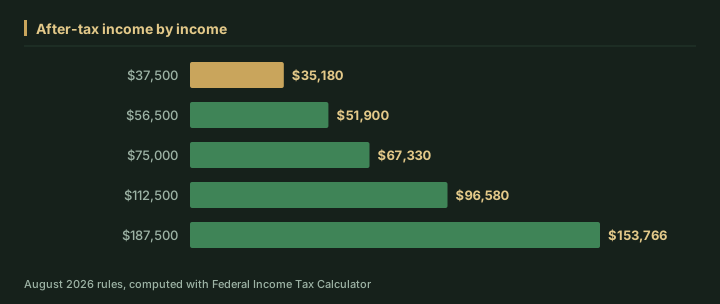
We ran 5 values of income through the calculator and left every other input at its default. As of August 2026, the output was:
| Income ($) | Tax ($) | After-tax income ($) | Taxable income ($) |
|---|---|---|---|
| 37,500 | 2,320 | 35,180 | 21,400 |
| 56,500 | 4,600 | 51,900 | 40,400 |
| 75,000 | 7,670 | 67,330 | 58,900 |
| 112,500 | 15,920 | 96,580 | 96,400 |
| 187,500 | 33,734 | 153,766 | 171,400 |
Running income from $37,500 up to $187,500 moves tax from $2,320 to $33,734 — a spread of $31,414. That gap is the part a single headline rate never shows.

The same runs seen through after-tax income
At $37,500, after-tax income works out to $35,180; at $187,500 it is $153,766. Looking only at tax tends to understate how much the outcome shifts across that range.
Where the total comes from
Holding income at $75,000, we ran the same calculation again and kept the breakdown it returns. The total is not one rate applied once — for the 2026 tax year it is built from 3 parts:

| Part | Tax |
|---|---|
| 10% bracket | $1,240 |
| 12% bracket | $4,560 |
| 22% bracket | $1,870 |
Assumptions behind these figures
| Input | Value |
|---|---|
| Income | $75,000 |
| Status | Single |
| Deduction type | Standard |
| Itemized | $0 |
| Year | 2026 |
| As of | August 2026 |
| Method | identical to /tools/federal-income-tax-calculator |
Brackets, thresholds and rates change from year to year, so treat these as August 2026 figures for the 2026 tax year. For your own situation, open the Federal Income Tax Calculator and enter your real numbers — the calculator runs the same code that produced every figure on this page.
Frequently Asked Questions
What's the real difference between a tax credit and a tax deduction?
A tax credit reduces the tax you owe dollar-for-dollar, while a tax deduction only reduces the income that gets taxed, so it returns just your marginal tax rate on that amount. Because of this, a credit is generally far more valuable than a deduction of the same headline size — often several times more, depending on your tax bracket.
Is a $1,000 tax credit worth more than a $1,000 tax deduction?
Yes, generally a $1,000 credit is worth more than a $1,000 deduction for almost every taxpayer, because the credit is subtracted directly from your tax bill while the deduction is only worth your marginal tax rate times $1,000. For example, at a 22% marginal rate a $1,000 deduction saves about $220, while a $1,000 credit saves the full $1,000.
What's the difference between a refundable and a nonrefundable tax credit?
A nonrefundable credit can reduce your tax bill to zero but not below — any excess beyond your tax owed is generally lost, though some allow a carryforward. A refundable credit can push your refund below zero tax owed, meaning the excess amount is paid to you even if you owed no tax at all, which makes refundable credits especially valuable for lower-income households.
Why is a tax deduction worth more to a high earner than a low earner?
Because a deduction's value is tied to your marginal tax rate, the same deduction amount saves more tax for someone in a higher bracket than for someone in a lower one. A $1,000 deduction is worth roughly your top marginal rate in tax savings — more for someone taxed near 37% than for someone taxed near 10% — which is why deductions tend to favor higher earners while credits are often more equalizing.
What are above-the-line deductions?
Above-the-line deductions, also called adjustments to income, are subtracted from gross income before arriving at adjusted gross income (AGI), and they're available whether or not you itemize. Common examples include deductible traditional IRA contributions and the deductible half of self-employment tax, and because many other tax breaks phase out based on AGI, these adjustments can have a valuable secondary effect beyond their direct tax savings.
Try the related calculators
Related guides
Retirement Account Tax Benefits: 401(k), IRA, and Roth (2026)
Whether a retirement account saves you tax now or later depends on which type you pick — here is how 401(k)s,...
The Tax Refund Process: How Long Does It Take? (2026)
You filed and the money still has not landed. Here is the realistic 2026 timeline, what the tracker stages act...
How to Fill Out a W-4 Form: 2026 Edition
A practical 2026 walkthrough of the IRS Form W-4 — filing status, the multiple-jobs step people skip, dependen...