How to Reduce Your Taxable Income Legally (2026)
Table of contents
- The two dials you're actually turning
- Lever 1: the pre-tax retirement account (almost always the biggest)
- Lever 2: the HSA, the only triple-tax-free dollar
- Lever 3: take the right deduction, then bunch it
- Lever 4: harvest losses against gains
- Lever 5: business deductions for the self-employed
- A wrinkle the self-employed get wrong
- Lever 6: time income and deductions across years
- Lever 7: use credits where they apply
- Lever 8: family and dependent planning
- A priority order, and the ways people blow it
- One last reality check before you change anything
- Run the numbers
- How the result moves with income
- The same runs seen through after-tax income
- Where the total comes from
- Assumptions behind these figures
The fastest legal way to cut your taxable income is to move dollars into accounts Congress built for exactly that purpose — a pre-tax 401(k) first, an HSA if you qualify, then the rest of the list below in roughly that order. None of this is a loophole; every lever here is something the tax code hands you deliberately. That distinction is the whole game: arranging your finances under the rules to owe less is tax avoidance, which courts have endorsed for nearly a century. Hiding income, inventing expenses, or claiming an account you never funded is tax evasion, which is a crime with prison attached. Everything in this guide is the first thing. Nothing in it is the second.
With that line drawn, here is the practical ranking.
The two dials you're actually turning
Your tax is driven by taxable income: gross income, minus adjustments, minus your deduction. Two broad ways to push it down:
- Above-the-line adjustments that come out before AGI is even computed — retirement and HSA contributions. These work whether or not you itemize, which is exactly why they sit at the top of the list.
- The deduction taken after AGI — the standard deduction or itemized, whichever is larger.
Credits are a third instrument entirely; they cut tax directly instead of cutting income, and they get their own section near the end. To watch any move below land on your actual bottom line, run it through the Federal Income Tax Calculator.
Lever 1: the pre-tax retirement account (almost always the biggest)
A traditional 401(k), 403(b), or similar workplace plan takes contributions in pre-tax dollars. Every dollar you defer is a dollar that never shows up in this year's taxable income.
Take Marcus, single, $98,000 of income in 2026, deferring $14,000 into his traditional 401(k):
| Item | No 401(k) | With $14,000 deferral |
|---|---|---|
| Income | $98,000 | $98,000 |
| 401(k) contribution | $0 | $14,000 |
| Income subject to tax (pre-deduction) | $98,000 | $84,000 |
| Marginal rate on the deferred slice | 22% | 22% |
| Federal tax saved this year | — | ≈ $3,080 |
Marcus knocks roughly $3,080 off this year's federal tax, and the $14,000 is still entirely his — invested, taxed later on withdrawal, ideally in a lower retirement bracket. A traditional IRA can also be deductible depending on income and whether a workplace plan covers you.
Two things worth being precise about. First, a pre-tax contribution is a deferral, not an escape — you pay tax on withdrawal. It still usually wins, because you often withdraw at a lower rate and the money compounds untaxed in between. But if you genuinely expect a higher bracket later, a Roth contribution (no deduction now, tax-free later) can beat it; the decision turns on your current versus expected future rate, laid out in Traditional vs Roth IRA Tax and Retirement Account Tax Benefits. For this guide's purpose, the traditional version is the one that lowers income today. Second: the employer match. A match is an immediate guaranteed return stacked on top of the tax saving. Passing up a full match to keep cash on hand is one of the most expensive moves an employee can make — capture the whole match before optimizing anything else here.
Lever 2: the HSA, the only triple-tax-free dollar
Enrolled in a qualifying high-deductible health plan? An HSA is, dollar for dollar, the most tax-efficient account in the code:
- Contributions are deductible above the line.
- Growth is untaxed.
- Withdrawals for qualified medical costs are untaxed.
Three separate breaks on the same dollar — nothing else common does all three. Because it reduces AGI, it works whether or not you itemize and stacks on top of retirement deferrals. If you can pay current medical costs out of pocket, treat the HSA as a stealth retirement account and let it ride.
Put a number on the "stealth retirement account" idea, because it is the part people underrate. Suppose a married couple in the 22% bracket contributes $8,000 to an HSA in 2026 and, instead of spending it, pays that year's $1,500 of routine medical costs out of pocket and lets the full $8,000 invest. The contribution alone cuts about $1,760 off this year's federal tax (22% of $8,000). But the larger move is what they didn't do: by not reimbursing themselves now, the $8,000 compounds untaxed for decades, and qualified withdrawals stay untaxed forever. They can even reimburse themselves years later for the receipts they're keeping today — there is no deadline to take an HSA reimbursement, so the account doubles as a tax-free emergency reserve backed by a drawer of old medical receipts. The one discipline it requires: actually being able to absorb current medical costs from cash flow. An HSA you constantly drain for routine bills is still good, but it's a checking account with a deduction, not the triple-advantage engine it can be.
Lever 3: take the right deduction, then bunch it
After the above-the-line moves, you take the larger of the standard deduction or itemized. For 2026:
| Filing status | 2026 standard deduction |
|---|---|
| Single | $16,100 |
| Married filing jointly | $32,200 |
| Head of household | $24,150 |
If your itemizable expenses (SALT capped at $10,000, mortgage interest, charitable gifts, medical above 7.5% of AGI) sit close to your standard deduction, bunching discretionary spending — especially charitable gifts — into alternating years pushes you over the threshold every other year and produces a bigger total deduction for the same total spending. The full mechanics, with a two-year table, live in Standard vs Itemized Deductions.
The detail that turns bunching from theory into the highest-leverage version of itself is the donor-advised fund. Instead of writing a charity a check every year, you contribute a multi-year lump to the fund in the bunching year — taking the full deduction that year, when it actually clears the standard deduction — then let the fund disburse grants to the charities on a normal annual schedule. The charities see no change in their cash flow; you converted several years of below-the-bar giving into one above-the-bar deduction without altering when the money actually reaches the cause. There is a subtler version for someone with appreciated stock: donating long-held appreciated shares directly (rather than selling them first) generally deducts the full fair market value and skips the capital-gains tax you'd owe on the sale — two benefits on one gift. That interaction with holding periods is exactly the territory of Capital Gains Tax: Short-Term vs Long-Term (2026). The discipline, as always: the gift has to be real and documented, and the deduction follows the contribution, not the intention to make one.
Lever 4: harvest losses against gains
Hold investments in a taxable brokerage account and you can sell down positions to realize capital losses that offset capital gains. If losses outrun gains, you can deduct a limited net loss against ordinary income each year and carry the rest forward.
Say you have a $7,500 long-term gain locked in on one stock and an unrealized $7,500 loss on another you no longer want. Selling the loser turns that $7,500 taxable gain into net zero, potentially saving 15% (more with NIIT) on it. Mind the wash-sale rule: rebuy the same or a substantially identical security within 30 days before or after the sale and the loss is disallowed. How holding periods and rates interact is in Capital Gains Tax: Short-Term vs Long-Term (2026).
Lever 5: business deductions for the self-employed
If you have 1099 or self-employment income, ordinary and necessary business expenses cut net business income directly — which lowers both income tax and self-employment tax, a double hit nothing on the W-2 side matches. Legitimate categories include the home-office deduction (space used regularly and exclusively for business), business mileage, software and supplies, and self-employed retirement plans like a SEP-IRA or solo 401(k) that allow far larger contributions than a regular IRA. The self-employed also deduct one-half of their SE tax above the line. Model the full picture with the Self-Employment Tax Calculator; if you're weighing contractor versus employee status, see 1099 vs W-2 Tax Implications and the 1099 vs W-2 Comparison Calculator.
The levers compound, and the self-employed have the most room to stack them. Take Dana, a single freelancer with $115,000 of net 1099 income before any planning in 2026:
| Step | Action | Effect on taxable income |
|---|---|---|
| Start | Net self-employment income | $115,000 |
| 1 | Deduct ½ of self-employment tax (above the line) | −≈ $8,100 |
| 2 | Solo 401(k), employee + employer contributions | −$27,000 |
| 3 | HSA contribution (eligible HDHP) | −$4,300 |
| 4 | Documented business expenses (software, home office, mileage) | −$10,500 |
| Resulting taxable income (pre-deduction) | ≈ $65,100 |
Dana legally moved roughly $50,000 out of taxable income using only sanctioned tools, each backed by a real contribution or a real, documented expense. At a marginal rate in the 22%–24% range that is comfortably north of $11,000 in combined federal tax saved, before the standard deduction even applies. Build your own version with the Self-Employment Tax Calculator and the Federal Income Tax Calculator.
A wrinkle the self-employed get wrong
The combined example above looks tidy on a table; in practice the most common self-employed mistake is the order of operations on a solo 401(k). The plan has two parts — an employee deferral and an employer (profit-sharing) contribution — and the employer side is computed on net income after the deduction for one-half of self-employment tax, not on gross receipts. People who plug gross income into the percentage formula over-contribute, trip the excess-contribution penalty, and erase exactly the saving they were chasing. The second recurring error is funding the employee deferral with money that was never actually set aside — a deduction has to correspond to a real contribution made by the deadline, and a phantom contribution claimed on Schedule C is no longer avoidance. Compute the employer piece off the adjusted number, fund it for real, and the Self-Employment Tax Calculator keeps the base figure honest.
Lever 6: time income and deductions across years
If you have any control over when income lands or expenses are paid, shifting them across the year boundary can lower the combined two-year bill — most powerfully when your bracket is about to change.
- Defer income into next year if next year's rate will be lower (delay an invoice, a bonus, a year-end sale).
- Accelerate deductions into this year if this year's rate is higher (pay a deductible expense in December, not January).
- Realize gains in a low-income year so more of them fall in the 0% or 15% long-term band.
This is at its strongest around retirement, a job change, a sabbatical, or a business's first slow year. Run both years' scenarios in the Tax Bracket Calculator to see which timing produces the lower combined tax.
A concrete two-year picture makes the payoff visible. Take a consultant whose income is lumpy: a heavy 2026 (≈ $180,000) followed by a deliberately light 2027 sabbatical year (≈ $40,000). A $25,000 year-end project could invoice in late December 2026 or early January 2027.
| Where the $25,000 lands | Approx. marginal rate on it | Tax on that slice |
|---|---|---|
| 2026 (heavy year, in the 24% band) | 24% | ≈ $6,000 |
| 2027 (light sabbatical year, 12% band) | 12% | ≈ $3,000 |
Moving one invoice across the year boundary halves the tax on that $25,000 — roughly $3,000 saved for sending the bill eleven days later, entirely legitimate because the work and the invoice timing are real. The same logic runs in reverse for deductions: a deductible business purchase you were going to make anyway is worth more pulled into the high-rate year than pushed into the low one. The discipline is to only shift things you genuinely control and that are genuinely real — backdating an invoice to a year you didn't earn it in crosses straight out of avoidance.
Lever 7: use credits where they apply
Cutting taxable income is only half the job. Tax credits reduce your tax bill dollar for dollar, and a credit is usually worth far more than a deduction of the same size — a $1,000 deduction at 22% saves $220, a $1,000 credit saves the whole $1,000. Education, dependent-care, energy, and retirement-savings credits each carry their own rules. Understand the difference before optimizing anything; Tax Credits vs Tax Deductions spells out exactly why credits usually win.
Lever 8: family and dependent planning
Family structure opens legitimate room. A dependent-care flexible spending account pays eligible childcare with pre-tax dollars, cutting taxable income directly. A 529 plan grows tax-free for qualified education costs and, in many states, the contribution earns a state income tax deduction or credit — a state-only benefit covered in State Income Tax Guide: All 50 States Explained (2026). Education and child-related credits then reduce tax directly on top. None of this is aggressive; these are accounts built for exactly these expenses. Just coordinate them — you cannot claim the same education dollars for both a tax-free 529 withdrawal and an education credit, and double-dipping one expense is disallowed.
A priority order, and the ways people blow it
For a typical wage earner, roughly in bang-for-buck order:
| Priority | Lever | Why it ranks here |
|---|---|---|
| 1 | Traditional 401(k)/403(b) deferral | Large limit, immediate above-the-line cut, employer match |
| 2 | HSA (if eligible) | Triple advantage; stacks on retirement |
| 3 | Deductible traditional IRA | Above the line; income/coverage rules apply |
| 4 | Optimize standard vs itemized; bunch | Costs only planning |
| 5 | Tax-loss harvesting | Offsets gains; respect the wash-sale window |
| 6 | Self-employed write-offs & retirement plans | Cuts income and SE tax |
| 7 | Income/deduction timing | Powerful in uneven-income years |
| 8 | Claim every credit you qualify for | Dollar-for-dollar; often the highest value |
The strategies are legitimate; the execution is where people lose the saving. The recurring failures:
| Mistake | Consequence | Fix |
|---|---|---|
| Over-contributing across accounts | Excess-contribution penalty erases the benefit | Track every account together, including a prior job's plan |
| Triggering a wash sale | Loss disallowed | Wait 31+ days or use a different security |
| Bunching with no plan | Gave more, saved nothing | Confirm the bunched year clears the standard deduction |
| Non-exclusive home office | Disallowed deduction, audit risk | Use a dedicated space, only |
| Ignoring the state side | Federal saving may not change state tax | Check both with the State Income Tax Calculator |
The thread running through all five: never spend a dollar purely "for the deduction." A deduction returns only your marginal rate, not the full dollar — the tax tail should never wag the spending dog.
One last reality check before you change anything
Lowering taxable income changes what you actually owe, which means your payroll withholding is probably now wrong. Start large pre-tax contributions mid-year and you can over-withhold (an interest-free loan to the government) or under-withhold elsewhere (a penalty). After making changes from this list, re-run your withholding with the W-4 Calculator so your paycheck reflects the lower tax. The entire point of legal tax reduction is keeping more of your money working during the year, not waiting on a refund.
A few companion guides go deeper where this one stays broad: Complete Guide to U.S. Federal Income Tax (2026) for the full calculation these levers plug into, Standard vs Itemized Deductions for choosing and bunching the larger deduction, Tax Credits vs Tax Deductions for why credits often beat deductions, Capital Gains Tax: Short-Term vs Long-Term (2026) for the rates that make loss harvesting and gain timing work, and Retirement Account Tax Benefits for the account-type detail. Everything described here rests on real provisions of the Internal Revenue Code — qualified plans, IRAs, HSAs, the capital-loss and wash-sale rules, self-employment deductions, and the standard and itemized deductions — and reports on Form 1040 with its Schedules 1, A, C, D, and SE plus Form 8889 for HSAs; the 2026 standard deduction, the $10,000 SALT cap, the 7.5%-of-AGI medical floor, and the brackets are projected 2026 figures trued up to the IRS's official numbers at year-end, with contribution limits set annually by the IRS and varying by account and income. Treat all of it as an educational 2026 estimate rather than tax advice, and run anything material past a CPA or Enrolled Agent before you act — the line between avoidance and evasion is bright, and staying on the legal side of it is the only version of this that's worth doing.
Run the numbers
Everything below came out of this site's own Federal Income Tax Calculator. The figures are not quoted from anywhere else: each row is one run of the same calculation the tool page performs, using August 2026 rules. Put the same inputs in and you will get the same output.
How the result moves with income
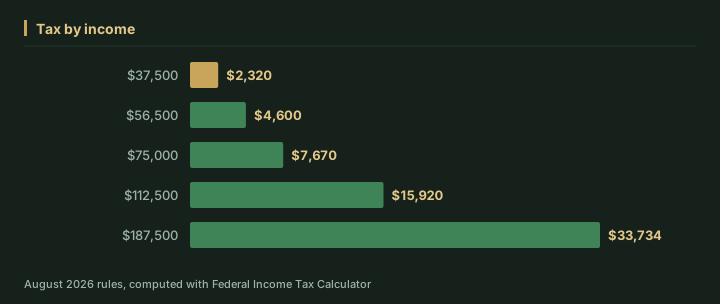
We ran 5 values of income through the calculator and left every other input at its default. As of August 2026, the output was:
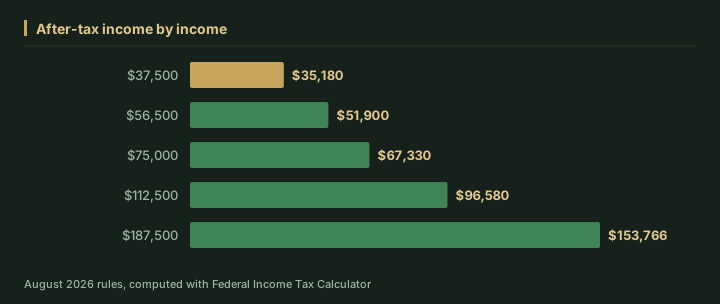
| Income ($) | Tax ($) | After-tax income ($) | Taxable income ($) |
|---|---|---|---|
| 37,500 | 2,320 | 35,180 | 21,400 |
| 56,500 | 4,600 | 51,900 | 40,400 |
| 75,000 | 7,670 | 67,330 | 58,900 |
| 112,500 | 15,920 | 96,580 | 96,400 |
| 187,500 | 33,734 | 153,766 | 171,400 |
Running income from $37,500 up to $187,500 moves tax from $2,320 to $33,734 — a spread of $31,414. That gap is the part a single headline rate never shows.
The same runs seen through after-tax income
At $37,500, after-tax income works out to $35,180; at $187,500 it is $153,766. Looking only at tax tends to understate how much the outcome shifts across that range.
Where the total comes from
Holding income at $75,000, we ran the same calculation again and kept the breakdown it returns. The total is not one rate applied once — for the 2026 tax year it is built from 3 parts:

| Part | Tax |
|---|---|
| 10% bracket | $1,240 |
| 12% bracket | $4,560 |
| 22% bracket | $1,870 |
Assumptions behind these figures
| Input | Value |
|---|---|
| Income | $75,000 |
| Status | Single |
| Deduction type | Standard |
| Itemized | $0 |
| Year | 2026 |
| As of | August 2026 |
| Method | identical to /tools/federal-income-tax-calculator |
Brackets, thresholds and rates change from year to year, so treat these as August 2026 figures for the 2026 tax year. For your own situation, open the Federal Income Tax Calculator and enter your real numbers — the calculator runs the same code that produced every figure on this page.
Frequently Asked Questions
What are the most effective legal ways to reduce taxable income?
The general starting point is pre-tax retirement contributions, like a traditional 401(k), followed by HSA contributions if you're eligible, then taking the larger of the standard or itemized deduction, and additional strategies like loss harvesting, business deductions, and timing income across years. These are all deliberate features of the tax code, not loopholes, and their impact depends on your specific income and circumstances.
What's the difference between legally reducing my taxes and tax evasion?
Legally reducing your taxable income, called tax avoidance, means arranging your finances within the rules the tax code provides, such as contributing to retirement accounts or claiming deductions you're entitled to. Tax evasion means hiding income, inventing expenses, or claiming deductions you're not entitled to, which is illegal and can carry serious criminal penalties; the distinction matters and should never be blurred.
Why is an HSA sometimes called a triple tax-free account?
A Health Savings Account generally offers three separate tax benefits on the same dollars: contributions are deductible, growth inside the account is untaxed, and withdrawals for qualified medical expenses are also untaxed. This combination is often described as more tax-efficient than typical retirement accounts, which usually offer only one or two of these breaks.
What is bunching deductions and how does it help?
Bunching means concentrating discretionary deductible expenses, especially charitable contributions, into one tax year rather than spreading them evenly, so that your itemized total clears the standard deduction threshold in that year even though it might not in a typical year. This can produce a larger total deduction over a two-year period than taking the same total spending evenly each year, particularly since the standard deduction has grown quite large.
Try the related calculators
Related guides
Retirement Account Tax Benefits: 401(k), IRA, and Roth (2026)
Whether a retirement account saves you tax now or later depends on which type you pick — here is how 401(k)s,...
The Tax Refund Process: How Long Does It Take? (2026)
You filed and the money still has not landed. Here is the realistic 2026 timeline, what the tracker stages act...
How to Fill Out a W-4 Form: 2026 Edition
A practical 2026 walkthrough of the IRS Form W-4 — filing status, the multiple-jobs step people skip, dependen...