1099 vs W-2: Tax Implications and Comparison (2026)
Table of contents
- What classification turns on
- The split that drives everything
- The deductions only one side gets
- QBI: a real but conditional advantage
- What you trade away that never hits a tax form
- Same $120,000, three outcomes — 2026 single filer
- The same comparison at a lower income
- Two wrinkles that quietly change the math
- Grossing up a contractor rate so it's actually equal
- So which?
- Questions people ask
- Is a 1099 always worse than a W-2 for taxes?
- Does a contractor really pay double the Social Security tax?
- What is QBI worth to a contractor?
- How much higher should a 1099 rate be than a W-2 salary?
- Can a W-2 employee deduct business expenses?
- About these numbers
- Run the numbers
- How the result moves with net profit
- The same runs seen through net self-employment earnings
- Assumptions behind these figures
Take $120,000. As a W-2 employee in 2026, that produces roughly $24,300 in combined federal tax. As a 1099 contractor billing the identical $120,000 with no business expenses, the figure jumps to about $30,400 — a swing of more than six thousand dollars on the exact same gross. Same work, same money, same year, $6,000 difference, decided entirely by which form the income lands on. And yet that's not the end of the story, because a third version of that contractor — one with $25,000 of real business expenses — ends up paying less federal tax than the employee.
That spread is what this guide is about. We'll work the full three-way comparison number by number, then unpack why the headline "7.65% vs 15.3%" framing overstates the gap, which deductions only a contractor gets, what the QBI deduction is worth, the benefits that never show on a tax form but cost real money, and how to gross up a 1099 rate so an offer is actually equivalent rather than just superficially bigger.
What classification turns on
A W-2 employee works under the employer's direction. The employer withholds income tax, withholds the employee's half of FICA, pays a matching employer half, and carries legal obligations and usually benefits.
A 1099 contractor runs a one-person business. The client pays the full agreed amount with nothing withheld and issues a Form 1099-NEC once payments reach the reporting threshold. Every tax on that money is the contractor's to handle.
Worth saying once, clearly: classification is decided by the actual working relationship — behavioral control, financial control, and the nature of the relationship — not by the contract's label or the form issued. Misclassification carries real exposure for both sides. From here on we assume the classification is correct and focus purely on the tax economics, which is where the decision usually actually lives.
One practical note before the math: receiving a 1099-NEC does not by itself make you a contractor, and not receiving one does not make the income tax-free. The form is a reporting mechanism, not the legal test, and self-employment income is reportable whether or not a payer issues paperwork. People occasionally treat a missing 1099 as a missing obligation — it isn't.
The split that drives everything
One distinction outweighs all the others.
| W-2 employee | 1099 contractor | |
|---|---|---|
| Social Security + Medicare | Employee pays 7.65%, employer pays the other 7.65% | Pays the full 15.3% as SE tax |
| Base it applies to | Gross wages | 92.35% of net profit, after expenses |
| Income tax withholding | Automatic via the W-4 | None — quarterly estimates instead |
| Offsetting deduction | None for the FICA paid | Deducts half of SE tax above the line |
The employee feels a 7.65% bite and nothing more. The contractor feels the full 15.3% — but on a smaller, post-expense base, and then deducts half of it against income tax. Those two offsets are why the real gap is narrower than the raw rate comparison implies, and why so many "1099 is always worse" takes are wrong in both directions. The contractor mechanics in full are in self-employment tax explained; model them with the self-employment tax calculator.
The deductions only one side gets
The contractor's structural counterweight is business expenses. A W-2 employee generally cannot deduct unreimbursed job costs on a federal return at all. A contractor reduces both SE tax and income tax with every legitimate business expense:
- Home-office costs — a proportionate share of rent, utilities, insurance
- Equipment, software, supplies
- Business mileage or actual vehicle costs
- The self-employed health insurance deduction, covering you and family
- SEP-IRA or Solo 401(k) contributions, at limits far above a typical employee 401(k)
- Continuing education, professional dues, business travel, part of business meals
This is the lever that flips a 1099 from "worse" to "better." A contractor with $25,000 of genuine, ordinary, necessary expenses is in a completely different position than one with none — and most of the comparison's drama lives in that line.
QBI: a real but conditional advantage
A self-employed person may also qualify for the Qualified Business Income (QBI) deduction, generally up to 20% of qualified net business income, bounded by taxable-income thresholds and tighter limits for certain service businesses. A W-2 employee gets nothing comparable on wages. QBI can narrow — sometimes wipe out — the contractor's extra SE-tax cost at moderate income. It's income-tested and rule-heavy, so treat it as genuine but conditional, and confirm eligibility rather than assuming it.
What you trade away that never hits a tax form
Tax is half the decision. Going 1099 typically means surrendering:
- Employer health insurance — you buy your own, though premiums may be deductible
- The employer 401(k) match — effectively free money you must now self-fund
- Paid time off, sick leave, holidays — unpaid time is simply lost revenue
- Unemployment insurance eligibility and workers' compensation
- The employer-paid 7.65% payroll share
- Predictable income and certain labor-law protections
None of these print on a 1040, and all of them are real money. A higher 1099 rate has to cover this entire list before any of it counts as "more."
Same $120,000, three outcomes — 2026 single filer
Same $120,000 gross, three scenarios, 2026 single brackets and the $16,100 standard deduction, rounded for clarity.
| W-2 employee | 1099, no expenses | 1099, $25,000 expenses | |
|---|---|---|---|
| Gross / revenue | $120,000 | $120,000 | $120,000 |
| Business expenses | $0 | $0 | −$25,000 |
| Net before SE tax | $120,000 | $120,000 | $95,000 |
| Employee FICA (7.65%) | −$9,180 | — | — |
| SE tax (15.3% × 92.35%) | — | −$16,956 | −$13,423 |
| One-half SE-tax deduction | — | $8,478 | $6,712 |
| AGI after SE-tax deduction | $120,000 | $111,522 | $88,288 |
| Standard deduction | −$16,100 | −$16,100 | −$16,100 |
| Taxable income | $103,900 | $95,422 | $72,188 |
| Federal income tax (approx.) | ≈ $17,919 | ≈ $15,054 | ≈ $9,940 |
| Total federal (FICA/SE + income) | ≈ $27,099 | ≈ $32,010 | ≈ $23,363 |
A note on the arithmetic so the table isn't a black box. SE tax in column two: $120,000 × 0.9235 = $110,820, × 15.3% = $16,955.46 ≈ $16,956. Income tax for the W-2 employee on $103,900 taxable: $1,240 (10% to $12,400) + $4,560 (12% on the $12,400–$50,400 band) + $11,770 (22% on $50,400–$103,900, i.e. $53,500 × 22% = $11,770) ≈ $17,919. The $25,000-expense column runs the same machinery on a $95,000 net base.
Read the bottom row slowly. With no expenses, the contractor pays roughly $4,900 more federal tax than the employee on an identical $120,000 — the exact result that ambushes first-year freelancers who quoted "the same rate." With $25,000 of real expenses, the contractor's tax drops about $3,700 below the employee's, and that $25,000 bought things the business actually needed. Expenses, QBI eligibility, and the value of replaced benefits decide this — never the gross alone. Build your own version with the 1099 vs W-2 calculator.
The same comparison at a lower income
The $120,000 figures make the gap look like a fixed dollar amount. It isn't — the math shifts with income, and at lower earnings the picture compresses. Run the identical three scenarios on $55,000 gross, 2026 single filer, same $16,100 standard deduction:
| W-2 employee | 1099, no expenses | 1099, $12,000 expenses | |
|---|---|---|---|
| Gross / revenue | $55,000 | $55,000 | $55,000 |
| Business expenses | $0 | $0 | −$12,000 |
| Net before SE tax | $55,000 | $55,000 | $43,000 |
| Employee FICA (7.65%) | −$4,208 | — | — |
| SE tax (15.3% × 92.35%) | — | −$7,772 | −$6,077 |
| One-half SE-tax deduction | — | $3,886 | $3,039 |
| AGI after SE-tax deduction | $55,000 | $51,114 | $39,961 |
| Standard deduction | −$16,100 | −$16,100 | −$16,100 |
| Taxable income | $38,900 | $35,014 | $23,861 |
| Federal income tax (approx.) | ≈ $4,420 | ≈ $3,954 | ≈ $2,615 |
| Total federal (FICA/SE + income) | ≈ $8,628 | ≈ $11,726 | ≈ $8,692 |
The arithmetic on the no-expense column: SE tax $55,000 × 0.9235 = $50,792.50, × 15.3% = $7,771.25 ≈ $7,772; income tax on $35,014 taxable = $1,240 (10% to $12,400) + ($35,014 − $12,400) × 12% = $22,614 × 12% = $2,713.68, total ≈ $3,954.
Two things stand out. The no-expense 1099 penalty is now about $3,100 rather than $4,900 in absolute dollars — but as a share of a smaller income it actually stings harder. And the $12,000-expense contractor lands almost exactly level with the employee (≈ $8,692 vs ≈ $8,628), which is the real lesson: at lower incomes you need proportionally fewer expenses to neutralize the SE-tax disadvantage, because there's simply less income being taxed at the higher marginal rates. The shape of the answer changes with the dollar amount; the direction of each lever does not.
Two wrinkles that quietly change the math
State tax doesn't behave the same on both sides. Most state income taxes follow federal taxable income closely, but a handful treat self-employment income, the QBI deduction, or the SE-tax deduction differently, and a contractor working across state lines can owe in more than one state. A W-2 employee's state withholding is generally handled by payroll; a contractor has to figure and pay it themselves. None of the federal-only tables above capture this, and for a multi-state contractor it can be the largest single difference — see the state income tax guide for all 50 states.
Portfolio and rental income don't carry SE tax at all. A common confusion: a contractor assumes every dollar of their non-employee income owes 15.3%. It doesn't. Interest, dividends, most capital gains, and most rental income are outside the SE-tax base entirely — only net earnings from a trade or business get hit. So a freelancer with a brokerage account isn't paying SE tax on the dividends, and conflating the two leads to chronic over-reserving. The full SE-tax boundary is mapped in self-employment tax explained.
Grossing up a contractor rate so it's actually equal
Because the contractor absorbs the employer's 7.65%, replaces lost benefits, and pays full SE tax, an equivalent 1099 offer must be higher than the W-2 number — not matching it. A workable frame:
- Start from the W-2 base. Say $60/hour as an employee.
- Add the employer payroll share you now carry. Roughly +7.65%.
- Add the value of lost benefits. Health, retirement match, paid time off commonly total 20–30% combined — quantify your own, don't guess.
- Add a buffer for unpaid gaps and self-employment risk. Bench time, slow invoices, no unemployment backstop.
The common shorthand is that a fair contractor rate runs roughly 1.25× to 1.5× the equivalent W-2 hourly rate just to break even on total economics. So a $60/hour W-2 role usually needs a $75–$90/hour 1099 rate to be an honest trade — not the $66 that merely looks higher. Below that band, the "raise" is an accounting illusion.
A concrete pass at that $60/hour W-2 example. Full-time it's about $124,800 a year ($60 × 2,080 hours). The employer also pays roughly 7.65% in payroll tax ($9,547) and, say, $14,000 in health premiums plus a $5,000 401(k) match — call the total employer cost to put you in that seat near $153,000. A contractor has to clear that full number and cover unpaid time off (two weeks of no billing is ~$5,000 of lost revenue at the equivalent rate) and bench gaps between clients. Spread $153,000-plus over the ~1,920 hours you can realistically bill after vacation and downtime and you land around $80/hour — squarely inside the 1.25–1.5× band, and a long way from the $66 that superficially "beats" $60. The shorthand isn't arbitrary; it's what falls out once the hidden employer costs are made explicit.
So which?
- W-2 if you value stable income, employer benefits and match, simpler taxes, and legal protections, and you have few deductible expenses.
- 1099 if you have genuine business expenses, want high-limit retirement plans like a Solo 401(k), value autonomy and multiple clients, and can command a properly grossed-up rate.
- Either way, model the after-tax number, not the gross. The figure on the offer letter is not the figure you keep.
For the brackets behind the table see how federal tax brackets work; for the wider frame, the complete guide to U.S. federal income tax; for the deduction side, how to reduce taxable income legally; and if you go 1099, estimated tax payments: when and how to pay.
Questions people ask
Is a 1099 always worse than a W-2 for taxes?
No. On identical gross with zero expenses it usually costs more federal tax because of full SE tax. Real business expenses, the QBI deduction, and a properly grossed-up rate can flip it. It turns on your specifics, not a blanket rule.
Does a contractor really pay double the Social Security tax?
The contractor pays the full 15.3% versus the employee's visible 7.65%, so it feels doubled. But it applies to 92.35% of net profit, and half of it is deductible against income tax — the effective gap is meaningfully smaller than the raw rates suggest.
What is QBI worth to a contractor?
Potentially up to 20% of qualified net business income, subject to taxable-income thresholds and tighter limits for some service businesses. It can offset much of the extra SE-tax cost at moderate income, but it's income-tested and rule-heavy, so confirm eligibility rather than counting on it.
How much higher should a 1099 rate be than a W-2 salary?
As a planning rule, roughly 1.25× to 1.5× the equivalent W-2 hourly rate just to break even after employer payroll tax, lost benefits, and unpaid downtime. The exact multiplier depends on the value of the benefits you're giving up.
Can a W-2 employee deduct business expenses?
Generally no — unreimbursed employee business expenses are not deductible on a federal return for most employees. That asymmetry is precisely why the comparison can swing hard once real expenses exist.
About these numbers
The classification principles and reporting reflect IRS guidance on employee-versus-contractor status and Form 1099-NEC / Form W-2; the SE-tax figures follow IRS Schedule SE and the Social Security Administration wage-base announcement, and the income-tax figures use the IRS annual Revenue Procedure bracket and standard-deduction tables, with QBI under the qualified-business-income rules. The 2026 brackets, the $16,100 single standard deduction, and the 15.3% / 92.35% / 7.65% factors are 2026 projections to be reconciled to the official IRS and SSA figures at year-end; the comparison dollars are rounded illustrations, not promises. This is an educational walkthrough, not advice on your own arrangement — classification, QBI, and entity choice are fact-specific and consequential, so run an actual offer past a CPA or IRS Enrolled Agent before you accept it or change how you're paid.
Run the numbers
Everything below came out of this site's own Self-Employment Tax Calculator. The figures are not quoted from anywhere else: each row is one run of the same calculation the tool page performs, using August 2026 rules. Put the same inputs in and you will get the same output.
How the result moves with net profit
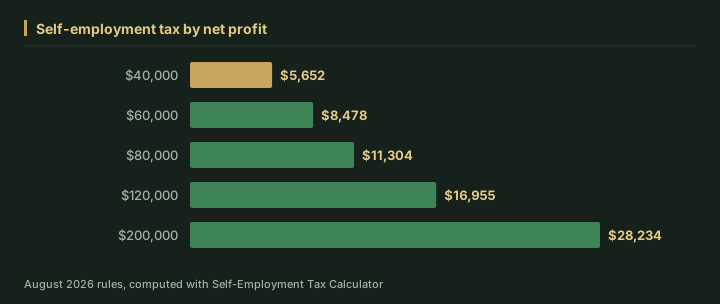
We ran 5 values of net profit through the calculator and left every other input at its default. As of August 2026, the output was:
| Net profit ($) | Self-employment tax ($) | Net self-employment earnings ($) | Social Security taxable ($) |
|---|---|---|---|
| 40,000 | 5,651.82 | 36,940 | 36,940 |
| 60,000 | 8,477.73 | 55,410 | 55,410 |
| 80,000 | 11,303.64 | 73,880 | 73,880 |
| 120,000 | 16,955.46 | 110,820 | 110,820 |
| 200,000 | 28,234.3 | 184,700 | 184,500 |
Running net profit from $40,000 up to $200,000 moves self-employment tax from $5,652 to $28,234 — a spread of $22,582. That gap is the part a single headline rate never shows.
The same runs seen through net self-employment earnings
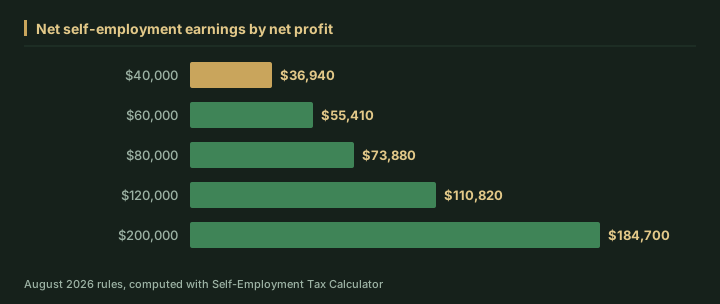
At $40,000, net self-employment earnings works out to $36,940; at $200,000 it is $184,700. Looking only at self-employment tax tends to understate how much the outcome shifts across that range.
Assumptions behind these figures
| Input | Value |
|---|---|
| Net profit | $80,000 |
| Status | Single |
| W-2 wages | $0 |
| Year | 2026 |
| As of | August 2026 |
| Method | identical to /tools/self-employment-tax-calculator |
Brackets, thresholds and rates change from year to year, so treat these as August 2026 figures for the 2026 tax year. For your own situation, open the Self-Employment Tax Calculator and enter your real numbers — the calculator runs the same code that produced every figure on this page.
Frequently Asked Questions
Do 1099 contractors pay more tax than W-2 employees on the same income?
It depends on the contractor's business expenses — a contractor with no business expenses generally pays noticeably more in combined tax than an equivalent W-2 employee because they owe the full 15.3% self-employment tax instead of splitting a 7.65% payroll tax with an employer. However, a contractor with substantial legitimate business expenses can end up paying less overall than the employee, since those expenses reduce both income tax and self-employment tax.
Why does a 1099 contractor pay a different Social Security and Medicare rate than a W-2 employee?
A W-2 employee pays 7.65% of wages toward Social Security and Medicare while the employer pays a matching 7.65%. A 1099 contractor is essentially both employee and employer, so they owe the full 15.3% combined rate as self-employment tax, though it's calculated on a reduced base (92.35% of net profit) and half of it is deductible against income tax.
What tax deductions can a 1099 contractor take that a W-2 employee cannot?
A 1099 contractor can generally deduct legitimate business expenses such as a home office, equipment and software, business mileage, self-employed health insurance premiums, and contributions to retirement accounts like a SEP-IRA or Solo 401(k) — deductions a W-2 employee typically cannot claim for unreimbursed job costs on a federal return. These deductions reduce both income tax and self-employment tax for the contractor.
Does receiving a 1099-NEC automatically make me a contractor for tax purposes?
No, worker classification is generally determined by the actual working relationship — factors like behavioral control, financial control, and the nature of the relationship — not by whether a 1099-NEC is issued. Likewise, not receiving a 1099 doesn't make income tax-free; self-employment income is generally reportable whether or not a payer issues the form.
What non-tax benefits do you give up by becoming a 1099 contractor?
Going from W-2 to 1099 status typically means losing employer-provided health insurance, any 401(k) matching contributions, paid time off and sick leave, unemployment insurance eligibility, workers' compensation coverage, and the employer's share of payroll tax. These benefits have real financial value and should be factored in alongside the tax differences when comparing a contractor rate to an employee salary.
Try the related calculators
Related guides
Retirement Account Tax Benefits: 401(k), IRA, and Roth (2026)
Whether a retirement account saves you tax now or later depends on which type you pick — here is how 401(k)s,...
The Tax Refund Process: How Long Does It Take? (2026)
You filed and the money still has not landed. Here is the realistic 2026 timeline, what the tracker stages act...
How to Fill Out a W-4 Form: 2026 Edition
A practical 2026 walkthrough of the IRS Form W-4 — filing status, the multiple-jobs step people skip, dependen...