How Federal Tax Brackets Work in 2026
Table of contents
- Where the myth comes from
- Bands, not buckets
- The 2026 schedule, all four statuses
- The deduction shields the bottom first
- Example 1: a $75,000 single filer, traced
- Example 2: the raise, demolished
- Example 3: same income, three statuses
- Example 4: a high earner across several bands
- The withholding trap that keeps the myth alive
- A second look: what a raise is really worth
- Reading the table without tripping the same wire
- Why the numbers move every year
- Edge cases the brackets do not cover
- Doing the bracket math yourself
- Common questions
- Will earning more ever leave me with less after taxes?
- What is the difference between my bracket and my tax rate?
- Do brackets apply to gross or taxable income?
- Why is married filing separately sometimes worse?
- Are the 2026 brackets confirmed?
- Run the numbers
- How the result moves with income
- The same runs seen through after-tax income
- Where the total comes from
- Assumptions behind these figures
"I'd get a raise but it'll bump me into the next bracket and I'll take home less." You have heard it. Maybe you have said it. It is wrong — not approximately wrong, not wrong-in-edge-cases, just flatly false for the federal income tax brackets. There is no income at which earning one more dollar leaves you with less money after federal income tax. None. The belief survives because the tax tables are written in a way that sounds like the whole-income-jumps-rate story, and because nobody walks through the actual math. So let's walk through it.
This guide is the brackets-only companion to the complete guide to U.S. federal income tax (2026). It shows the 2026 schedule, the band-by-band arithmetic, and four worked cases — including the raise, demolished with arithmetic rather than assertion.
Where the myth comes from
Two things feed it. First, the language. "You're in the 22% bracket" sounds like a label slapped on your entire income, the way a tax rate works in countries with flat taxes. It is not. Second, paychecks. A bonus or a raise often gets withheld at a flat supplemental rate, so the next paycheck can shrink more than the raise seems to justify. People see that one check, conclude the raise backfired, and tell everyone. The year-end tax follows the gentle math below; the scary paycheck was a withholding artifact, fixable with the W-4 Calculator and explained in how to fill out the W-4 form in 2026.
Bands, not buckets
The mechanism is a marginal, progressive schedule. Taxable income is cut into bands. Each band has a rate. The rate on a band applies only to the income that lands inside that band — not to the income beneath it.
The picture I use with clients: a stack of buckets with holes in the bottom of each. Money pours into the lowest bucket first and is taxed at 10%. Fill it, and the overflow drops into the 12% bucket, then the 22% bucket, and so on. The rate written on a bucket only ever touches the water in that bucket. Crossing into a higher bucket does nothing to the water already sitting in the lower ones.
Your marginal rate is the rate on the highest bucket you reached — the rate on your next dollar. Your effective rate is total tax divided by income, always lower, and covered in depth in marginal vs effective tax rate explained.
The 2026 schedule, all four statuses
Brackets apply to taxable income — income after the standard or itemized deduction, not gross salary. Projected 2026:
Single
| Rate | Taxable income band | Band width |
|---|---|---|
| 10% | $0 – $12,400 | $12,400 |
| 12% | $12,400 – $50,400 | $38,000 |
| 22% | $50,400 – $105,700 | $55,300 |
| 24% | $105,700 – $201,775 | $96,075 |
| 32% | $201,775 – $256,225 | $54,450 |
| 35% | $256,225 – $640,600 | $384,375 |
| 37% | $640,600+ | — |
Married filing jointly
| Rate | Taxable income |
|---|---|
| 10% | $0 – $24,800 |
| 12% | $24,800 – $100,800 |
| 22% | $100,800 – $211,400 |
| 24% | $211,400 – $403,550 |
| 32% | $403,550 – $512,450 |
| 35% | $512,450 – $768,700 |
| 37% | $768,700+ |
Head of household
| Rate | Taxable income |
|---|---|
| 10% | $0 – $17,700 |
| 12% | $17,700 – $67,450 |
| 22% | $67,450 – $105,700 |
| 24% | $105,700 – $201,775 |
| 32% | $201,775 – $256,200 |
| 35% | $256,200 – $640,600 |
| 37% | $640,600+ |
Married filing separately mirrors Single through the 35% band; its 37% rate starts at $384,350, not $640,600.
Look at how lopsided the single-filer widths are: the 12% band is $38,000 wide, the 32% band only about $54,450. Uneven widths are why the effective rate crawls upward through the middle of the income range and then accelerates near the top.
The deduction shields the bottom first
Nothing reaches a bracket until you subtract your deduction. Projected 2026 standard deduction:
| Filing status | Standard deduction |
|---|---|
| Single | $16,100 |
| Married filing jointly | $32,200 |
| Married filing separately | $16,100 |
| Head of household | $24,150 |
A single filer's first $16,100 is effectively taxed at 0% — it never reaches a band. Stack the 10% band on top and a meaningful chunk of an ordinary paycheck is taxed very lightly. Whether to take the standard deduction or itemize is its own decision, in standard vs itemized deductions.
Example 1: a $75,000 single filer, traced
- Gross income: $75,000
- Standard deduction: −$16,100
- Taxable income: $58,900
Fill the bands:
| Band | Income in this band | Rate | Tax |
|---|---|---|---|
| 10% | $0 – $12,400 → $12,400 | 10% | $1,240 |
| 12% | $12,400 – $50,400 → $38,000 | 12% | $4,560 |
| 22% | $50,400 – $58,900 → $8,500 | 22% | $1,870 |
| Total | $7,670 |
Marginal rate: 22%. Effective rate: about 13.0% of taxable income, roughly 10.2% of the $75,000 gross. This person is "in the 22% bracket" and hands over about a tenth of gross pay in federal income tax. That gap is the whole point of progressivity — and the setup for the next example.
Example 2: the raise, demolished
Same filer, $5,000 raise. Gross goes to $80,000, taxable income to $63,900. The fear: the raise "bumps them to 22%" and costs money. Check it.
The first $58,900 of taxable income is taxed exactly as before — not one band changes. Only the new $5,000 is taxed at the 22% marginal rate:
| Before raise | After raise | |
|---|---|---|
| Taxable income | $58,900 | $63,900 |
| Federal income tax | $7,670 | $8,770 |
| Extra tax from the raise | — | $1,100 |
| Extra take-home from the raise | — | $3,900 |
The $5,000 raise produced $1,100 of tax (22% of $5,000) and $3,900 of additional money in hand. There is no threshold anywhere in the table where the next dollar makes you poorer. Crossing into a higher band changes the rate on dollars above the line and leaves every dollar below it untouched.
The only thing extra income can genuinely shrink is an income-tested benefit — a credit or subsidy phasing out — which is a separate mechanic, not a bracket effect, and it tapers gradually rather than clawing back tax you already paid. That distinction is drawn out in tax credits vs tax deductions.
Example 3: same income, three statuses
Status changes both the deduction and the thresholds. Take $90,000 gross:
| Single | Head of household | MFJ (one earner) | |
|---|---|---|---|
| Standard deduction | $16,100 | $24,150 | $32,200 |
| Taxable income | $73,900 | $65,850 | $57,800 |
| 10% band tax | $1,240 | $1,770 | $2,480 |
| 12% band tax | $4,560 | $5,769 | $3,960 |
| 22% band tax | $5,170 | $0 | $0 |
| Total tax | $10,970 | $7,539 | $6,440 |
Same gross, three bills. The single filer pays most: smallest deduction, narrowest bands. Head of household gains a bigger deduction and a wider 12% band. The one-earner married couple wins outright here. This is the cost of filing under the wrong status, in dollars. Test yours with the tax bracket calculator.
Example 4: a high earner across several bands
Single filer, $300,000 gross, standard deduction, taxable income $283,900 — into the 35% band:
| Band | Income taxed | Rate | Tax |
|---|---|---|---|
| 10% | $12,400 | 10% | $1,240.00 |
| 12% | $38,000 | 12% | $4,560.00 |
| 22% | $55,300 | 22% | $12,166.00 |
| 24% | $96,075 | 24% | $23,058.00 |
| 32% | $54,450 | 32% | $17,424.00 |
| 35% | $27,675 | 35% | $9,686.25 |
| Total | $68,134.25 |
Marginal rate 35%, effective rate on gross about 22.7%. Even up here the lower bands keep the average far under the top rate. Check the full pipeline instantly with the Federal Income Tax Calculator.
The withholding trap that keeps the myth alive
It is worth dwelling on why otherwise numerate people keep believing the raise myth, because the answer is not stupidity — it is that their paycheck genuinely lied to them for one cycle.
When an employer pays a bonus or a mid-year raise, payroll software often withholds the extra at a flat supplemental rate that can be noticeably higher than the worker's real marginal rate. So the bonus check looks gutted. The worker does the only experiment available — compares the check to what they expected — concludes the higher bracket ate it, and the myth gets one more eyewitness.
Here is the resolution. Withholding is a prepayment estimate, not the tax. At filing, the year's actual tax is computed with the band math above, and any over-withholding on that bonus comes back as a larger refund (or a smaller balance due). The bonus was never taxed at a punitive rate; it was withheld aggressively and reconciled later. The lesson is not "avoid bonuses" — it is "if a bonus is over-withheld, fix the W-4," covered in how to fill out the W-4 form in 2026 and the W-4 Calculator.
A second look: what a raise is really worth
Run the $185,000-equivalent thought differently. Suppose a single filer at $58,900 taxable income is weighing whether a promotion that adds $20,000 of gross pay is "worth the stress." Critics frame it as bracket risk. The math frames it as a flat fact:
| Before | After +$20,000 | |
|---|---|---|
| Taxable income | $58,900 | $78,900 |
| Tax | $7,670 | $12,070 |
| Extra tax on the $20,000 | — | $4,400 |
| Extra take-home | — | $15,600 |
The entire $20,000 sits in the 22% band (it does not even reach the 24% threshold of $105,700), so the tax on it is a clean 22% = $4,400, and $15,600 lands in the worker's pocket. Nothing about the original $7,670 changed. A bigger raise that did cross into 24% would simply tax the portion above $105,700 at 24% and everything below it exactly as before — still strictly more money. The bracket structure cannot produce a losing raise; it is arithmetically impossible.
Reading the table without tripping the same wire
The single most common misread is taking "22% — $50,400–$105,700" to mean "if my taxable income lands in this range I pay 22% on all of it." It means the opposite: only the portion of taxable income between $50,400 and $105,700 is taxed at 22%; everything below $50,400 stays at the lower rates.
Walk a single filer with exactly $50,401 of taxable income. Exactly one dollar sits in the 22% band. Tax = $1,240 (10%) + $4,560 (12%) + $0.22 (22% on that single dollar) ≈ $5,800.22. A filer at $50,400 owes $5,800.00. The threshold added 22 cents on one extra dollar — a slope, not a cliff. There is no point in the table where one more dollar jumps the tax on dollars you already earned.
Why the numbers move every year
The thresholds are not carved in stone — they are inflation-indexed annually. Without indexing, ordinary cost-of-living raises would slowly drag people into higher bands even with flat real purchasing power, a problem called bracket creep. Under current law the IRS recomputes every threshold and the standard deduction each year and publishes them in a Revenue Procedure late in the prior year. The rate structure (10/12/22/24/32/35/37) is statutory and stable; the dollar boundaries drift up. Practical consequence: if your pay rises only with inflation, your effective rate stays roughly flat, because the brackets rose alongside it. Your effective rate climbs only when your real income outpaces inflation. The tax bracket calculator stays current so you do not track the adjustments by hand.
Edge cases the brackets do not cover
Mixing these parallel taxes into the bracket math is where big estimating errors come from:
- Long-term capital gains and qualified dividends ride a separate 0/15/20 schedule. They stack "on top" of ordinary income to decide which capital-gains rate applies but are not taxed at the bracket rates — see capital gains tax: short-term vs long-term.
- Self-employment tax is a flat 15.3% on net earnings, entirely separate; a freelancer pays it and income tax. See self-employment tax explained for 2026.
- FICA payroll tax on wages is also separate from and additional to the income brackets.
- State income tax has its own brackets (or none) and never changes your federal bands — see the state income tax guide for all 50 states.
When someone is shocked by their total tax, the culprit is almost always one of these parallel taxes, not the federal brackets misbehaving. The brackets themselves are entirely predictable once you accept the band-by-band rule.
Doing the bracket math yourself
- Taxable income = gross income − adjustments − standard or itemized deduction.
- Pull your status's table above.
- For each band, multiply the rate by the slice of taxable income inside that band.
- Sum the bands — that is tax before credits.
- Marginal rate = the highest band you reached; effective rate = total tax ÷ income.
Tedious but trivial. The Federal Income Tax Calculator and Tax Bracket Calculator both do it band by band so you can sanity-check by hand.
Common questions
Will earning more ever leave me with less after taxes?
Not from the federal income brackets. A higher rate only touches dollars above the threshold; every dollar earned raises after-tax income. Separate income-tested benefits can phase out, but that is not a bracket effect.
What is the difference between my bracket and my tax rate?
"Bracket" usually means your top marginal rate — the rate on your last dollar. Your actual tax rate (effective) is the average across all income and is always lower. See marginal vs effective tax rate explained.
Do brackets apply to gross or taxable income?
Taxable income — gross minus adjustments minus the standard or itemized deduction. Your gross salary never runs through the brackets directly.
Why is married filing separately sometimes worse?
Its thresholds are roughly half the joint amounts and compress fast, and it disqualifies several credits. Most couples pay less filing jointly, with specific exceptions.
Are the 2026 brackets confirmed?
They are projected figures based on the permanent rate structure and annual inflation indexing, reconciled to official IRS numbers at year-end. Treat them as estimates.
If you want to go deeper on the official mechanics, the band-by-band method here follows the IRS Form 1040 Tax Computation Worksheet, the thresholds and standard deduction track the annual IRS Revenue Procedure for inflation-adjusted items applied to the permanent statutory rates, and the capital-gains note follows the IRS qualified dividends and capital gain worksheet; state specifics come from the individual state Departments of Revenue. Every 2026 figure here is a projection reconciled to the official IRS release at year-end, so use it to plan and estimate rather than as a substitute for a filed return — and for a decision that hinges on the exact numbers, have a CPA or Enrolled Agent look at your full situation, because a general guide cannot.
Run the numbers
Everything below came out of this site's own Federal Income Tax Calculator. The figures are not quoted from anywhere else: each row is one run of the same calculation the tool page performs, using August 2026 rules. Put the same inputs in and you will get the same output.
How the result moves with income
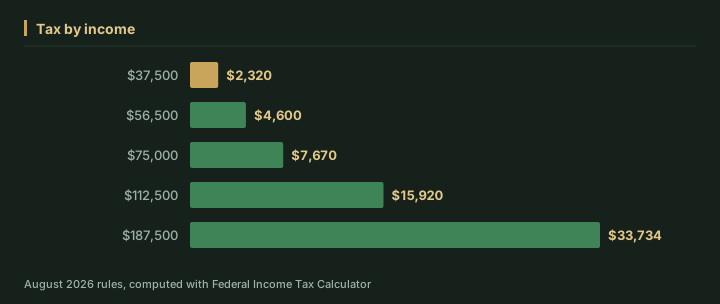
We ran 5 values of income through the calculator and left every other input at its default. As of August 2026, the output was:
| Income ($) | Tax ($) | After-tax income ($) | Taxable income ($) |
|---|---|---|---|
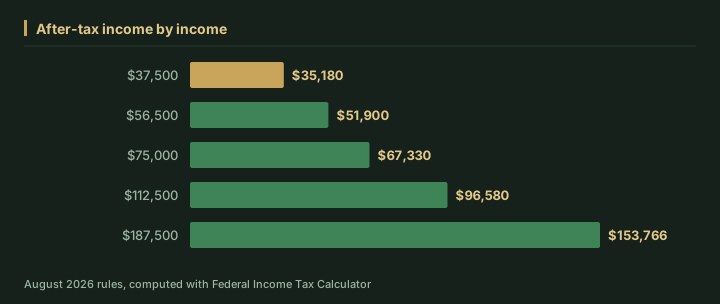
| 37,500 | 2,320 | 35,180 | 21,400 |
| 56,500 | 4,600 | 51,900 | 40,400 |
| 75,000 | 7,670 | 67,330 | 58,900 |
| 112,500 | 15,920 | 96,580 | 96,400 |
| 187,500 | 33,734 | 153,766 | 171,400 |
Running income from $37,500 up to $187,500 moves tax from $2,320 to $33,734 — a spread of $31,414. That gap is the part a single headline rate never shows.
The same runs seen through after-tax income
At $37,500, after-tax income works out to $35,180; at $187,500 it is $153,766. Looking only at tax tends to understate how much the outcome shifts across that range.
Where the total comes from
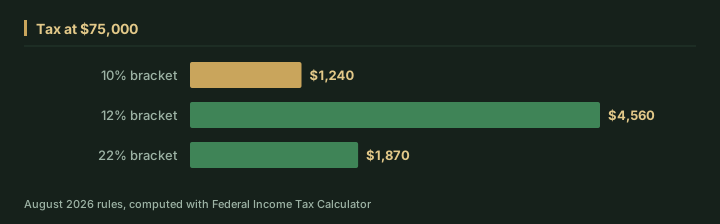
Holding income at $75,000, we ran the same calculation again and kept the breakdown it returns. The total is not one rate applied once — for the 2026 tax year it is built from 3 parts:
| Part | Tax |
|---|---|
| 10% bracket | $1,240 |
| 12% bracket | $4,560 |
| 22% bracket | $1,870 |
Assumptions behind these figures
| Input | Value |
|---|---|
| Income | $75,000 |
| Status | Single |
| Deduction type | Standard |
| Itemized | $0 |
| Year | 2026 |
| As of | August 2026 |
| Method | identical to /tools/federal-income-tax-calculator |
Brackets, thresholds and rates change from year to year, so treat these as August 2026 figures for the 2026 tax year. For your own situation, open the Federal Income Tax Calculator and enter your real numbers — the calculator runs the same code that produced every figure on this page.
Frequently Asked Questions
Can earning more money from a raise ever leave me with less take-home pay?
No — under the federal progressive tax bracket system, there is generally no income level at which earning one additional dollar results in less money in your pocket after tax, because only the income within a higher bracket is taxed at that bracket's rate, not your entire income. This is a common misconception, but a raise or bonus that pushes you into a new bracket only means that specific new bracket's rate applies to the income above the threshold.
Why does my paycheck sometimes shrink more than expected after a raise?
This is typically a withholding artifact rather than a real tax increase — bonuses and raises are sometimes withheld at a flat supplemental rate on that specific paycheck, which can make that check look smaller than expected even though your actual year-end tax liability follows the normal, gentler bracket math. Adjusting your W-4 can help align withholding more closely with your actual tax.
How do tax brackets apply to my income exactly?
Tax brackets work like a series of buckets — your taxable income fills the lowest bracket first, is taxed at that bracket's rate, and only the amount that spills over into the next bracket is taxed at the next, higher rate, continuing up through however many brackets your income reaches. Your marginal rate is the rate on the highest bucket you reach, but it never applies to money sitting in the lower buckets.
Try the related calculators
Related guides
Retirement Account Tax Benefits: 401(k), IRA, and Roth (2026)
Whether a retirement account saves you tax now or later depends on which type you pick — here is how 401(k)s,...
The Tax Refund Process: How Long Does It Take? (2026)
You filed and the money still has not landed. Here is the realistic 2026 timeline, what the tracker stages act...
How to Fill Out a W-4 Form: 2026 Edition
A practical 2026 walkthrough of the IRS Form W-4 — filing status, the multiple-jobs step people skip, dependen...