Self-Employment Tax Explained: Complete 2026 Guide
Table of contents
- The tax W-2 workers never feel
- Splitting the 15.3% into its two real parts
- Why the IRS only counts 92.35% of your profit
- Where the 2026 cap actually changes the answer
- A high-earner walk-through
- The half that comes back
- Who's actually on the hook — and who isn't
- Maya's $80,000, worked all the way down
- Where people trip up
- Run the numbers
- How the result moves with net profit
- The same runs seen through net self-employment earnings
- Assumptions behind these figures
Maya quit her marketing job in March 2026 and went out on her own. By December she'd billed clients $80,000 and spent almost nothing to do it — a laptop she already owned, a $600 software stack. She set aside money for taxes the way her old paychecks taught her to: roughly what the federal brackets implied on $80,000, minus the standard deduction. She thought she was being responsible. When she ran the real numbers in February, she was short by more than eleven thousand dollars.
The gap was self-employment tax — a levy her W-2 paychecks had been quietly handling for years without her ever seeing it. This is the single most common reason first-year freelancers get hurt at filing, and it has almost nothing to do with the income-tax brackets everyone obsesses over. So let's take it apart: what the tax is, why the IRS only counts 92.35% of your profit, where the 2026 cap bites, the deduction that gives part of it back, and Maya's $80,000 worked all the way through.
The tax W-2 workers never feel
Look at an old pay stub from a salaried job. There's a line for Social Security and a line for Medicare — together about 7.65% of gross. What the stub does not show is the matching 7.65% the employer paid on the same wages. Two halves, 15.3% total, both funding the same Social Security and Medicare accounts. The employee only ever feels one half.
Self-employment removes the employer. You are simultaneously the company and the only worker, so both halves are yours. That is self-employment tax: 15.3%, and it sits on top of federal income tax rather than instead of it. Maya didn't budget wrong on income tax. She budgeted as if the second tax — the one her employer used to absorb — didn't exist.
That stacking is the whole story. A $25,000 side gig doesn't get taxed at "your bracket." It gets taxed at your bracket plus roughly 14% of SE tax layered underneath. People who only model the brackets consistently under-save, and the shortfall scales with how profitable the venture is.
Splitting the 15.3% into its two real parts
Calling it "the 15.3%" hides that it's two separate taxes with very different behavior — one capped, one not.
| Component | Rate | What it applies to in 2026 |
|---|---|---|
| Social Security (OASDI) | 12.4% | Net SE earnings up to the $184,500 wage base |
| Medicare (Hospital Insurance) | 2.9% | Every dollar of net SE earnings — no ceiling |
| Combined below the cap | 15.3% | Earnings up to $184,500 |
| Additional Medicare | 0.9% | Earnings above $200,000 single / $250,000 MFJ |
The Social Security slice is the heavy one, and it's the only part that ever stops. Medicare never does. A surgeon clearing $600,000 of consulting profit has long since exhausted the 12.4% but is still paying 2.9% on every dollar, plus the extra 0.9% above the high-income line. Most freelancers, though, live entirely below the cap, where the flat 15.3% is the number that matters.
Why the IRS only counts 92.35% of your profit
Here is the rule that generates more confused emails than anything else in this area: you do not pay 15.3% on your full net profit. You pay it on 92.35% of it.
The reasoning is fairer than it looks. A real employer gets to deduct its half of payroll tax as a business expense. A self-employed person is, functionally, their own employer — so the code lets you shave the earnings base by 7.65% before applying the rate, roughly mirroring that employer deduction. The factor 0.9235 is nothing more exotic than 1 − 0.0765.
Put plainly: the adjustment stops you from paying the employer-side tax on dollars that, for an actual employer, would never have been taxed in the first place. It isn't a loophole and it isn't a favor. It's the mechanism that keeps a solo operator's burden roughly level with a W-2 worker-plus-employer pair on comparable money. The working formula, below the cap, is short:
Net profit × 0.9235 × 15.3% = self-employment tax
Rather than rebuild that by hand every quarter, the self-employment tax calculator runs it (and the cap logic) instantly.
Where the 2026 cap actually changes the answer
The 12.4% Social Security portion only reaches earnings up to the 2026 wage base of $184,500. Cross that line — counting W-2 wages and adjusted SE earnings together — and the 12.4% switches off. The 2.9% Medicare keeps going with no top.
This matters most in a scenario people rarely anticipate: holding a W-2 job and a side business at the same time. Say your day job pays $190,000 in wages. Social Security tax has already been collected up to the cap through payroll. Your freelance profit on top of that generally owes only the 2.9% Medicare piece — not the full 15.3% — because the Social Security base is already spent. (Schedule SE has a dedicated worksheet that coordinates the wage and SE sides so you don't double-count the cap; it's one of the few worksheets genuinely worth reading line by line.) Get this wrong in the optimistic direction and you overpay; get it wrong the other way and you owe.
The coordination runs in a specific order, and the order is what people miss. Social Security tax fills from W-2 wages first, then self-employment earnings get whatever cap room is left. A few cases to make that concrete:
| 2026 W-2 wages | Adjusted SE earnings | SS room left for SE | SE earnings owing 12.4% | SE earnings owing only 2.9% |
|---|---|---|---|---|
| $0 | $90,000 | $184,500 | $90,000 | $0 |
| $120,000 | $90,000 | $64,500 | $64,500 | $25,500 |
| $184,500 | $90,000 | $0 | $0 | $90,000 |
| $230,000 | $90,000 | $0 | $0 | $90,000 |
In the middle row the freelancer pays the full 15.3% on the first $64,500 of adjusted SE earnings and only the 2.9% Medicare slice on the remaining $25,500 — a meaningful saving over assuming 15.3% on everything, and exactly the calculation a lot of side-hustlers never run. Worth noting the cap is indexed every year, so $184,500 is a 2026 figure, not a permanent one; the structure stays, the number moves.
A high-earner walk-through
To see the cap and the Additional Medicare tax actually engage, take a single consultant with $240,000 of net Schedule C profit and no W-2 wages, tax year 2026.
Step 1 — the 92.35% rule. $240,000 × 0.9235 = $221,640 of adjusted SE earnings.
Step 2 — Social Security portion, capped. Only the first $184,500 is hit with 12.4%. $184,500 × 12.4% = $22,878.00.
Step 3 — Medicare portion, uncapped. All $221,640 is hit with 2.9%. $221,640 × 2.9% = $6,427.56.
Step 4 — Additional Medicare tax. The 0.9% surtax applies to earnings over $200,000 for a single filer. Here it runs on the adjusted SE earnings above that line: ($221,640 − $200,000) × 0.9% = $21,640 × 0.9% = $194.76. (This piece is reported separately on Form 8959, not on Schedule SE, and it gets no one-half deduction — a detail that surprises high earners.)
Step 5 — total. $22,878.00 + $6,427.56 + $194.76 = $29,500.32 of combined self-employment and additional Medicare tax. Compare that to a naive 15.3% on the full $221,640, which would be $33,910.92 — the cap saved this consultant roughly $4,400, while the surtax added back about $195. The one-half deduction here applies to the regular SE tax only ($22,878 + $6,427.56 = $29,305.56 ÷ 2 = $14,652.78 above the line); the $194.76 surtax is excluded from it.
The half that comes back
The code claws part of the bite back. You deduct one-half of your self-employment tax as an above-the-line adjustment. "Above the line" is the part that matters: it lowers adjusted gross income directly, so you get it whether you itemize or take the standard deduction — there's no hoop.
It's the employer-deduction logic showing up a second time. An employer deducts its half of FICA; the solo operator deducts the equivalent half of SE tax. One caution that trips people up constantly: this does not shrink the SE tax itself. The 15.3% figure is whatever it is. The deduction only reduces the income tax stacked on top of it. Two different taxes, one partial offset, and it only flows one direction.
Who's actually on the hook — and who isn't
The trigger is low. You generally owe SE tax once net self-employment earnings hit $400 for the year. Profit after expenses, not gross revenue — but $400 is barely a threshold at all. It catches:
- Freelancers, consultants, independent contractors (usually a 1099-NEC in the mail)
- Single-member LLC owners — the LLC is disregarded, profit lands on Schedule C
- Sole proprietors and gig drivers
- A general partner's distributive share of partnership income
- Side-hustle profit even when a full-time W-2 job exists alongside it
What generally escapes it: W-2 wages (FICA already taken there), most rental real estate (unless you're a dealer or provide substantial services), portfolio income like interest, dividends, and most capital gains, and a genuinely passive limited-partner share (with exceptions — there are always exceptions here).
The S corporation is the one structure that rewrites this. An S-corp owner pays FICA only on a reasonable salary they pay themselves; the remaining profit distributed out is not hit with SE tax. That's a real lever once profit is large enough to justify the payroll and compliance overhead, and it's covered with its trade-offs in how to reduce taxable income legally and the entity discussion in 1099 vs W-2 tax implications.
A handful of narrower triggers and exemptions are worth knowing because they catch people off guard:
- Statutory employees (certain commission drivers, full-time life-insurance agents, some home workers) get a W-2 with box 13 checked and report on Schedule C without SE tax — FICA was already handled on the wage side.
- Notary public fees are specifically exempt from SE tax, though they still count as income tax. A part-time notary who also freelances has to split the income, which is fiddly but real.
- Clergy face the opposite surprise: ministers are generally treated as self-employed for SE-tax purposes on ministerial earnings even when they receive a W-2, and a parsonage allowance excluded from income tax is still inside the SE-tax base.
- Newspaper carriers under 18 delivering to consumers are exempt.
- The $400 floor is per-person, not per-business. Run three small ventures at $200 profit each and the $600 total clears the threshold — you don't get a fresh $400 exemption per Schedule C.
None of these are common, but each one produces a confidently wrong return when someone assumes the general rule covers them.
Maya's $80,000, worked all the way down
Back to the freelancer from the opening. Single filer, $80,000 of net Schedule C profit, tax year 2026, every number shown.
Step 1 — Apply the 92.35% rule. $80,000 × 0.9235 = $73,880 subject to SE tax.
Step 2 — Apply 15.3%. $73,880 is far below the $184,500 cap, so the full rate runs. $73,880 × 15.3% = $11,303.64 self-employment tax.
Step 3 — Take the one-half deduction. $11,303.64 ÷ 2 = $5,651.82 off the top, above the line.
Step 4 — Income tax on the reduced base. $80,000 profit − $5,651.82 SE-tax deduction = AGI $74,348.18. Subtract the 2026 single standard deduction of $16,100 → taxable income ≈ $58,248.
| 2026 single bracket | Rate | Tax on this slice |
|---|---|---|
| $0 – $12,400 | 10% | $1,240.00 |
| $12,400 – $50,400 | 12% | $4,560.00 |
| $50,400 – $58,248 | 22% | $1,726.56 |
| Income tax | ≈ $7,526.56 |
Step 5 — Add the two taxes. SE tax $11,303.64 + income tax $7,526.56 ≈ $18,830 total federal on $80,000 of profit. Effective federal rate near 23.5%, before a dime of state tax.
Notice which number is bigger. The SE tax ($11,303.64) exceeds the income tax ($7,526.56) at this profit level. That's the entire reason Maya was short eleven thousand dollars — she'd planned for the smaller of the two taxes and ignored the larger one. Stack both pieces yourself with the federal income tax calculator beside the SE tool before you decide how much to set aside.
Where people trip up
The arithmetic above is the easy part. The expensive mistakes are almost always conceptual, and they cluster in a handful of predictable places.
Treating SE tax as part of the brackets. It isn't a higher bracket or an add-on rate — it's a structurally separate tax that ignores your standard deduction entirely. The standard deduction reduces income tax. It does nothing to the $11,303.64. People who mentally fold the two together always under-reserve.
Assuming the $400 floor means small gigs are exempt. It's the opposite of an exemption. $400 of profit is a doormat, not a wall. A weekend reselling habit or a few freelance invoices clears it without trying. The income may be modest; the obligation is still real.
Expecting the one-half deduction to shrink the SE tax. It never touches it. In Maya's case the deduction was $5,651.82 against income, while the SE tax stayed exactly $11,303.64. The deduction softens the second tax, not the first — a distinction worth re-reading because it reverses how most people instinctively expect it to work.
Forgetting the cap interaction when there's also a W-2. The most common version: a high W-2 salary already maxed Social Security through payroll, so the side-business profit should only owe the 2.9% Medicare piece — but the freelancer pays the full 15.3% out of habit and overpays for years without noticing. The mirror error (a moderate W-2, assuming the cap is "used up" when it isn't) goes the other way and produces a surprise bill.
Ignoring that every business deduction works twice. Because SE tax sits on net profit, a legitimate expense cuts the SE tax and the income tax — a genuine double benefit you rarely get anywhere else in the code. Home-office, business mileage, the self-employed health insurance deduction, and a SEP-IRA or Solo 401(k) all pull both levers at once; the contribution side is laid out in retirement account tax benefits. The part that surprises people most is the asymmetry: a deductible business expense lowers the SE base, but the self-employed health insurance deduction and retirement contributions, while they cut income tax, generally do not reduce the SE-tax base — they come off after net profit is set. Two expenses of the same dollar size can therefore have very different total tax value depending on where they sit in the stack. We'd usually tell a freelancer to chase the ordinary-and-necessary business deductions first, precisely because those are the ones that hit both taxes.
Confusing gross receipts with net profit when reserving cash. A freelancer who bills $120,000 but nets $70,000 after real expenses owes SE tax on the $70,000 figure, not the $120,000. Reserving a flat percentage of every invoice is a fine cash-flow habit, but the actual liability tracks profit — so a high-expense business over-reserves and a near-zero-expense business under-reserves if it doesn't true up. The fix is the quarterly check-in, not a prettier set-aside rule.
Paying it all in one April lump. No employer is withholding, so the IRS expects the roughly $18,830 in four installments across the year. Pay it correctly but late and an underpayment charge can still apply. A workable habit for irregular freelance income is parking 25–35% of every payment received in a separate account and truing it up each quarter — the mechanics, deadlines, and safe-harbor rules are in estimated tax payments: when and how to pay, and you can size each installment with the estimated tax payment calculator. For how this slots into the wider federal picture, the complete guide to U.S. federal income tax and how federal tax brackets work connect the pieces.
In practice, the freelancers who never get blindsided aren't the ones with the most sophisticated tax knowledge — they're the ones who internalized early that profit is taxed twice and reserved accordingly. Everything in this guide reflects the long-standing structure of self-employment tax in the Internal Revenue Code as it appears on IRS Schedule SE and Form 1040, with the bracket and standard-deduction dollars from the IRS annual inflation Revenue Procedure and the $184,500 cap from the Social Security Administration's contribution-and-benefit-base announcement — all 2026 projections to be squared against the official IRS and SSA releases at year-end, while the 15.3% rate, the 0.9235 factor, and the one-half deduction are statutory and don't drift year to year. Read it as a working explanation, not as advice for your return: SE tax tangles with entity choice, multi-state issues, and the rest of your income, so before you file or set your estimates, run the specifics past a CPA or an IRS Enrolled Agent who can see your whole picture.
Run the numbers
Everything below came out of this site's own Self-Employment Tax Calculator. The figures are not quoted from anywhere else: each row is one run of the same calculation the tool page performs, using August 2026 rules. Put the same inputs in and you will get the same output.
How the result moves with net profit
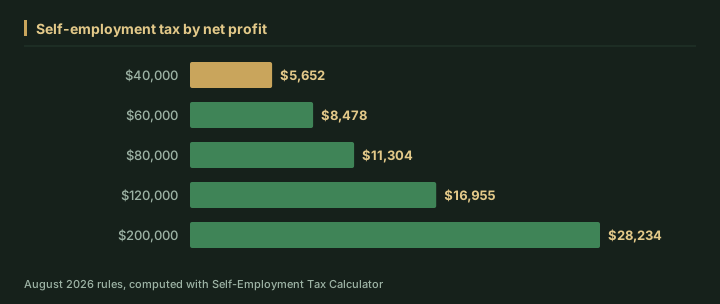
We ran 5 values of net profit through the calculator and left every other input at its default. As of August 2026, the output was:
| Net profit ($) | Self-employment tax ($) | Net self-employment earnings ($) | Social Security taxable ($) |
|---|---|---|---|
| 40,000 | 5,651.82 | 36,940 | 36,940 |
| 60,000 | 8,477.73 | 55,410 | 55,410 |
| 80,000 | 11,303.64 | 73,880 | 73,880 |
| 120,000 | 16,955.46 | 110,820 | 110,820 |
| 200,000 | 28,234.3 | 184,700 | 184,500 |
Running net profit from $40,000 up to $200,000 moves self-employment tax from $5,652 to $28,234 — a spread of $22,582. That gap is the part a single headline rate never shows.
The same runs seen through net self-employment earnings
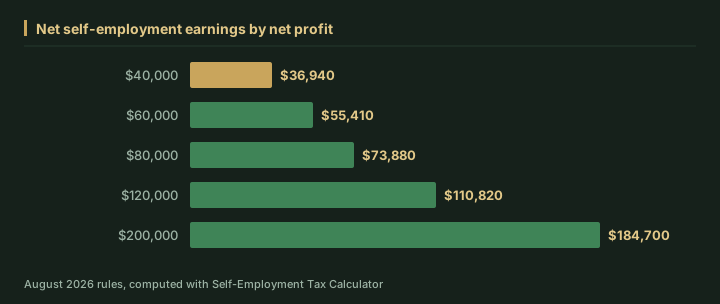
At $40,000, net self-employment earnings works out to $36,940; at $200,000 it is $184,700. Looking only at self-employment tax tends to understate how much the outcome shifts across that range.
Assumptions behind these figures
| Input | Value |
|---|---|
| Net profit | $80,000 |
| Status | Single |
| W-2 wages | $0 |
| Year | 2026 |
| As of | August 2026 |
| Method | identical to /tools/self-employment-tax-calculator |
Brackets, thresholds and rates change from year to year, so treat these as August 2026 figures for the 2026 tax year. For your own situation, open the Self-Employment Tax Calculator and enter your real numbers — the calculator runs the same code that produced every figure on this page.
Frequently Asked Questions
What is self-employment tax and how is it different from income tax?
Self-employment tax is a 15.3% tax covering both the employee and employer shares of Social Security and Medicare, layered on top of federal income tax rather than replacing it. W-2 employees only feel half of this, 7.65%, because their employer pays the matching half, while self-employed individuals must pay the full amount themselves since they are effectively both employer and employee.
Why is self-employment tax calculated on 92.35% of profit instead of the full amount?
This adjustment exists because a traditional employer's share of payroll tax isn't counted as part of an employee's taxable wages, so the 92.35% factor, which is simply 1 minus 7.65%, removes the equivalent slice for a self-employed person to keep their tax burden roughly comparable to a W-2 employee and their employer combined. It's a fairness mechanism built into the calculation, not a special deduction.
Is there a cap on self-employment tax?
Partially — the Social Security portion (12.4%) only applies up to an annual wage base that's indexed for inflation each year, so check the current figure, but the Medicare portion (2.9%) applies to all self-employment earnings with no cap, plus an additional 0.9% Medicare surtax above certain higher income thresholds. This means very high earners pay a lower effective self-employment tax rate than someone entirely below the cap.
Can I deduct any of my self-employment tax?
Yes, one-half of your self-employment tax is generally deductible as an above-the-line deduction against your income tax, though it doesn't reduce the self-employment tax itself — only the income tax computed afterward. This deduction is typically applied automatically when you calculate self-employment tax correctly.
Try the related calculators
Self-Employment Tax Calculator
Work out self-employment tax with the Social Security and Medicare breakdown.
Calculate →Estimated Tax Payment Calculator
Compute quarterly estimated tax payments and their due dates.
Calculate →1099 vs W-2 Comparison Calculator
Compare take-home pay as a 1099 contractor vs a W-2 employee.
Calculate →Related guides
Retirement Account Tax Benefits: 401(k), IRA, and Roth (2026)
Whether a retirement account saves you tax now or later depends on which type you pick — here is how 401(k)s,...
The Tax Refund Process: How Long Does It Take? (2026)
You filed and the money still has not landed. Here is the realistic 2026 timeline, what the tracker stages act...
How to Fill Out a W-4 Form: 2026 Edition
A practical 2026 walkthrough of the IRS Form W-4 — filing status, the multiple-jobs step people skip, dependen...