Estimated Tax Payments: When and How to Pay (2026)
Table of contents
- The four 2026 dates, and the quirk in them
- Safe harbor: being penalty-proof without forecasting
- Sizing each payment two ways
- Who actually gets caught by this
- State estimates run on their own clock
- How the penalty actually accrues
- Paying it
- When income is lumpy: the annualized method
- Adjusting mid-year when life changes
- A short decision path
- Quick answers
- What if I miss a quarterly deadline?
- 90% or the 100%/110% safe harbor — which?
- Do estimates cover income tax and self-employment tax together?
- What exactly is the $1,000 threshold measured against?
- My income is seasonal and mostly arrives in December — now what?
- How we keep this accurate
- Run the numbers
- How the result moves with net profit
- The same runs seen through net self-employment earnings
- Assumptions behind these figures
You must make estimated tax payments if you expect to owe $1,000 or more after withholding and refundable credits, and your withholding won't reach the smaller of 90% of this year's tax or 100% of last year's (110% for higher earners). In plain terms: if income arrives without tax taken out — freelance pay, investment gains, rent, a pension that under-withholds, a big bonus structure — the IRS expects four payments a year, not one reckoning in April.
That's the whole obligation in two sentences. The rest of this guide is the operational detail behind it: the exact 2026 dates, the safe harbors that make you penalty-proof without a crystal ball, two ways to size the checks, what to do when income lands unevenly, and how the penalty is actually computed (it surprises people — it's not a flat fine).
The four 2026 dates, and the quirk in them
Tax year 2026 estimated tax is paid in four installments. The trap is that the "quarters" aren't quarters. The second period is two months long; the fourth runs into the next January.
| Installment | Income period it covers | Due |
|---|---|---|
| 1st | Jan 1 – Mar 31, 2026 | April 15, 2026 |
| 2nd | Apr 1 – May 31, 2026 | June 15, 2026 |
| 3rd | Jun 1 – Aug 31, 2026 | September 15, 2026 |
| 4th | Sep 1 – Dec 31, 2026 | January 15, 2027 |
Weekend or legal holiday on a due date pushes it to the next business day. The January 15, 2027 payment is technically skippable if you file the complete 2026 return and pay the full balance by February 2, 2027 — but that's a tight window most people don't bother chasing, so the practical advice is to just make the January payment.
Safe harbor: being penalty-proof without forecasting
You are not required to predict your final tax to the dollar. The code hands you a safe harbor: hit one of the targets below with withholding plus timely estimates, and no underpayment penalty applies — even if you still write a large check at filing.
| Option | Pay at least | When it's the smart pick |
|---|---|---|
| Current-year | 90% of your 2026 total tax | Income flat or falling versus 2025 |
| Prior-year (standard) | 100% of your 2025 total tax | Most filers — it's a fixed, known number |
| Prior-year (high income) | 110% of your 2025 total tax, if 2025 AGI exceeded $150,000 | Higher earners |
The prior-year route wins on simplicity for one reason worth stating outright: last year's tax is already a settled, unchanging figure. You don't have to model a volatile current year at all. Take 2025 total tax, multiply by 100% (or 110% if 2025 AGI cleared $150,000), divide by four, send that each quarter. Have a breakout 2026 and you still owe zero penalty — you just settle the extra at filing without the interest-style charge for underpayment. We'd usually steer steady earners straight here and not overthink it.
Sizing each payment two ways
There are two honest approaches, and which one fits depends on whether your year is predictable.
Approach A — safe-harbor autopilot. Use the prior-year method. If 2025 total tax was $14,000 and 2025 AGI was under $150,000, you pay $14,000 ÷ 4 = $3,500 each quarter and stop thinking about it. Protected no matter how 2026 lands.
Approach B — project the current year. Estimate 2026 taxable income, run it through the brackets, add self-employment tax, subtract withholding and credits, split the remainder by four. More work, but it stops you overpaying when income is dropping.
Worked example, Approach B, a single consultant projecting $62,000 of net profit in 2026:
- SE tax: $62,000 × 0.9235 = $57,257; × 15.3% = $8,760.32
- One-half SE-tax deduction: $8,760.32 ÷ 2 = $4,380.16 → AGI ≈ $62,000 − $4,380.16 = $57,619.84
- Less the 2026 single standard deduction $16,100 → taxable income ≈ $41,520
- Income tax, 2026 single brackets: $12,400 × 10% = $1,240, plus ($41,520 − $12,400) × 12% = $29,120 × 12% = $3,494.40 → ≈ $4,734.40
- Total 2026 tax ≈ $8,760.32 + $4,734.40 = ≈ $13,495
- Quarterly estimate ≈ $13,495 ÷ 4 ≈ $3,374 per installment
Note how the SE tax ($8,760) again dwarfs the income tax ($4,734) at this level — it's the bigger of the two, and the part people forget. Run the SE and income pieces with the self-employment tax calculator, then split the total into installments with the estimated tax payment calculator. The underlying SE math is in self-employment tax explained.
Who actually gets caught by this
The obligation reads narrow on paper and is wide in practice. The people who owe estimates and don't realize it, in rough order of how often it bites:
- Self-employed people, freelancers, gig workers — no withholding anywhere, the cleanest case.
- Investors with large interest, dividend, or capital-gain income — a brokerage generally doesn't withhold, so a big realized gain in a taxable account is a classic trigger.
- Landlords with net rental income after depreciation.
- Retirees whose pension or IRA withholding is set too low to cover the full bill — easy to miss because it feels like withholding is handling it.
- W-2 employees with a meaningful side income that pushes the after-withholding balance past $1,000.
- Anyone with a one-time event — sold a business, exercised stock options, took a large Roth conversion, settled a lawsuit.
If your only income is a regular W-2 job with adequate withholding, you generally don't file estimates at all — the paycheck system already satisfies pay-as-you-go for you. The trouble starts the moment a chunk of untaxed income enters the picture and the W-4 wasn't adjusted to absorb it. (If that's your situation, raising withholding on the W-4 is often simpler than starting estimates — see how to fill out a W-4 form.)
State estimates run on their own clock
A point that quietly costs people money: this entire guide is federal. If your state has an income tax, it almost certainly has its own estimated-payment regime — frequently with the same April/June/September/January rhythm, but not always, and with its own thresholds and safe-harbor percentages that do not mirror the federal ones. A few states use different period definitions entirely. Paying the IRS perfectly and forgetting the state is one of the most common avoidable penalties we see, particularly for someone who just moved or picked up out-of-state clients. The state-by-state landscape is in the state income tax guide for all 50 states; the federal-state interaction shows up again in the complete guide to U.S. federal income tax.
How the penalty actually accrues
It is not a flat fine. It's computed like interest: a federal short-term rate plus a statutory margin, applied to each quarter's shortfall, for the days it stayed unpaid, until you pay or the return comes due.
Two consequences fall out of that, and they're the ones that cost people money:
- Each quarter stands alone. A fat Q4 payment does not heal a thin Q1 — the Q1 gap has been accruing a charge for roughly nine months by the time you notice. The IRS evaluates every installment separately, so chronic late-in-the-year catch-ups don't work the way people hope.
- Withholding is deemed paid evenly. Tax pulled from a paycheck or pension counts as paid in equal slices across all four periods regardless of when it actually came out. This is a genuinely powerful escape hatch: a married couple can have one spouse spike W-2 withholding in November and retroactively patch a short Q1.
The penalty is also waived in narrow situations — casualty, federally declared disaster, retirement after 62, or disability — where the shortfall was reasonable cause, not willful neglect.
Paying it
Every method below is processed by the IRS:
- IRS Direct Pay — free bank transfer, no enrollment, instant confirmation; the default for most individuals.
- EFTPS — free, requires enrollment, schedules payments ahead and keeps full history; good if you want automation.
- Debit/credit card or digital wallet — third-party processors charge a fee that usually beats out any card rewards.
- IRS online account — pay and watch balances on one dashboard.
- Check or money order with a Form 1040-ES voucher — still accepted; mail early for a clean postmark.
One operational detail people get wrong: always tag the payment to the correct tax year and "estimated tax," or it can land on a prior-year balance and leave the current year short. A misapplied payment is maddening to unwind — the money is technically with the IRS, but credited to the wrong period, so the current year still shows a shortfall accruing a charge while you spend weeks getting it reassigned. Two minutes of care selecting "2026 estimated tax" on the payment screen prevents a genuinely tedious correction later. If you ever do see a notice for a quarter you know you paid, pull the confirmation number first — the fix is almost always a reapplication, not a second payment.
When income is lumpy: the annualized method
The standard setup assumes income flows evenly and asks for four roughly equal checks. That quietly punishes anyone whose income is back-loaded — the consultant who earns almost nothing until a giant Q4 engagement, or someone who realizes a large capital gain in December.
The annualized income installment method is the fix. Instead of one-quarter of the annual tax each period, you compute tax on income actually earned through each cutoff, annualize it, and pay only what that period genuinely requires. Earn little early and Q1–Q2 are small; earn a lot late and the bigger payments correctly fall in Q3–Q4 — with no penalty for the light early quarters.
The price is paperwork. You reconcile it on Form 2210, Schedule AI at filing, and you have to track income by period through the year. For seasonal earners or a one-time windfall it's usually worth the effort. For a steady earner it's needless friction — the flat safe harbor is far easier and just as protective.
A quick illustration of why it matters. Suppose a consultant earns nothing in Q1–Q3 and then closes a single $90,000 project that pays in December. Under the equal-installment expectation, the system wanted roughly a quarter of the year's tax by April 15 — money the consultant simply didn't have, because the income didn't exist yet. The flat method would assess a penalty on those phantom early shortfalls. The annualized method instead says: through March 31 you had earned $0, so $0 was required; the obligation only materializes once the income does, landing the real payment in the January 15, 2027 installment with no penalty for the empty quarters. The cost is keeping a dated income log and filling out Schedule AI — tedious, but for a genuinely back-loaded year it can be the difference between a clean filing and a penalty on income you hadn't yet received.
Adjusting mid-year when life changes
The four checkpoints exist precisely because a year is not knowable in January. Common mid-year resets:
- Income jumps — a new client, a rate increase, a surprise capital gain. Recompute from the next deadline forward; you don't retroactively fix past quarters, you raise the remaining ones (or lean on the withholding trick if you have a W-2 in the mix).
- Income falls — a client lost, a slow stretch. If you were on the prior-year safe harbor you're still protected, but you may now be over-paying; switching focus to the 90% current-year target can free up cash.
- Filing-status change — marriage or divorce mid-year reshapes brackets and the standard deduction enough to make a January estimate stale by summer.
- A spouse starts or stops working — for couples this is the single most under-appreciated trigger, because it changes both the joint bracket math and how much W-2 withholding is covering.
Re-running the numbers before each deadline is not busywork; it's the entire point of having four of them.
A short decision path
- Steady income, zero hassle wanted: prior-year safe harbor (100% / 110%), one-quarter each deadline.
- Income clearly below last year: the 90% current-year method, so you don't overpay.
- Very uneven or back-loaded: consider the annualized method.
- Some W-2 income in the mix: raising withholding late in the year retroactively covers earlier quarters — keep that lever in your pocket.
Re-check before each deadline; mid-year income swings are exactly why the system has four checkpoints instead of one. For how withholding and brackets interact underneath all this, see how federal tax brackets work, the complete guide to U.S. federal income tax, and — if you have a W-2 job alongside — how to fill out a W-4 form.
Quick answers
What if I miss a quarterly deadline?
Pay as soon as you can. The charge accrues daily on the shortfall, so a late payment always beats no payment. You can also bump W-2 withholding — yours or a spouse's — before year-end, since withholding is treated as paid evenly across all four periods and can retroactively cover an earlier miss.
90% or the 100%/110% safe harbor — which?
Whichever is smaller for you. Rising income: the prior-year amount is usually lower and is a fixed, known figure. Falling income: 90% of the smaller current-year tax may be less. You only have to satisfy one of them.
Do estimates cover income tax and self-employment tax together?
Yes — a single combined remittance covering federal income tax, SE tax, and the additional Medicare tax if it applies. There's nothing separate to send.
What exactly is the $1,000 threshold measured against?
Tax expected to be owed after withholding and refundable credits — not total tax. If withholding already leaves only $900 outstanding, you're generally not required to make estimates, though paying anyway removes the surprise.
My income is seasonal and mostly arrives in December — now what?
Use the annualized income installment method. Each period's required payment is based on income actually earned by that point, so a back-loaded year produces small early payments and larger later ones with no penalty for the light quarters.
How we keep this accurate
The thresholds, dates, and safe-harbor structure here track IRS Form 1040-ES and its instructions, the underpayment computation on Form 2210 (with Schedule AI for the annualized method), and the IRS annual inflation Revenue Procedure for bracket and standard-deduction dollars; the self-employment inputs follow IRS Schedule SE and the Social Security Administration wage-base announcement. The 2026 due dates and the $1,000 / 90% / 100% / 110% / $150,000 figures reflect the established framework, while the dollar amounts are 2026 projections we reconcile against the official IRS and SSA releases at year-end. Treat all of it as an educational walkthrough rather than advice for your situation — penalty math and the annualized method get intricate fast, so if your income is uneven or you had a major one-time event, have a CPA or IRS Enrolled Agent confirm the plan before you commit to it.
Run the numbers
Everything below came out of this site's own Self-Employment Tax Calculator. The figures are not quoted from anywhere else: each row is one run of the same calculation the tool page performs, using August 2026 rules. Put the same inputs in and you will get the same output.
How the result moves with net profit
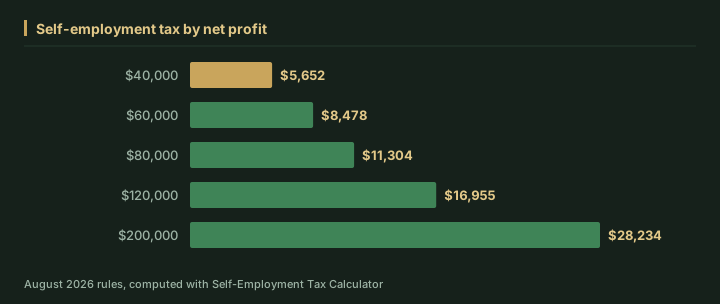
We ran 5 values of net profit through the calculator and left every other input at its default. As of August 2026, the output was:
| Net profit ($) | Self-employment tax ($) | Net self-employment earnings ($) | Social Security taxable ($) |
|---|---|---|---|
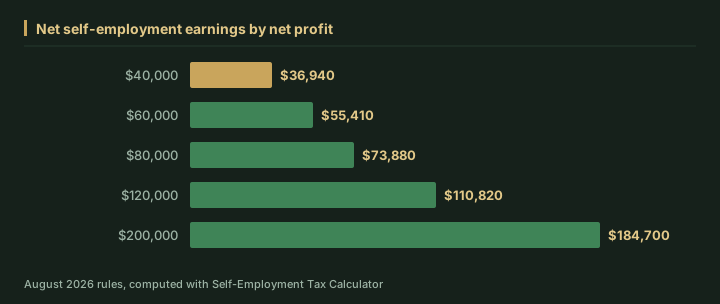
| 40,000 | 5,651.82 | 36,940 | 36,940 |
| 60,000 | 8,477.73 | 55,410 | 55,410 |
| 80,000 | 11,303.64 | 73,880 | 73,880 |
| 120,000 | 16,955.46 | 110,820 | 110,820 |
| 200,000 | 28,234.3 | 184,700 | 184,500 |
Running net profit from $40,000 up to $200,000 moves self-employment tax from $5,652 to $28,234 — a spread of $22,582. That gap is the part a single headline rate never shows.
The same runs seen through net self-employment earnings
At $40,000, net self-employment earnings works out to $36,940; at $200,000 it is $184,700. Looking only at self-employment tax tends to understate how much the outcome shifts across that range.
Assumptions behind these figures
| Input | Value |
|---|---|
| Net profit | $80,000 |
| Status | Single |
| W-2 wages | $0 |
| Year | 2026 |
| As of | August 2026 |
| Method | identical to /tools/self-employment-tax-calculator |
Brackets, thresholds and rates change from year to year, so treat these as August 2026 figures for the 2026 tax year. For your own situation, open the Self-Employment Tax Calculator and enter your real numbers — the calculator runs the same code that produced every figure on this page.
Frequently Asked Questions
Who is required to make estimated tax payments?
Generally, you must make estimated tax payments if you expect to owe $1,000 or more after withholding and refundable credits, and your withholding won't cover the smaller of 90% of this year's tax or 100% (110% for higher earners) of last year's tax. This typically applies to freelancers, self-employed people, investors with large gains, landlords, and retirees whose pension withholding is too low, since none of them have an employer automatically withholding enough tax.
What is the safe harbor rule for estimated taxes?
The safe harbor rule lets you avoid an underpayment penalty by paying at least 100% of your prior year's total tax (or 110% if your prior-year adjusted gross income was above a certain threshold) through withholding and estimated payments, regardless of how the current year turns out. It's popular because it's based on an already-known, fixed number rather than requiring you to accurately forecast a volatile current year.
How do I figure out how much to pay each quarter?
There are two general approaches: use the safe harbor method by taking last year's total tax, applying the 100%/110% rule, and dividing by four, or project your current year's income and tax more precisely and divide that total by four. The safe-harbor approach is simpler and penalty-proof, while projecting the current year can avoid overpaying if your income is dropping, though it takes more work.
Are the estimated tax quarters evenly spaced?
No, the four payment periods are not equal three-month quarters — the spacing is uneven, with one gap covering only about two months and the final period stretching into January of the following year. It's worth checking the current IRS due dates each year rather than assuming even three-month spacing.
What happens if I skip a quarterly estimated payment?
Missing or underpaying a quarterly estimated tax installment can result in an underpayment penalty calculated for that specific period, since the IRS generally assesses these payments on a per-period basis rather than only looking at the full year at filing time. Making up a missed payment later in the year does not fully erase the penalty for the period it was due.
Try the related calculators
Related guides
Retirement Account Tax Benefits: 401(k), IRA, and Roth (2026)
Whether a retirement account saves you tax now or later depends on which type you pick — here is how 401(k)s,...
The Tax Refund Process: How Long Does It Take? (2026)
You filed and the money still has not landed. Here is the realistic 2026 timeline, what the tracker stages act...
How to Fill Out a W-4 Form: 2026 Edition
A practical 2026 walkthrough of the IRS Form W-4 — filing status, the multiple-jobs step people skip, dependen...