The Tax Refund Process: How Long Does It Take? (2026)
Table of contents
- The part nobody explains: submitted is not filed
- How long it really takes in 2026
- Why the clock sometimes resets without anything being wrong
- A quick detour: why your refund is the size it is
- Reading the tracker without driving yourself crazy
- The mid-February hold most filers don't see coming
- When the money stalls, it is usually one of these
- If a notice shows up instead of money
- A four-figure refund is not the win it feels like
- Set yourself up for the fastest possible refund
- Frequently asked questions
- When does the 21-day clock actually start?
- My refund has passed 21 days. What now?
- Why is my whole refund frozen when I only claimed one credit?
- Does refreshing the tracker repeatedly do anything?
- Can the IRS keep my refund to cover a debt?
- Is a big refund something to be happy about?
- Sources & methodology
- Run the numbers
- How the result moves with income
- The same runs seen through taxable income
- Assumptions behind these figures
You hit submit on a Tuesday night in early February. The software flashed a green checkmark, your spouse asked when the money would show up, and you said "a couple of weeks, maybe?" — mostly because that sounds right and partly because you have no real idea. Two weeks later the bank balance has not moved, the app still says something vague, and now you are refreshing it at red lights. If that is roughly where you are, the rest of this guide is for you.
I have walked a lot of people through this exact stretch of anxiety, and almost all of it comes from one thing: nobody told them what the IRS is actually doing with the return between "submitted" and "deposited." So let's go through it like a timeline, not a brochure.
The part nobody explains: submitted is not filed
Pressing submit hands your return to your software's transmission system. Your software then sends it to the IRS, and the IRS does something most people never see — it runs a fast validation pass and decides whether to accept or reject the return. This usually happens within a day or two.
A rejected return has not been filed. It bounced. The usual culprits are dull and fixable: a name that does not match Social Security records, a mistyped SSN for a dependent, or a prior-year adjusted gross income that does not line up with what the IRS has on file. You correct it, resend, and the IRS looks again. The frustrating wrinkle is that your refund clock does not care how early you filed — it starts ticking from acceptance, so a return that bounces on February 4 and is accepted on February 7 effectively started on the 7th.
Paper returns have no version of this step. There is no overnight acceptance ping. The return waits in a physical queue to be opened, sorted, and keyed in by a person. That single structural difference is, more than anything else, why "I mailed it" and "I e-filed it" produce such different waits.
Once a return is accepted, it moves into processing. Here the IRS matches your reported income against the W-2s and 1099s your employers and payers already sent in, rechecks the arithmetic, validates any credits, and confirms you are who you say you are. Clear that, and the refund amount is approved. Then the money is either released to your bank or printed onto a check and mailed.
How long it really takes in 2026
The headline number is that most e-filed returns with direct deposit are refunded in about 21 days from acceptance. Treat that the way you treat a quoted commute time. Plenty of trips land near it. Some are quicker. A handful blow well past it because of one specific snarl, and the average tells you nothing about which trip you are on.
| How you filed | How the refund comes back | Realistic wait |
|---|---|---|
| E-file, direct deposit | Deposited to your account | Around 21 days from acceptance, often less |
| E-file, paper check | Mailed check | ~21 days to process, then mail transit |
| Paper return, direct deposit | Deposited to your account | Roughly 6–8+ weeks |
| Paper return, paper check | Mailed check | Roughly 6–8+ weeks, plus mail transit |
| Amended return (1040-X) | Either method | 16 weeks or more |
Read that table from the top down and the pattern is hard to miss: every manual or physical step you add lengthens the wait, and the slowest combination is paper in, paper out. There is one more variable the table cannot show — when in the season you file. Processing queues swell as April approaches, so an identical return filed in early February generally clears faster than the same return filed in late March.
Here is a concrete pair to make it real. File electronically on February 2, 2026, get accepted February 3, choose direct deposit, hit no snags — the 21-day window points to roughly February 24. Take the same refund and the same taxpayer, but mail a paper 1040 on February 2 instead, and an early-to-mid-April deposit is entirely normal. Nothing about the tax changed. Only the delivery method did.
Why the clock sometimes resets without anything being wrong
Three things quietly extend the 21 days even on a perfectly correct return:
The clock starts at acceptance, not the moment you submitted — already covered, but it is the single most common reason someone tells me their refund is "late" when it is not. A return rejected and resubmitted simply started later than they think.
Routine review is the second. The IRS pulls some returns for checks that have nothing to do with an error you made — including random quality sampling. Your return is fine; it just drew a longer line.
Bank and calendar timing is the third. A refund the IRS releases on a Friday before a holiday weekend may not post until the following week. The IRS did its part on schedule; your bank's posting cycle did the waiting.
None of these mean trouble. They mean the 21 days is a planning estimate, not a date you can build a car payment around.
A quick detour: why your refund is the size it is
Before you obsess over when the refund arrives, it is worth knowing why there is one at all. A refund is just the gap between what you paid in during the year — paycheck withholding, any estimated payments, refundable credits — and what your final tax actually came to. For a single filer in 2026 the first $16,100 of income disappears under the standard deduction, then the rest gets taxed in slices: 10% up to $12,400, 12% from $12,400 to $50,400, 22% from $50,400 to $105,700, and upward from there. If your employer withheld as though your bill would be bigger than those slices actually produce, the overpayment comes back. That is why two people with identical salaries can get refunds that are nothing alike — their W-4s, credits, and side income differ. The tax refund estimator and the federal income tax calculator let you see that gap before you ever file.
Reading the tracker without driving yourself crazy
The only official ways to track a federal refund are the IRS "Where's My Refund?" tool and the IRS2Go app. Have your SSN or ITIN, filing status, and the exact whole-dollar refund amount ready. The tracker moves through three states, and knowing what each one is actually telling you saves a lot of needless worry.
| Tracker stage | What it actually means | Your move |
|---|---|---|
| Return Received | The IRS has it and is processing | Nothing — this is normal and can last a while |
| Refund Approved | Processing is done; amount is locked in | Watch for the personalized issue date that appears |
| Refund Sent | Money is released to your bank or in the mail | Allow up to ~5 days for the bank to post; weeks for a mailed check |
The tool refreshes about once a day, usually overnight. Checking it at noon, then 2 p.m., then 4 p.m. accomplishes exactly nothing — there is no new information until the next overnight cycle. For e-filed returns the status usually shows up about 24 hours after acceptance. For paper returns it can take roughly four weeks just to appear at all, which catches mailers off guard every year.
The mid-February hold most filers don't see coming
If your return claims the Earned Income Tax Credit (EITC) or the Additional Child Tax Credit (ACTC), the IRS is barred by law from issuing the refund until mid-to-late February — no matter how early you filed and were accepted. This is an anti-fraud rule that buys the IRS time to match wage data and shut down identity theft and bogus claims before money goes out.
A point people get wrong constantly: the hold freezes the entire refund, not just the credit portion. And filing on the very first day of the season does not beat it. The legal release date is the legal release date. Someone who filed in late January and someone who filed in mid-February, both claiming EITC, often see the money within days of each other.
| Filer claiming EITC/ACTC | Filed | Accepted | Earliest realistic refund |
|---|---|---|---|
| Files the first week possible | Late January | Late January | Late February, after the hold lifts |
| Files mid-season | Mid-February | Mid-February | Late February, roughly the same window |
| Has a wage-data mismatch | Late January | Late January | After the mismatch clears, then the hold |
Filing early still earns its keep — it locks your place in the queue, narrows the window for someone to file fraudulently in your name, and clears any non-credit issues before the hold even lifts. It just does not move the statutory date. If your household budget leans on this refund, plan around late February into early March, not late January.
When the money stalls, it is usually one of these
Most refunds arrive on schedule. When one does not, the cause is almost always on this short list:
- A mismatch. A misspelled name, a transposed digit in an SSN, or reported income that does not match employer-filed forms kicks the return into manual review.
- Something missing. An absent form or schedule pauses processing until the IRS gets or reconstructs it.
- Identity verification. Trip the fraud filters and the IRS mails a letter (5071C is the common one) asking you to verify identity. The refund does not move until you respond — and the letter comes by mail, not text or phone.
- An offset. Past-due federal or state tax, defaulted federal student loans, unpaid child support, and certain other federal debts can shrink or erase the refund through the Treasury Offset Program. You get a notice explaining it.
- Amended or injured-spouse claims. Form 1040-X and Form 8379 run on far longer tracks than an original return.
- A bounced deposit. A wrong account or routing number can reject the direct deposit; the IRS then falls back to a mailed check, adding weeks.
When should you actually pick up the phone? Only after "Where's My Refund?" tells you to, or after it has been more than 21 days since e-file acceptance (six weeks since mailing). Before those windows, a phone agent generally cannot see anything the online tool does not already show you, so calling early just adds your hold time to your wait time.
If a notice shows up instead of money
A real IRS notice about your refund arrives as a letter with a notice number printed in the upper-right corner. A few you might meet:
- CP12 — the IRS corrected one or more errors and your refund amount changed. If you read the explanation and agree, you do nothing.
- 5071C / 4883C — identity verification. The refund is frozen until you confirm your identity the way the letter specifies.
- CP49 — some or all of the refund was applied to a tax debt you owed.
- Treasury Offset notice — a non-tax debt such as student loans or child support reduced the refund; the agency that was owed, not the IRS, holds those dollars.
Treat any text, email, or phone call claiming to be the IRS about your refund as a scam until proven otherwise. The IRS does not open refund conversations through those channels and never demands a gift card or wire to "release" your money.
If the refund lands lighter than your software promised, it is almost always one of three things — a corrected math or credit error (a CP12-type notice will spell it out), an offset for a debt, or a credit reduced after wage matching. The notice reconciles the figure. If you still disagree after reading it carefully, that is a clean reason to take the return and the notice to a CPA or Enrolled Agent rather than guessing at it.
A four-figure refund is not the win it feels like
Getting a $3,000 check in April feels great. Strip away the feeling and look at the mechanics: you sent the federal government extra money out of every paycheck all year, it sat there earning you nothing, and you finally got your own money back months later. That is an interest-free loan, and you were the lender.
Two workers, both with a real 2026 tax bill of exactly $5,200:
| Over-withholder | Tuned withholding | |
|---|---|---|
| Actual tax for the year | $5,200 | $5,200 |
| Total withheld over the year | $8,300 | $5,280 |
| April refund | $3,100 | $80 |
| Extra in each biweekly check | $0 | About $116 |
Both end the year exactly square with the IRS. The difference is that the second worker kept about $116 in every paycheck instead of lending it out interest-free and collecting it back in spring. For most people the "correct" refund is small — a thin cushion, not a windfall you celebrate.
The dial that controls all of this is Form W-4. If your refund (or your balance due) is consistently large, rerun your withholding with the W-4 calculator and project next year's result with the refund estimator before you file again. Our walkthrough on how to fill out the W-4 form goes line by line. The same overpay/underpay logic applies if you send quarterly payments — see estimated tax payments: when and how.
Set yourself up for the fastest possible refund
- E-file. It is faster and more accurate, and you get an acceptance confirmation within a day or two instead of guessing.
- Choose direct deposit. A printed check has to be produced, mailed, and then clear your bank — three avoidable delays.
- File early but only when complete. Wait until every W-2 and 1099 is in hand; an income mismatch is one of the surest ways to land in manual review.
- Keep your records. Save the acceptance confirmation and a copy of the return in case you have to verify identity or answer a notice.
- Track with official tools only. "Where's My Refund?" or IRS2Go. No third party can make the IRS pay you sooner, whatever they advertise.
To see roughly where you will land — refund or balance due — before you file, run the numbers through the federal income tax calculator and the tax refund estimator. For the full structure of how your tax is built, see the complete guide to U.S. federal income tax, and to understand why withholding aims at your bracket in the first place, read how federal tax brackets work.
Frequently asked questions
When does the 21-day clock actually start?
At acceptance, not at submission. The IRS accepts or rejects an e-filed return within roughly a day or two. If a return is rejected and you resubmit, the timeline restarts from the new acceptance — which is why so many "late" refunds are simply not as old as the filer thinks.
My refund has passed 21 days. What now?
Twenty-one days is a typical case, not a promise. Check "Where's My Refund?" first; if it asks you to contact the IRS or it has genuinely been more than 21 days since e-file acceptance (or six weeks since mailing), that is the point to follow up. Common reasons for the delay include data mismatches, identity verification, missing forms, an offset, or an EITC/ACTC hold.
Why is my whole refund frozen when I only claimed one credit?
Because the EITC/ACTC hold is statutory and applies to the entire refund, not the credit slice alone. It lifts mid-to-late February regardless of how early you filed, with money typically posting in the days after.
Does refreshing the tracker repeatedly do anything?
No. It updates roughly once a day, overnight. Checking it five times an afternoon shows you the same screen, and phone agents generally have no faster information until the standard timeframes pass.
Can the IRS keep my refund to cover a debt?
Yes. Through the Treasury Offset Program it can reduce or take a refund for past-due federal or state tax, defaulted federal student loans, unpaid child support, and certain other federal debts. A notice explains any offset, and for non-tax debts the agency you owed holds the money.
Is a big refund something to be happy about?
Usually not. It means you over-withheld and lent the government money interest-free for a year. Adjusting your W-4 so withholding tracks your real tax keeps that money in your paychecks instead.
Sources & methodology
The timelines here describe how the 2026 filing season typically runs, drawn from IRS processing guidance, the "Where's My Refund?" tool and IRS2Go app, the statutory mid-February hold on EITC and ACTC refunds, and the instructions for Form 1040, Form 1040-X, and Form 8379. They are descriptions of common experience, not commitments — a return's complexity, its accuracy, and the IRS's seasonal workload all move an individual outcome off the median, sometimes substantially.
The dollar amounts in the worked examples are 2026 projections used to illustrate mechanics, not figures specific to any taxpayer; they are reconciled against the official IRS numbers at year-end, and the relationships they demonstrate (withholding versus liability, e-file versus paper) hold regardless of small revisions to the underlying figures. Nothing here is tax or financial advice. For anything involving an identity-verification notice, an offset, or an amended return, take the actual paperwork to a CPA, Enrolled Agent, or qualified tax professional rather than acting on a general guide.
Run the numbers
Everything below came out of this site's own Tax Refund Estimator. The figures are not quoted from anywhere else: each row is one run of the same calculation the tool page performs, using August 2026 rules. Put the same inputs in and you will get the same output.
How the result moves with income
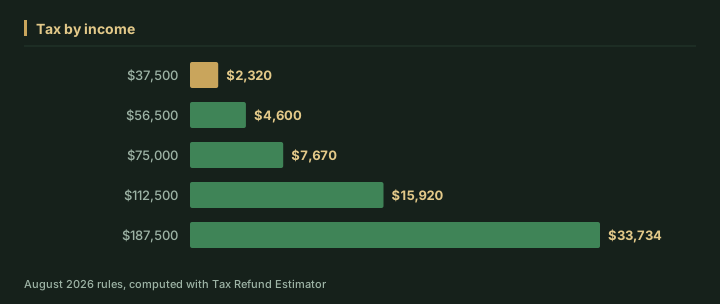
We ran 5 values of income through the calculator and left every other input at its default. As of August 2026, the output was:
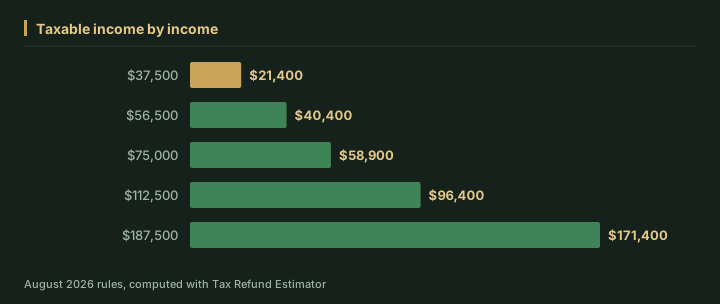
| Income ($) | Tax ($) | Taxable income ($) | Balance ($) |
|---|---|---|---|
| 37,500 | 2,320 | 21,400 | 6,680 |
| 56,500 | 4,600 | 40,400 | 4,400 |
| 75,000 | 7,670 | 58,900 | 1,330 |
| 112,500 | 15,920 | 96,400 | 6,920 |
| 187,500 | 33,734 | 171,400 | 24,734 |
Running income from $37,500 up to $187,500 moves tax from $2,320 to $33,734 — a spread of $31,414. That gap is the part a single headline rate never shows.
The same runs seen through taxable income
At $37,500, taxable income works out to $21,400; at $187,500 it is $171,400. Looking only at tax tends to understate how much the outcome shifts across that range.
Assumptions behind these figures
| Input | Value |
|---|---|
| Income | $75,000 |
| Status | Single |
| Withholding | $9,000 |
| Deduction type | Standard |
| Itemized | $0 |
| Credits | $0 |
| Year | 2026 |
| As of | August 2026 |
| Method | identical to /tools/tax-refund-estimator |
Brackets, thresholds and rates change from year to year, so treat these as August 2026 figures for the 2026 tax year. For your own situation, open the Tax Refund Estimator and enter your real numbers — the calculator runs the same code that produced every figure on this page.
Try the related calculators
Related guides
Retirement Account Tax Benefits: 401(k), IRA, and Roth (2026)
Whether a retirement account saves you tax now or later depends on which type you pick — here is how 401(k)s,...
How to Fill Out a W-4 Form: 2026 Edition
A practical 2026 walkthrough of the IRS Form W-4 — filing status, the multiple-jobs step people skip, dependen...
1099 vs W-2: Tax Implications and Comparison (2026)
Same $120,000, three outcomes in 2026: a W-2 employee, a 1099 with no expenses, and a 1099 with $25,000 of exp...