Marginal vs Effective Tax Rate Explained
Table of contents
- Two questions, two answers
- Pinning down the definitions
- A worked household: married, $185,000
- The gap across a range of incomes
- Why the gap exists, in one idea
- Which rate drives which decision
- A raise or a side gig
- Valuing a deduction
- Roth vs traditional contributions
- Comparing job offers or filing scenarios
- Budgeting and estimated payments
- Timing income across years
- The number that actually answers "how much do I keep?"
- A worked decision: should this couple do a Roth conversion?
- A test you can run on any tax claim
- The confusions that cost people
- Calculating each rate yourself
- Quick answers
- Which is my "real" tax rate?
- Can my effective rate ever equal my marginal rate?
- Which rate decides whether a bonus is "worth it"?
- Does the effective rate include Social Security and Medicare?
- How do I lower my effective rate?
- Are the 2026 figures here final?
- How we keep this accurate
- Run the numbers
- How the result moves with income
- The same runs seen through after-tax income
- Where the total comes from
- Assumptions behind these figures
Your top rate says 22%. Your actual rate is closer to 10%. Both numbers describe the same person, the same income, the same year — and confusing them is behind a surprising amount of bad financial planning. One number tells you what happens to your next dollar. The other tells you what happened to all of them. They are not interchangeable, and the gap between them runs into double digits for ordinary households.
This guide draws the line between the two precisely, runs the 2026 arithmetic on a real household, and then gets to the part that matters: which rate you should be using when you evaluate a raise, a Roth conversion, a job offer, or a quarterly estimate. It pairs with how federal tax brackets work in 2026 and the complete guide to U.S. federal income tax (2026).
Two questions, two answers
Each rate answers a different question. Keep the questions straight and you will never mix the rates up again.
- Marginal rate answers: "If I earn one more dollar, how much of it goes to tax?" It is the rate of the highest bracket your taxable income reaches.
- Effective rate answers: "What share of my income did I actually hand over?" It is total tax divided by income.
Because the system is progressive, lower bands taxed at lower rates, the effective rate is always below the marginal rate — the only exception being income so low it all fits in the first 10% band, where they are equal.
Pinning down the definitions
Marginal rate is the statutory rate on your last (highest) dollar of taxable income. Land in the 22% band and your marginal rate is 22%, full stop.
Effective rate is total tax ÷ income — but there are two versions, and being sloppy about which one you mean is where arguments start:
| Version | Formula | What it tells you |
|---|---|---|
| Effective rate on taxable income | Total tax ÷ taxable income | The pure progressivity effect |
| Effective rate on gross income | Total tax ÷ gross income | The real share of your paycheck, deduction included |
The second is usually the one people actually care about, because it credits the standard deduction for shielding part of your pay entirely.
A worked household: married, $185,000
Skip the lone-single-filer cliché. Take a married couple filing jointly, two earners, $185,000 of combined gross income, taking the 2026 MFJ standard deduction of $32,200.
- Gross income: $185,000
- Taxable income: $185,000 − $32,200 = $152,800
Apply the 2026 MFJ brackets band by band:
| Band | Range | Income taxed | Rate | Tax |
|---|---|---|---|---|
| 10% | $0 – $24,800 | $24,800 | 10% | $2,480 |
| 12% | $24,800 – $100,800 | $76,000 | 12% | $9,120 |
| 22% | $100,800 – $152,800 | $52,000 | 22% | $11,440 |
| Total | $23,040 |
Now the rates that come out of it:
- Marginal rate = 22% — the next dollar this couple earns is taxed at 22%.
- Effective rate on taxable income = $23,040 ÷ $152,800 = about 15.1%.
- Effective rate on gross income = $23,040 ÷ $185,000 = about 12.5%.
A household "in the 22% bracket" pays roughly 12 and a half cents of federal income tax per dollar of gross pay. Quoting "22%" overstates their real burden by nearly double. Reproduce it with the Federal Income Tax Calculator or check the bands with the Tax Bracket Calculator.
The gap across a range of incomes
The spread between the two rates widens as income climbs, then the effective rate slowly catches up to the marginal rate at the very top. These rows are MFJ couples on the 2026 standard deduction:
| Gross income | Taxable income | Total tax | Marginal rate | Effective rate (gross) |
|---|---|---|---|---|
| $70,000 | $37,800 | $4,400 | 12% | 6.3% |
| $110,000 | $77,800 | $9,200 | 12% | 8.4% |
| $185,000 | $152,800 | $23,040 | 22% | 12.5% |
| $260,000 | $227,800 | $42,752 | 24% | 16.4% |
| $450,000 | $417,800 | $98,791 | 32% | 22.0% |
Three things to take from this. The effective rate sits well below the marginal rate at every row. Two households can share a marginal rate ($110,000 and a $90,000 couple are both at 12%) yet pay very different effective rates. And even the $450,000 couple with a 32% marginal rate pays an effective rate of 22% — the lower bands never stop pulling the average down.
Why the gap exists, in one idea
The effective rate is a weighted average of every bracket rate you touched, each rate weighted by how many of your dollars fell in that band. For the $185,000 couple the weights are $24,800 at 10%, $76,000 at 12%, and $52,000 at 22%. The biggest single chunk ($76,000) sits in the 12% band, which drags the average down toward 12%, far from the 22% top rate.
That yields a rule worth memorizing: your effective rate is pulled toward the rate of your largest income band, not your highest one. A household whose income barely pokes into the 24% band has almost everything taxed at 22% and below, so its effective rate is nowhere near 24%. Only when a huge share of income sits in the top band does the effective rate close in on the marginal rate — which is exactly why the gap narrows for very high earners.
The standard deduction widens the gap further by taxing a slab of income at an effective 0%. For this couple, $32,200 of gross pay never reaches a band at all, which is why the effective rate on gross income (12.5%) sits below the effective rate on taxable income (15.1%).
Which rate drives which decision
Pick the wrong rate and you reach the wrong conclusion. Here is the matching.
A raise or a side gig
Marginal rate. New income stacks on top of old income, so it is taxed at your top rate (and possibly into the next band). A $10,000 raise for the $185,000 couple above is taxed at 22%, netting $7,800 after federal income tax. Their 12.5% average rate is irrelevant — only the marginal rate touches the new dollars. If the side income is self-employment, layer in SE tax too; see self-employment tax explained for 2026.
Valuing a deduction
Marginal rate. A deduction peels off your top dollars first, so a $1,000 deduction saves 22% × $1,000 = $220 for this couple. This is why deductions are worth more to higher earners and why credits behave differently — see tax credits vs tax deductions.
Roth vs traditional contributions
Compare your marginal rate today against your expected rate in retirement. Traditional saves at today's marginal rate; Roth is taxed at today's marginal rate but withdrawn tax-free. Expect a lower rate later, traditional often wins; expect higher, Roth often does. Core of traditional vs Roth IRA tax and retirement account tax benefits.
Comparing job offers or filing scenarios
Effective rate. You care about total tax on the whole income, not the last dollar. The tax bracket calculator reports both side by side for any income and status.
Budgeting and estimated payments
Effective rate. To set aside the right reserve — especially if you make estimated tax payments — apply last year's effective rate to projected income. Using the marginal rate here would massively overstate the bill and over-reserve cash you could be using.
Timing income across years
Marginal rate in each year. Shift a bonus, a Roth conversion, or a capital gain into a year when your marginal rate is lower and you cut the tax on those specific dollars. This is the logic of "filling up a bracket": in a low-income year — early retirement, a sabbatical, a startup year with losses — realizing income up to the top of a low band can be far cheaper than realizing it in a high-earning year. A retiree with little ordinary income might convert traditional IRA money to Roth precisely to use up the 10% and 12% bands cheaply, a move explored in traditional vs Roth IRA tax.
The number that actually answers "how much do I keep?"
The federal income-tax marginal rate is only part of the cost of the next dollar. That dollar can also catch:
- FICA or SE tax — roughly 7.65% on wages within the Social Security wage base, or about 15.3% on self-employment profit (partly offset by the SE-tax deduction).
- State income tax — your state's marginal rate, where one exists.
- Phaseouts — if the extra income shrinks an income-tested credit or deduction, the true marginal cost climbs higher still.
Stack them and you get the combined marginal rate, the figure that genuinely answers "how much of my next dollar do I keep?" Take a single wage earner in the 22% federal band living in a state with a 5% flat tax:
| Component | Rate on the next dollar |
|---|---|
| Federal income tax | 22% |
| Employee FICA | 7.65% |
| State income tax | 5% |
| Combined marginal rate | ~34.65% |
This worker keeps about 65 cents of the next dollar — still clearly worth earning, but a very different number from the 22% "bracket" they would quote, and different again from their roughly 10% federal effective rate. For overtime, a traditional 401(k) decision, or whether to take freelance work, the combined marginal rate is the right lens. Check the federal piece with the Federal Income Tax Calculator; the state layer is in the state income tax guide for all 50 states.
A worked decision: should this couple do a Roth conversion?
Abstract rules are easy to nod along to and hard to apply, so here is the $185,000 couple facing a real choice. They have $40,000 sitting in a traditional IRA they are considering converting to Roth this year. The conversion adds $40,000 of ordinary income on top of their $152,800 taxable income.
The wrong way to think about it: "our effective rate is 12.5%, so the conversion costs about $5,000." The right way: the conversion is new income stacked on top, so it is taxed at the marginal rate, not the average. Their taxable income runs from $152,800 to $192,800, which stays entirely inside the 22% MFJ band (it ends well below the $211,400 top of that band). The conversion is taxed at a clean 22%:
| Without conversion | With $40,000 conversion | |
|---|---|---|
| Taxable income | $152,800 | $192,800 |
| Federal income tax | $23,040 | $31,840 |
| Tax cost of the conversion | — | $8,800 |
The conversion costs $8,800, not the $5,000 the effective-rate mistake would have suggested — a 76% underestimate that would have wrecked the plan. Whether the conversion is worth $8,800 depends on the couple's expected rate when they eventually withdraw, which is the heart of traditional vs Roth IRA tax. The point here is narrower: use the marginal rate to price new income, every time, or your number will be badly wrong in the direction that hurts.
A test you can run on any tax claim
Whenever you see "people in that bracket pay X%," ask which rate is meant. If it is the statutory bracket rate, that is the marginal rate and it overstates the real burden. If it is total tax over income, that is an effective rate — then ask which income base (gross or taxable) and whether payroll and state taxes are folded in. Most heated tax arguments dissolve the instant both sides say which of these numbers they mean.
The confusions that cost people
- "I'm in the 24% bracket, so I pay 24%." No — that is the marginal rate; the effective rate is materially lower.
- "A raise pushes all my income into a higher bracket." No — only dollars above the threshold. See how federal tax brackets work in 2026.
- "My effective rate includes payroll tax." Usually it is income tax only. FICA is separate, so your true total federal burden is higher than the income-tax effective rate alone.
- "State and federal effective rates just add up." They sit on different bases and sometimes interact; add them only as a rough approximation.
- "My average rate is what I save by deducting more." No — the marginal rate governs the value of an extra deduction, not the average.
Calculating each rate yourself
- Taxable income = gross income − adjustments − standard or itemized deduction.
- Apply the 2026 brackets for your status band by band; sum for total tax before credits.
- Marginal rate = the rate of the highest band you reached.
- Effective rate = total tax ÷ income (state which base — gross or taxable).
- Cross-check both with the Federal Income Tax Calculator.
Quick answers
Which is my "real" tax rate?
The effective rate on gross income — that is the closest answer to "what share of my pay went to federal income tax." The marginal rate is only the rate on your next dollar.
Can my effective rate ever equal my marginal rate?
Only if all your taxable income sits in one band, realistically just the lowest 10% one. For everyone else the effective rate is strictly lower.
Which rate decides whether a bonus is "worth it"?
The marginal rate — a bonus stacks on top of everything else and is taxed at your top rate. It is still worth taking; you simply keep less than 100% of it.
Does the effective rate include Social Security and Medicare?
Typically no. The effective income-tax rate covers federal income tax only; FICA is computed separately, so your total federal burden as a share of income is higher.
How do I lower my effective rate?
Anything that cuts total tax relative to income: above-the-line deductions, itemizing when it beats the standard deduction, credits, and shifting income into long-term capital gains. See how to reduce taxable income legally.
Are the 2026 figures here final?
Projected 2026 values from the permanent rate structure and annual inflation indexing, reconciled to official IRS numbers at year-end. Estimates, not certainties.
How we keep this accurate
The rate definitions and the band-by-band computation follow IRS Form 1040 and the Tax Computation Worksheet in its instructions; the 2026 bracket thresholds and standard deduction apply the annual IRS Revenue Procedure for inflation-adjusted items to the permanent statutory rate schedule, which is fixed in law and does not move year to year. Payroll treatment in the combined-rate section reflects Social Security Administration figures and IRS rules on FICA and self-employment tax. State references come from the individual state Departments of Revenue. Every 2026 number on this page is a projection that gets reconciled against the official IRS release once published, so treat it as a planning estimate. This is educational material, not personalized advice — the right rate for a specific decision depends on details a general article cannot see, so for a real-money call, run it past a CPA or Enrolled Agent who can look at your full return.
Run the numbers
Everything below came out of this site's own Federal Income Tax Calculator. The figures are not quoted from anywhere else: each row is one run of the same calculation the tool page performs, using August 2026 rules. Put the same inputs in and you will get the same output.
How the result moves with income
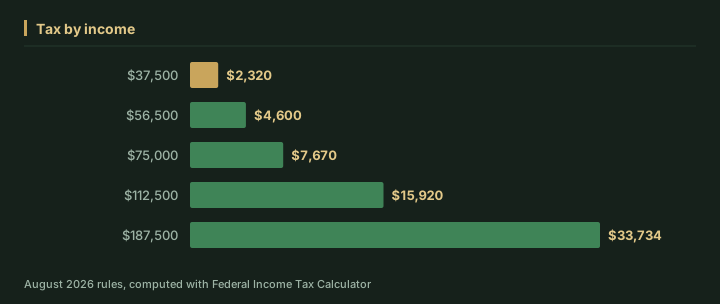
We ran 5 values of income through the calculator and left every other input at its default. As of August 2026, the output was:
| Income ($) | Tax ($) | After-tax income ($) | Taxable income ($) |
|---|---|---|---|
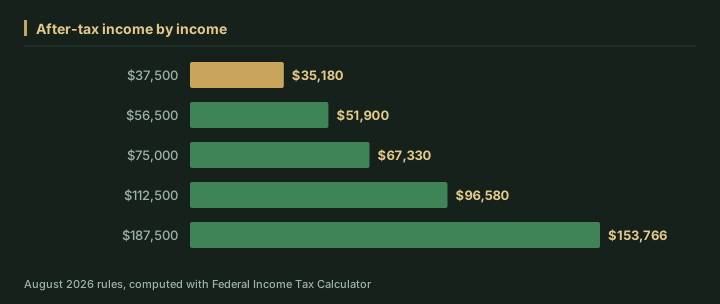
| 37,500 | 2,320 | 35,180 | 21,400 |
| 56,500 | 4,600 | 51,900 | 40,400 |
| 75,000 | 7,670 | 67,330 | 58,900 |
| 112,500 | 15,920 | 96,580 | 96,400 |
| 187,500 | 33,734 | 153,766 | 171,400 |
Running income from $37,500 up to $187,500 moves tax from $2,320 to $33,734 — a spread of $31,414. That gap is the part a single headline rate never shows.
The same runs seen through after-tax income
At $37,500, after-tax income works out to $35,180; at $187,500 it is $153,766. Looking only at tax tends to understate how much the outcome shifts across that range.
Where the total comes from
Holding income at $75,000, we ran the same calculation again and kept the breakdown it returns. The total is not one rate applied once — for the 2026 tax year it is built from 3 parts:

| Part | Tax |
|---|---|
| 10% bracket | $1,240 |
| 12% bracket | $4,560 |
| 22% bracket | $1,870 |
Assumptions behind these figures
| Input | Value |
|---|---|
| Income | $75,000 |
| Status | Single |
| Deduction type | Standard |
| Itemized | $0 |
| Year | 2026 |
| As of | August 2026 |
| Method | identical to /tools/federal-income-tax-calculator |
Brackets, thresholds and rates change from year to year, so treat these as August 2026 figures for the 2026 tax year. For your own situation, open the Federal Income Tax Calculator and enter your real numbers — the calculator runs the same code that produced every figure on this page.
Frequently Asked Questions
What's the difference between marginal and effective tax rate?
Your marginal tax rate is the rate applied to your next dollar of income — essentially the rate of the highest tax bracket you reach. Your effective tax rate is your total tax divided by your income, reflecting the average rate across all your income, and it is generally always lower than your marginal rate because of how progressive tax brackets work.
Why is my effective tax rate so much lower than my tax bracket?
Because a progressive tax system taxes only the income within each bracket at that bracket's rate, not all of your income at your top rate, your effective rate ends up being a weighted average pulled toward whichever bracket holds the largest share of your income. Someone whose income barely reaches a higher bracket will have most of their income taxed at lower rates, keeping their effective rate well below the marginal figure.
Which rate should I use to evaluate a raise or bonus?
You should generally use your marginal tax rate, since new income like a raise or bonus stacks on top of your existing income and is taxed at your top bracket rate, and possibly the next bracket if it's large enough. Your effective (average) rate isn't relevant to new income because it reflects all your prior income, not the specific tax treatment of the additional dollars.
Does the standard deduction affect the gap between marginal and effective tax rates?
Yes, the standard deduction widens that gap because it shields a chunk of your income from tax entirely, effectively an 0% rate on that portion, which pulls your overall effective rate down further, especially when measured against gross income rather than taxable income.
Try the related calculators
Related guides
Retirement Account Tax Benefits: 401(k), IRA, and Roth (2026)
Whether a retirement account saves you tax now or later depends on which type you pick — here is how 401(k)s,...
The Tax Refund Process: How Long Does It Take? (2026)
You filed and the money still has not landed. Here is the realistic 2026 timeline, what the tracker stages act...
How to Fill Out a W-4 Form: 2026 Edition
A practical 2026 walkthrough of the IRS Form W-4 — filing status, the multiple-jobs step people skip, dependen...