Traditional vs Roth IRA: Tax Implications Compared (2026)
Table of contents
- One account taxes you later, one taxes you now
- Why the break-even is a rate, not a date
- The equal-rate case, walked through
- The asymmetry the rate math ignores
- The break-even across different rate combinations
- Reading yourself into one column or the other
- Why "I'm not sure" is a legitimate answer
- Thirty years, side by side
- RMDs: the difference that ambushes big balances
- Conversions: the backdoor and the bracket-filling move
- Eligibility phase-outs, in concept
- A decision path, in order
- Three people, three answers
- Frequently asked questions
- When the rate is the same now and later, does the choice matter at all?
- How is the total contribution limit shared between the two?
- Is a backdoor Roth something I can just do myself?
- Will a Roth IRA ever force me to take money out?
- What does pulling money out early actually trigger?
- Where do I find the 2026 income limits?
- Sources & methodology
- Run the numbers
- How the result moves with income
- The same runs seen through after-tax income
- Where the total comes from
- Assumptions behind these figures
Put $7,000 into a Traditional IRA and let it grow to $35,000, and at a 22% withdrawal rate you keep about $27,300. Put the same $7,000 into a Roth at the same 22% rate today and you keep the full $35,000 — except you also gave up roughly $1,540 of tax savings up front that, invested, closes most of that gap. Now change one thing: if your retirement rate drops to 12%, the Traditional version keeps about $30,800; if it climbs to 32%, only about $23,800. Same contribution, same market, same person — the entire spread is your tax rate moving. That single moving part is the whole comparison, and this guide is about reading it correctly.
One account taxes you later, one taxes you now
| Traditional IRA | Roth IRA | |
|---|---|---|
| Contribution | May be deductible now | Never deductible (after-tax) |
| Growth | Untaxed while invested | Untaxed while invested |
| Qualified withdrawal | Taxed as ordinary income | Completely tax-free |
| RMDs for original owner | Yes | None |
| Early contribution withdrawal | Tax + 10% penalty (exceptions apply) | Contributions out anytime, tax/penalty-free |
| Income limits | Deduction phases out if covered by a workplace plan | Direct contribution phases out at higher income |
A Traditional IRA says "tax me later." A Roth says "tax me now, then never again." Every other difference is a consequence of that one line.
Why the break-even is a rate, not a date
The pivot is not your age or your account balance. It is your marginal tax rate today against your expected rate when you withdraw. The cleanest way to internalize this: if your rate is identical now and in retirement, and you actually invest the Traditional deduction's tax savings, the two accounts produce the same after-tax dollars. They only diverge when the rates differ. So the real decision is a forecast — which way does your rate move?
The equal-rate case, walked through
Single filer, $7,000 contributed, grows to roughly $35,000 by retirement.
With the Roth, you pay 22% on the $7,000 today — about $1,540 out of pocket now — and the full $35,000 is yours tax-free later. With the Traditional, you deduct the $7,000 (saving about $1,540 now), and the $35,000 is taxed at 22% on the way out, around $7,700, leaving $27,300. But that $1,540 you saved was supposed to be invested too; grow it proportionally, tax it on the back end, and the arithmetic converges on the same place.
People find that "wash" result counterintuitive, but it is just multiplication: applying a growth factor and a tax rate gives the same answer regardless of order. The fragile word is if — if you invest the savings. Most people who go Traditional spend the refund instead of investing it. Do that and the Roth quietly wins even at equal rates, because the Roth forced you to save the full pre-tax-equivalent amount. This is a behavior question dressed up as a math question.
The asymmetry the rate math ignores
Pure rate comparison misses one thing entirely. Contribute $7,000 to a Roth each year for three years, then hit an emergency in year four: you can pull your $21,000 of contributions — not earnings — with zero tax and zero penalty, because that money was already taxed. The same $21,000 yanked early from a Traditional IRA before 59½ generally draws ordinary income tax plus a 10% penalty, plausibly $4,000–$6,000 in combined cost depending on your bracket. For a younger saver without a deep emergency fund, that flexibility is a concrete Roth advantage that never appears in a rate spreadsheet.
The break-even across different rate combinations
This is where the comparison earns its keep — the answer flips depending on the gap between your current and future rates, not either rate alone.
| Your situation | Marginal rate now | Rate in retirement | Generally favors |
|---|---|---|---|
| Early career, lower income now | 12% | 22% | Roth — lock in the low rate |
| Peak earnings, expecting a quieter retirement | 24% | 12% | Traditional — deduct high, withdraw low |
| Steady middle income, no big change expected | 22% | 22% | Roughly a tie — Roth for the flexibility |
| You expect tax rates generally to rise | 22% | 24%+ | Roth — pay today's lower rate |
| High income, large balances, future RMD pressure | 32% | 24% | Traditional now, Roth conversions later |
Find your marginal rate in the 2026 brackets: for a single filer, 12% spans $12,400–$50,400, 22% spans $50,400–$105,700, and 24% spans $105,700–$201,775; for married filing jointly, 12% spans $24,800–$100,800 and 22% spans $100,800–$211,400. Pin down your current marginal rate with the tax bracket calculator and see how a deduction shifts your bill with the federal income tax calculator.
Reading yourself into one column or the other
Roth tends to fit you when:
- You are early in your career or temporarily in a low bracket.
- You expect your income — or tax rates broadly — to be higher later.
- You want tax-free, RMD-free money and the flexibility to pull contributions if you must.
- You want to hand tax-efficient money to heirs.
Traditional tends to fit you when:
- You are in peak-earning years and want the deduction now.
- You expect a lower tax rate in retirement than today.
- You are not covered by a workplace plan (the deduction is generally fully available regardless of income), or you simply want to lower this year's taxable income — see how to reduce taxable income legally.
Plenty of savers split between both for tax diversification — having taxable and tax-free pools in retirement gives you year-by-year control over your own bracket.
Why "I'm not sure" is a legitimate answer
In retirement, your tax bill is partly yours to steer — but only if you have more than one type of account. A retiree who needs $60,000 in a year can draw from a Traditional account up to the top of a low bracket, then take the rest tax-free from a Roth, holding the overall rate down. A retiree with everything in a Traditional account has no such lever; every dollar of need is fully taxable, and one large expense — a roof, a hospital bill — can spike them into a higher bracket. Owning both account types is like carrying both cash and a credit card: the optionality has value on its own, separate from the rate bet. That is why uncertainty is a perfectly good reason to fund both rather than agonize over a forecast no one can make precisely.
Thirty years, side by side
Assume $7,000 of pre-tax-equivalent money per year, a 7% return, a 22% rate today.
| Traditional IRA | Roth IRA | |
|---|---|---|
| Annual amount working for you | $7,000 (full, pre-tax) | $5,460 (after 22% tax on $7,000) |
| Approximate balance after 30 years | ~$660,000 | ~$515,000 |
| Tax owed on withdrawals | Ordinary income, each year | $0 (qualified) |
| After-tax value if retirement rate = 22% | ~$515,000 | ~$515,000 |
| After-tax value if retirement rate = 12% | ~$580,000 | ~$515,000 |
| After-tax value if retirement rate = 32% | ~$449,000 | ~$515,000 |
Rounded and illustrative, but the shape is the point: equal rate, dead heat; lower future rate, Traditional pulls ahead; higher future rate, Roth pulls ahead — exactly what the theory predicts, now with numbers behind it. Build your own version with the federal income tax calculator.
RMDs: the difference that ambushes big balances
Traditional IRAs carry Required Minimum Distributions starting at an age set in current law (early-to-mid 70s). Need the money or not, you withdraw and pay tax on a slice every year, which can lift a retiree into a higher bracket and change how Social Security and Medicare premiums are taxed.
Roth IRAs have no RMD for the original owner. The balance compounds tax-free for life and passes to heirs efficiently. For savers with substantial balances who do not need the money to live on, this is a major mark in the Roth column that the pure rate math simply does not capture.
Conversions: the backdoor and the bracket-filling move
Two related strategies surface constantly.
A Roth conversion moves money from a Traditional IRA into a Roth and you pay ordinary income tax on the converted amount that year. It shines in a low-income year — early retirement before RMDs and Social Security start is the classic window — letting you "fill up" a low bracket now to dodge larger taxable withdrawals later.
The backdoor Roth exists because direct Roth contributions phase out at higher incomes, so some high earners contribute to a Traditional IRA and then convert to Roth. Widely discussed, genuinely error-prone — the pro-rata rule can make the conversion partly taxable if you hold other pre-tax IRA money. This is where you bring in a tax professional rather than improvise.
Both strategies swap a tax bill now for tax-free growth and no RMDs later, and whether that pays off is, yet again, a rate-timing question. A large conversion can also reshape your withholding and estimated-payment needs — see estimated tax payments: when and how.
A worked conversion: a retiree has a $45,000 income year before Social Security and RMDs begin. For a single filer in 2026, taxable income up to $50,400 stays inside the 12% bracket. They convert roughly $5,000 from a Traditional IRA, pay about 12% ($600) now, and lift that $5,000 plus all its future growth out of ever being taxed again or counted toward a future RMD. Left in the Traditional account and withdrawn later in a 22% year, the same money plus growth gets taxed far harder. The craft is filling low brackets in low-income years without spilling into the next one — and because a big conversion can raise the taxable share of Social Security and bump Medicare premiums, this is squarely professional-advice territory.
The five-year rules deserve a flag. Roth accounts run two separate five-year clocks people trip over: one governs tax-free earnings (the account generally open five years and you 59½), and a separate clock applies to each conversion and affects whether converted principal comes out penalty-free before 59½. The details are technical and the penalties real, so before withdrawing from a Roth that holds converted money, check IRS Publication 590-B or ask a professional rather than assuming all Roth money behaves alike.
Eligibility phase-outs, in concept
Two separate income tests matter, both using ranges the IRS resets every year:
The Traditional IRA deduction is fully available if neither you nor a spouse is covered by a workplace plan. If you (or a spouse) are covered, it phases out as income rises and can reach zero — though a non-deductible contribution is still allowed. The Roth IRA contribution amount phases down above certain income levels and is eliminated at higher incomes.
This guide deliberately omits specific 2026 dollar thresholds because they are indexed annually. Confirm your exact eligibility with IRS Publication 590-A (contributions) and Publication 590-B (distributions), or a tax professional.
A decision path, in order
- Capture any employer 401(k) match first — it outranks funding either IRA. See retirement account tax benefits.
- Estimate your marginal rate now with the tax bracket calculator, and honestly project your retirement rate.
- Likely lower rate in retirement? Lean Traditional. Likely higher, or you want certainty and no RMDs? Lean Roth.
- Genuinely unsure? Split contributions for tax diversification.
- Income blocking a direct Roth or the Traditional deduction? Research conversions with a professional before acting.
- Check eligibility against IRS Publication 590-A for the current year's phase-outs.
For how brackets, deductions, and credits interact more broadly, see the complete guide to U.S. federal income tax, how federal tax brackets work, and marginal vs effective tax rate. To stress-test any scenario, run it through the federal income tax calculator and check the capital gains calculator for how taxable-account investing stacks up.
Three people, three answers
A 27-year-old earning $48,000. As a single filer in 2026, the income above the $16,100 standard deduction lands largely in the 12% bracket. Paying 12% now to buy decades of tax-free growth is a strong trade, and earnings almost certainly climb from here. Roth, clearly — the deduction is barely worth anything at 12%.
A 47-year-old couple earning $250,000 jointly. Their top dollars sit in the 24% MFJ bracket ($211,400–$403,550). A deduction is worth 24 cents on the dollar here, and they expect lower income in retirement. Lean Traditional for the deduction now — though if a workplace plan limits the deduction, a Roth (or backdoor Roth) may be the practical path, and a small Roth slice still buys tax diversification.
A 60-year-old with a large Traditional balance and no Roth. The exposure is future RMDs forcing high taxable income in their 70s. Adding only Traditional money concentrates that exposure. Add Roth contributions now, and explore conversions in any lower-income year before RMDs begin, with a professional running the bracket math.
None of these are prescriptions — they show the same framework producing different answers as age, income, and existing holdings change.
Frequently asked questions
When the rate is the same now and later, does the choice matter at all?
Mathematically, not much — at an identical rate, and assuming you invest the Traditional deduction's tax savings, the two accounts land in the same place. The tiebreaker becomes behavior and flexibility: the Roth forces full saving and lets contributions come out penalty-free, which is why it often edges ahead even on a tie.
How is the total contribution limit shared between the two?
Your combined annual IRA contribution across Traditional and Roth is capped at the single IRS limit for the year — you cannot get two full limits by opening one of each. Splitting within that one cap is a standard way to build tax diversification.
Is a backdoor Roth something I can just do myself?
It is contributing to a Traditional IRA and converting it to Roth, used by people whose income is too high to contribute to a Roth directly. The pro-rata rule can make the conversion partly taxable if you hold other pre-tax IRA money, so this is one to run past a professional rather than wing.
Will a Roth IRA ever force me to take money out?
Not while you are the original owner — there is no RMD, so the balance can keep compounding tax-free indefinitely. Traditional IRAs do require RMDs starting at an age set in current law, which is one of the Roth's quiet structural advantages.
What does pulling money out early actually trigger?
A Traditional IRA withdrawal before 59½ generally faces income tax plus a 10% penalty, with exceptions such as a first home, higher education, or disability. Roth contributions come out anytime tax- and penalty-free; Roth earnings are governed by the age and five-year rules.
Where do I find the 2026 income limits?
The Traditional deduction phase-out and the Roth contribution phase-out both use income ranges the IRS re-indexes every year. Since they shift annually, confirm the exact 2026 figures in IRS Publication 590-A or with a tax professional instead of carrying over last year's number.
Sources & methodology
The break-even results in this comparison come from applying the 2026 federal brackets to a fixed contribution and growth assumption and then varying only the withdrawal-year rate, which isolates the one variable that actually drives the Traditional-versus-Roth answer. The illustrative balances are rounded and use a flat 7% return to keep the relationships visible; real outcomes will differ with market returns, contribution timing, and how consistently the Traditional deduction's tax savings are reinvested — a behavioral input the arithmetic cannot assume for you. The bracket figures are 2026 projections trued up to the official IRS numbers at year-end, and the conclusions hold regardless of minor revisions because they depend on the direction of the rate change, not its exact size.
Account rules follow IRS Publication 590-A (contributions and the deduction/contribution phase-outs), Publication 590-B (distributions, conversions, and the 10% additional tax with its exceptions), and the Required Minimum Distribution rules under current law; income phase-out and contribution limits are described by mechanism rather than dollar amount because the IRS indexes them every year, so the live figures belong on IRS.gov. This is educational material, not tax, investment, or financial advice — Roth conversions, the pro-rata rule, and the five-year clocks are individually fact-specific, and a CPA, Enrolled Agent, or qualified financial advisor should sign off before you act.
Run the numbers
Everything below came out of this site's own Federal Income Tax Calculator. The figures are not quoted from anywhere else: each row is one run of the same calculation the tool page performs, using August 2026 rules. Put the same inputs in and you will get the same output.
How the result moves with income
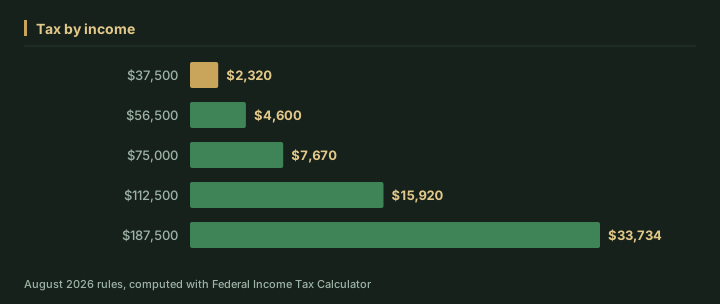
We ran 5 values of income through the calculator and left every other input at its default. As of August 2026, the output was:
| Income ($) | Tax ($) | After-tax income ($) | Taxable income ($) |
|---|---|---|---|
| 37,500 | 2,320 | 35,180 | 21,400 |
| 56,500 | 4,600 | 51,900 | 40,400 |
| 75,000 | 7,670 | 67,330 | 58,900 |
| 112,500 | 15,920 | 96,580 | 96,400 |
| 187,500 | 33,734 | 153,766 | 171,400 |
Running income from $37,500 up to $187,500 moves tax from $2,320 to $33,734 — a spread of $31,414. That gap is the part a single headline rate never shows.
The same runs seen through after-tax income
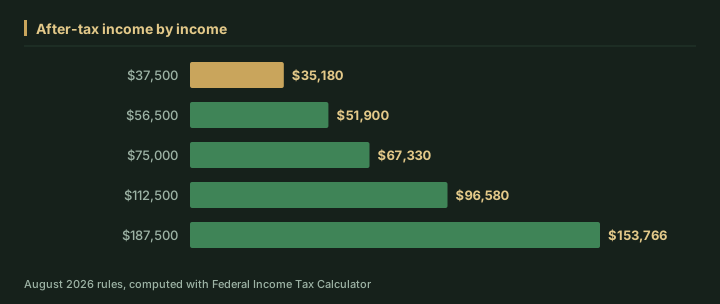
At $37,500, after-tax income works out to $35,180; at $187,500 it is $153,766. Looking only at tax tends to understate how much the outcome shifts across that range.
Where the total comes from
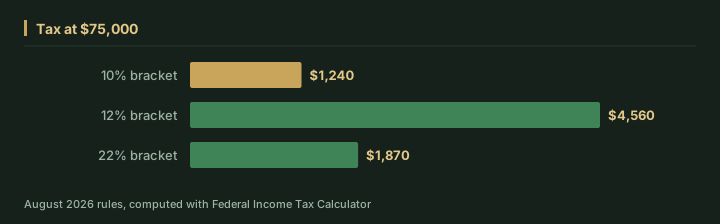
Holding income at $75,000, we ran the same calculation again and kept the breakdown it returns. The total is not one rate applied once — for the 2026 tax year it is built from 3 parts:
| Part | Tax |
|---|---|
| 10% bracket | $1,240 |
| 12% bracket | $4,560 |
| 22% bracket | $1,870 |
Assumptions behind these figures
| Input | Value |
|---|---|
| Income | $75,000 |
| Status | Single |
| Deduction type | Standard |
| Itemized | $0 |
| Year | 2026 |
| As of | August 2026 |
| Method | identical to /tools/federal-income-tax-calculator |
Brackets, thresholds and rates change from year to year, so treat these as August 2026 figures for the 2026 tax year. For your own situation, open the Federal Income Tax Calculator and enter your real numbers — the calculator runs the same code that produced every figure on this page.
Try the related calculators
Related guides
"California vs Texas: State Tax Comparison for 2026"
"Texas has no income tax; California's top rate is 12.3%. That gap is real and also the most misleading number...
"Standard Deduction vs Itemized: Real Examples"
"Four real households, four different right answers. Instead of explaining the rule again, this walks the actu...