"Standard Deduction vs Itemized: Real Examples"
Table of contents
- The rule in one line, then onto the numbers
- Example 1 — The renter who should not itemize
- Example 2 — The homeowner who should itemize but doesn't
- Example 3 — The household where itemizing clearly wins
- Example 4 — The medical-expense year
- The pattern across all four
- Example 5 — The bunching strategy that flips the answer
- Why the standard deduction wins so often now
- Common questions
- Run the numbers
- How the result moves with income
- The same runs seen through after-tax income
- Where the total comes from
- Assumptions behind these figures
A renter with a generous charitable streak was certain she should itemize. A homeowner with a big mortgage never bothered and took the standard deduction every year on autopilot. Both were wrong, and both were leaving money on the table in opposite directions. The standard-versus-itemized choice is not hard in theory — you take whichever is larger — but theory does not show you where your own numbers actually land. So this skips the re-explanation and walks four real households through the 2026 math. For the underlying rules and the full deduction list, pair it with standard vs itemized deductions; this article is the worked examples.
The rule in one line, then onto the numbers
You deduct either the standard deduction or the total of your itemized deductions — whichever is bigger. Never both. The 2026 standard deduction is the number to beat:
| Filing status | 2026 standard deduction |
|---|---|
| Single | $16,100 |
| Married filing jointly | $32,200 |
| Head of household | $24,150 |
Itemized deductions mainly comprise state and local taxes (capped — the SALT cap), deductible mortgage interest, charitable gifts, and large medical expenses above an income-based floor. Itemizing wins only when those add up to more than the standard figure above. Now the households.
Example 1 — The renter who should not itemize
Single, $70,000 income, rents, donates $3,000 a year, no mortgage, no state income tax state.
| Itemized component | Amount |
|---|---|
| State/local taxes | ~$1,500 (sales tax, no income tax) |
| Mortgage interest | $0 (renter) |
| Charitable gifts | $3,000 |
| Total itemized | $4,500 |
| Standard deduction (single) | $16,100 |
The standard deduction wins by $11,600. Her instinct that "I give a lot, so I should itemize" is the classic trap: $3,000 of generosity is real, but it is nowhere near the $16,100 floor. Take the standard deduction. Itemizing here would actively raise her taxable income. The lesson: a single large-feeling deduction rarely clears the bar alone — it is the stack that matters.
Example 2 — The homeowner who should itemize but doesn't
Married filing jointly, $180,000 income, $9,000 mortgage interest, $10,000 state and local taxes (at the SALT cap), $5,000 charitable.
| Itemized component | Amount |
|---|---|
| State/local taxes (capped) | $10,000 |
| Mortgage interest | $9,000 |
| Charitable gifts | $5,000 |
| Total itemized | $24,000 |
| Standard deduction (MFJ) | $32,200 |
This is the surprise: even with a real mortgage and the SALT cap maxed, itemized still loses to the $32,200 joint standard deduction by $8,200. The couple's autopilot — "we own a home, so we itemize" — happens to be wrong, but for the opposite reason they'd guess: the joint standard deduction is so large that ordinary homeowners frequently cannot beat it. Take the standard deduction. Post-cap, far fewer households itemize than assume they do, and "I have a mortgage" is no longer the automatic answer it was a decade ago.
Example 3 — The household where itemizing clearly wins
Married filing jointly, $220,000 income, $18,000 mortgage interest, $10,000 SALT (capped), $12,000 charitable.
| Itemized component | Amount |
|---|---|
| State/local taxes (capped) | $10,000 |
| Mortgage interest | $18,000 |
| Charitable gifts | $12,000 |
| Total itemized | $40,000 |
| Standard deduction (MFJ) | $32,200 |
Now itemizing wins by $7,800. The difference from Example 2 is not one heroic line — it is a large mortgage plus substantial giving stacked on the capped SALT. The extra $7,800 of deduction, valued at this couple's marginal rate (run it through the Federal Income Tax Calculator), is roughly $1,700 of real tax saved by itemizing instead of defaulting. Itemize. The pattern: itemizing tends to win for higher earners with a big mortgage and meaningful charitable giving — not for the merely middle-class homeowner.
Example 4 — The medical-expense year
Single, $60,000 income, $14,000 unreimbursed medical expenses after a major procedure, $2,000 charitable, modest state tax.
Medical expenses are deductible only above a percentage-of-income floor, so not all $14,000 counts — but in a high-medical year the deductible portion can be large enough to vault an otherwise-standard filer over the line.
| Itemized component | Amount |
|---|---|
| Deductible medical (above the income floor) | ~$9,500 |
| State/local taxes | ~$3,000 |
| Charitable gifts | $2,000 |
| Total itemized | ~$14,500 |
| Standard deduction (single) | $16,100 |
Even here it is close and still loses — $16,100 edges it out. The real lesson of Example 4 is that itemizing is not a permanent identity: it can be right in one year (a heavy medical or disaster year, or a year of concentrated giving) and wrong the next. The choice is re-decided every filing season, not set once.
The pattern across all four
| Household | Itemized total | Standard | Winner |
|---|---|---|---|
| Renter, modest giving | $4,500 | $16,100 | Standard |
| Homeowner, average | $24,000 | $32,200 | Standard |
| High earner, big mortgage + giving | $40,000 | $32,200 | Itemize |
| High-medical year | ~$14,500 | $16,100 | Standard |
Three of four take the standard deduction — which is the real-world distribution since the standard deduction roughly doubled and SALT was capped. Itemizing now wins mainly for a specific profile: higher income, large mortgage, significant charitable giving, sometimes a catastrophic-expense year. The reliable move is not to assume — it is to total your real itemized lines and compare them to your filing status's number, every year, then put the bigger figure into the Federal Income Tax Calculator to see the actual tax difference.
Example 5 — The bunching strategy that flips the answer
Return to the Example 2 couple — married, $180,000, $24,000 of itemized deductions, losing to the $32,200 standard deduction by $8,200. They are not stuck. They give $10,000 to charity a year out of habit; nothing forces that to be one year's gift.
If they make two years of giving in a single year — $20,000 in Year 1, $0 in Year 2 (or routed through a donor-advised fund) — the picture changes:
| Year 1 (bunched) | Year 2 (lean) | |
|---|---|---|
| State/local taxes (capped) | $10,000 | $10,000 |
| Mortgage interest | $9,000 | $9,000 |
| Charitable gifts | $20,000 | $0 |
| Itemized total | $39,000 | $19,000 |
| Standard deduction (MFJ) | $32,200 | $32,200 |
| Take | Itemize ($39,000) | Standard ($32,200) |
Across the two years they deduct $39,000 + $32,200 = $71,200, versus $32,200 × 2 = $64,400 if they had taken the standard deduction both years and given evenly. That is $6,800 of extra deduction — roughly $1,500 of real tax saved — from changing only the timing of gifts they were making anyway. This is "bunching," and it is the single most useful move for households that sit just below the standard-deduction line. It is one of the legitimate levers in how to reduce taxable income legally.
Why the standard deduction wins so often now
It is worth stating plainly why three of the first four households take the standard deduction, because it is recent history, not coincidence. The standard deduction was roughly doubled and the deduction of state and local taxes was capped in the same set of changes. Together those two moves did most of the work: a much higher bar to clear, and the most reliable large itemized line (state and local taxes) frozen at the cap. The result is that the typical homeowner — the Example 2 couple — no longer itemizes, reversing the pre-cap intuition that "owning a home means itemizing." This is the structural reason the examples land the way they do, and it is stable for 2026 per what's new in 2026 tax law. Plan around the world as it is, not the one your parents filed in.
Common questions
Can I take both? No. It is strictly one or the other — the larger of the two.
If I'm just under the standard deduction, is itemizing worth it? No — if itemized is below the standard, itemizing raises your taxable income. Only itemize when the total clearly exceeds the standard figure for your status.
Does a strategy exist to make itemizing win? Yes — "bunching": concentrating two years of charitable gifts (or other discretionary deductible spending) into one year to clear the standard deduction that year, then taking the standard deduction the next. It is one of the legitimate moves in how to reduce taxable income legally.
Did the larger standard deduction really change who itemizes? Substantially. With the standard deduction near these levels and SALT capped, the share of filers who itemize is far smaller than it was historically — which is exactly why Examples 1 and 2 surprise people.
Does my state follow the same choice? Not necessarily — some states require you to match your federal choice, others let you itemize on the state return even if you took the federal standard deduction. Check the state income tax guide for all 50 states and your state Department of Revenue.
These four households cover most of what real filers run into, and the throughline is simple: the standard deduction wins far more often than homeowners expect, itemizing wins decisively only for a particular high-mortgage, high-giving profile, and a single heavy year can change the answer for that year alone. Total your own lines, compare to the 2026 figure for your status, and let the Federal Income Tax Calculator price the difference — these are projected 2026 values reconciled to the official IRS Revenue Procedure at year-end, and a CPA can confirm the medical floor and SALT specifics on a real return.
Run the numbers
Everything below came out of this site's own Federal Income Tax Calculator. The figures are not quoted from anywhere else: each row is one run of the same calculation the tool page performs, using August 2026 rules. Put the same inputs in and you will get the same output.
How the result moves with income
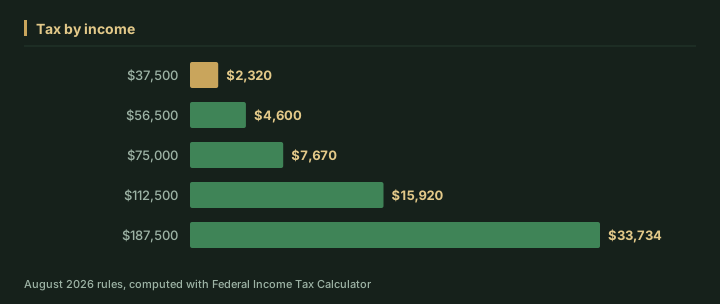
We ran 5 values of income through the calculator and left every other input at its default. As of August 2026, the output was:
| Income ($) | Tax ($) | After-tax income ($) | Taxable income ($) |
|---|---|---|---|
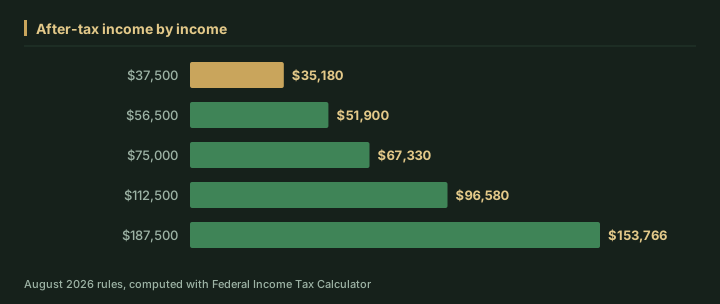
| 37,500 | 2,320 | 35,180 | 21,400 |
| 56,500 | 4,600 | 51,900 | 40,400 |
| 75,000 | 7,670 | 67,330 | 58,900 |
| 112,500 | 15,920 | 96,580 | 96,400 |
| 187,500 | 33,734 | 153,766 | 171,400 |
Running income from $37,500 up to $187,500 moves tax from $2,320 to $33,734 — a spread of $31,414. That gap is the part a single headline rate never shows.
The same runs seen through after-tax income
At $37,500, after-tax income works out to $35,180; at $187,500 it is $153,766. Looking only at tax tends to understate how much the outcome shifts across that range.
Where the total comes from
Holding income at $75,000, we ran the same calculation again and kept the breakdown it returns. The total is not one rate applied once — for the 2026 tax year it is built from 3 parts:

| Part | Tax |
|---|---|
| 10% bracket | $1,240 |
| 12% bracket | $4,560 |
| 22% bracket | $1,870 |
Assumptions behind these figures
| Input | Value |
|---|---|
| Income | $75,000 |
| Status | Single |
| Deduction type | Standard |
| Itemized | $0 |
| Year | 2026 |
| As of | August 2026 |
| Method | identical to /tools/federal-income-tax-calculator |
Brackets, thresholds and rates change from year to year, so treat these as August 2026 figures for the 2026 tax year. For your own situation, open the Federal Income Tax Calculator and enter your real numbers — the calculator runs the same code that produced every figure on this page.
Frequently Asked Questions
If I own a home with a mortgage, should I automatically itemize my deductions?
Not necessarily — since the SALT (state and local tax) deduction is capped and the standard deduction has grown substantially, many homeowners with a mortgage still come out ahead taking the standard deduction rather than itemizing. It depends on your specific mortgage interest, state and local taxes, and charitable giving totals compared against your filing status's standard deduction amount.
If I donate a lot to charity, does that mean I should itemize?
Not on its own — charitable donations alone are often far below the standard deduction threshold, so a filer with modest itemizable items in other categories, like state taxes or mortgage interest, may still come out ahead taking the standard deduction even with meaningful giving. It's the total of all your itemizable categories combined, not any single large-feeling deduction, that determines whether itemizing wins.
Do large medical expenses guarantee that itemizing is worth it?
Not automatically — only medical expenses above a certain percentage of your adjusted gross income are deductible, so even a large medical expense year might still fall short of the standard deduction once combined with other itemizable items. It's worth adding up the deductible portion alongside your other itemized categories and comparing the total to your standard deduction each year.
How often do people actually benefit from itemizing versus taking the standard deduction?
Since the standard deduction was substantially increased and the SALT deduction was capped, a majority of filers generally come out ahead taking the standard deduction, with itemizing tending to benefit higher-income households with a large mortgage and significant charitable giving. It's worth comparing both every year rather than assuming last year's choice still applies.
Try the related calculators
Related guides
Traditional vs Roth IRA: Tax Implications Compared (2026)
Same $7,000, same growth, wildly different outcomes — Traditional and Roth IRAs only diverge when your tax rat...
"California vs Texas: State Tax Comparison for 2026"
"Texas has no income tax; California's top rate is 12.3%. That gap is real and also the most misleading number...