"What's New in 2026 Tax Law: Key Changes"
Table of contents
- The biggest "change" is the one nobody announces: indexing
- What is structurally stable for 2026
- What actually moves year to year
- How to see what changed for you
- Indexing, quantified: what it is actually worth
- Bracket creep: the flip side
- How to follow tax changes without the noise
- Questions people ask
- About these numbers
- Run the numbers
- How the result moves with income
- The same runs seen through after-tax income
- Where the total comes from
- Assumptions behind these figures
Every year produces a wave of "major tax changes" coverage, and most of it will never touch your return. The changes that actually affect a typical 2026 filing are narrower, more predictable, and less dramatic than the headlines imply — and separating the real ones from the noise is worth more than memorizing any list. This is the honest version: what genuinely changed for 2026, what only looks new because a number moved with inflation, and how to see the effect on your own return with the Federal Income Tax Calculator and Tax Bracket Calculator.
The biggest "change" is the one nobody announces: indexing
The largest dollar movement on most returns every year is not legislation. It is inflation indexing. The bracket thresholds and the standard deduction are adjusted upward each year for inflation, which quietly cuts tax even when rates and rules are identical, because more income fits in the lower bands and a bigger slice is shielded from tax entirely.
The 2026 standard deduction:
| Filing status | 2026 standard deduction |
|---|---|
| Single | $16,100 |
| Married filing jointly | $32,200 |
| Married filing separately | $16,100 |
| Head of household | $24,150 |
The 2026 federal brackets keep the familiar seven-rate structure — 10%, 12%, 22%, 24%, 32%, 35%, 37% — with each threshold nudged up from the prior year. If your income rose only with inflation, indexing means your effective rate can fall slightly even though nothing about the law changed. This is the single most under-appreciated annual "change," and it is the one the Tax Bracket Calculator makes visible: the bands move, not the rates.
What is structurally stable for 2026
SmartTaxCalcs computes 2026 on the basis that the current statutory rate schedule remains in force, with the annual inflation adjustment applied on top. That means the things people most worry will "change" are, for 2026 planning purposes, stable:
- The seven marginal rates — unchanged in structure; only the income thresholds index.
- The roughly doubled standard deduction — still in place, so the post-2017 reality that most filers do not itemize continues. The worked consequences are in standard deduction vs itemized: real examples.
- The SALT cap on deducting state and local taxes — still the binding constraint that keeps many homeowners on the standard deduction.
- Long-term capital gains — still the preferential 0% / 15% / 20% schedule, with breakpoints indexed; the mechanics are in capital gains tax: short-term vs long-term.
- Self-employment tax — still 15.3% combined on 92.35% of net profit, with the Social Security wage base rising to a projected $184,500 for 2026; see self-employment tax explained for 2026.
"Stable structure, indexed numbers" is the accurate one-line summary of 2026 for the large majority of filers.
What actually moves year to year
The genuine annual changes that warrant attention, in priority order:
- Inflation-adjusted figures. Brackets, the standard deduction, the Social Security wage base, capital-gains breakpoints, retirement contribution limits. These move every year and are the changes most likely to affect your number.
- Retirement contribution limits. Generally rise with inflation; a higher limit is a larger legal shelter — relevant to retirement account tax benefits.
- Phase-out and threshold updates. Income levels where credits and deductions begin to taper also index, which can change eligibility even with flat income.
- Any enacted legislation. Tax law can change by statute at any time. When it does, official IRS guidance is the authority — not early reporting, which is frequently wrong about effective dates and details.
The discipline that matters: treat (1) as near-certain and the thing to actually plan around, and treat (4) as real only once the IRS publishes guidance.
How to see what changed for you
Generic "what changed" lists do not tell you whether your bill moved. The reliable method is to run last year and this year side by side:
- Enter your prior-year income and filing status in the Federal Income Tax Calculator at the prior year.
- Re-run the same income for 2026.
- The difference is the net effect of indexing on your specific situation — usually a small reduction if income only kept pace with inflation.
- Check the band shift in the Tax Bracket Calculator to see whether your marginal bracket moved even though your income did not.
This converts a vague headline into a concrete dollar figure for your household, which is the only version of "what's new" that affects a decision.
Indexing, quantified: what it is actually worth
"Indexing modestly lowers tax" is easy to say and easy to dismiss. Put a number on it. Take a single filer whose income rose only with inflation — say from $80,000 to $82,400 (a 3% cost-of-living bump):
| Prior year | 2026 | |
|---|---|---|
| Gross income | $80,000 | $82,400 |
| Standard deduction | (prior, lower) | $16,100 (indexed up) |
| Bracket thresholds | (prior, lower) | indexed up |
| Effective rate | baseline | slightly lower |
Because the standard deduction and every bracket threshold moved up alongside the raise, more of the higher income is shielded or taxed in lower bands than the prior-year structure would have allowed. The taxpayer's effective rate edges down even though their real income did not rise and no law changed in their favor. Run both years through the Federal Income Tax Calculator and the difference is concrete dollars, not a talking point. Indexing is a real annual tax cut that arrives without an announcement — and the only "2026 change" most households will actually feel.
Bracket creep: the flip side
Indexing protects you only if your income tracks inflation. Earn a real raise — above inflation — and the opposite happens: more income lands in higher bands, raising your effective rate. This is the genuine version of "bracket creep," and it is not a flaw to fear but a structure to plan around. The lever is the same as always: pre-tax retirement contributions, HSA contributions, and other above-the-line items reduce the income that climbs the bands. A real raise is still a raise — you keep most of every new dollar, as how to determine your tax bracket shows — but it is also the moment a contribution increase does the most good, which ties directly to how to reduce taxable income legally and retirement account tax benefits.
How to follow tax changes without the noise
A practical filter, because most "tax change" coverage will not affect you:
- Inflation-adjusted figures — near-certain every year, the change most likely to touch your return. Plan around it.
- Enacted legislation — real only when the IRS publishes guidance. Early reporting is frequently wrong on effective dates and scope; wait for the official source.
- Proposals and political commentary — not law, often never becomes law. Interesting, not actionable.
The single habit that beats every "what changed" article: each year, re-run your own prior-year income at the new year in the Federal Income Tax Calculator and Tax Bracket Calculator. That converts every headline into the only figure that matters — the change to your number.
Questions people ask
Did tax rates go up or down for 2026? The seven marginal rates are structurally unchanged for 2026 planning. The thresholds indexed upward, which modestly lowers tax on inflation-only income growth — a decrease in effect, not in rate.
Is the bigger standard deduction going away? It remains in place for 2026 in the structure used here. That is why most filers still take it rather than itemize.
Should I change anything because of "new 2026 law"? For most households the right response to indexing is none — it happens automatically. The actionable items are unchanged fundamentals: contribute to retirement, withhold accurately, capture deductions. See how to reduce taxable income legally.
Where do I confirm the final numbers? The official IRS Revenue Procedure for the year is the authority for inflation-adjusted figures, and IRS guidance is authoritative for any enacted change. Early news coverage is not.
Why do the figures here say "projected"? Because the precise inflation-adjusted 2026 numbers are reconciled to the official IRS release; until then they are well-grounded projections from the permanent rate schedule, not filed certainties.
About these numbers
The 2026 brackets, the $16,100 / $32,200 / $16,100 / $24,150 standard deductions, the projected $184,500 Social Security wage base, and the indexed capital-gains breakpoints are projected values: the permanent statutory rate schedule with the IRS annual inflation adjustment applied, reconciled to the official IRS Revenue Procedure and Social Security Administration announcements at year-end. Any statutory change is authoritative only via published IRS guidance. This article is general educational information, not tax advice, and is updated as official 2026 figures are released — for how a change affects a specific return, consult a CPA or Enrolled Agent.
Run the numbers
Everything below came out of this site's own Federal Income Tax Calculator. The figures are not quoted from anywhere else: each row is one run of the same calculation the tool page performs, using August 2026 rules. Put the same inputs in and you will get the same output.
How the result moves with income
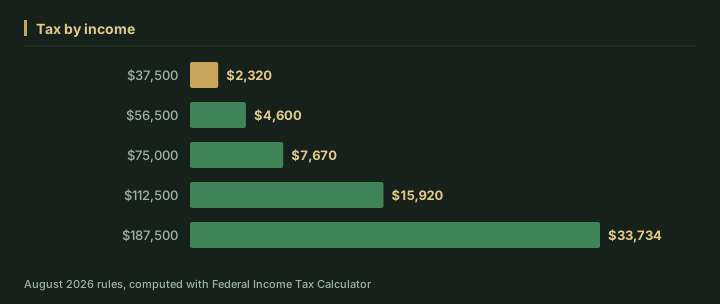
We ran 5 values of income through the calculator and left every other input at its default. As of August 2026, the output was:
| Income ($) | Tax ($) | After-tax income ($) | Taxable income ($) |
|---|---|---|---|
| 37,500 | 2,320 | 35,180 | 21,400 |
| 56,500 | 4,600 | 51,900 | 40,400 |
| 75,000 | 7,670 | 67,330 | 58,900 |
| 112,500 | 15,920 | 96,580 | 96,400 |
| 187,500 | 33,734 | 153,766 | 171,400 |
Running income from $37,500 up to $187,500 moves tax from $2,320 to $33,734 — a spread of $31,414. That gap is the part a single headline rate never shows.
The same runs seen through after-tax income
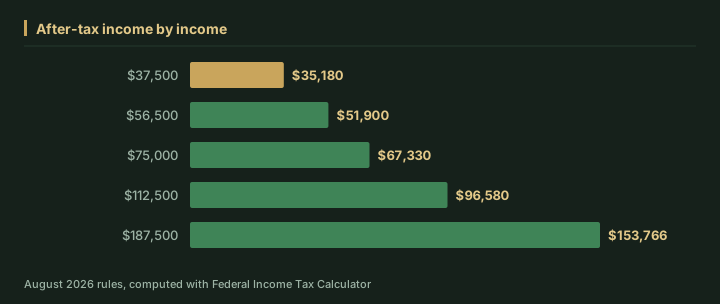
At $37,500, after-tax income works out to $35,180; at $187,500 it is $153,766. Looking only at tax tends to understate how much the outcome shifts across that range.
Where the total comes from
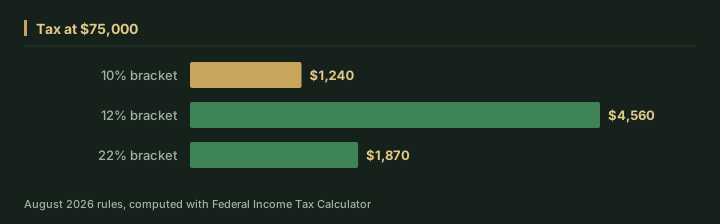
Holding income at $75,000, we ran the same calculation again and kept the breakdown it returns. The total is not one rate applied once — for the 2026 tax year it is built from 3 parts:
| Part | Tax |
|---|---|
| 10% bracket | $1,240 |
| 12% bracket | $4,560 |
| 22% bracket | $1,870 |
Assumptions behind these figures
| Input | Value |
|---|---|
| Income | $75,000 |
| Status | Single |
| Deduction type | Standard |
| Itemized | $0 |
| Year | 2026 |
| As of | August 2026 |
| Method | identical to /tools/federal-income-tax-calculator |
Brackets, thresholds and rates change from year to year, so treat these as August 2026 figures for the 2026 tax year. For your own situation, open the Federal Income Tax Calculator and enter your real numbers — the calculator runs the same code that produced every figure on this page.
Frequently Asked Questions
What actually changed in the federal tax code for 2026?
For most filers, the biggest annual change isn't new legislation but routine inflation indexing — the standard deduction and tax bracket thresholds are adjusted upward each year for inflation, which can modestly lower your effective tax rate even if nothing else about the law changed. The core structure, including the seven marginal rates, the SALT cap, and the capital gains rate schedule, is generally described as stable for the current tax year absent new legislation.
How can inflation indexing lower my taxes without any new law being passed?
Because the standard deduction and bracket thresholds move upward each year to keep pace with inflation, more of your income can be shielded from tax or taxed at lower rates even if your income only rose by the same amount as inflation. This means your effective tax rate can edge down slightly year over year purely from indexing, without any change to tax rates or rules.
How do I know if a tax law change I heard about actually applies to me?
The most reliable approach is to run your own numbers for last year and the current year side by side using a tax calculator, since generic headlines about tax changes often don't specify how they affect your particular income and filing status. Treat inflation-adjusted figures as near-certain and treat reports of new legislation as speculative until confirmed by official IRS guidance.