"2026 Tax Filing Deadlines: Mark Your Calendar"
Table of contents
- The dates that move, and why
- The 2026 federal calendar
- The one distinction that matters most: extension is not a payment delay
- Which deadlines have no extension at all
- Which deadline is your most important one?
- The two penalties, and why filing always beats hiding
- A worked timeline: the freelancer's year
- Build the calendar once, in January
- Frequently asked
- Sources
- Run the numbers
- How the result moves with expected income
- The same runs seen through required annual
- Assumptions behind these figures
If you could only memorize one tax date, which should it be — and is it the April one everyone names? Not necessarily. The deadline that costs you the most to miss depends on whether you are an employee with a refund coming or a freelancer paying your own way, and several of the dates people treat as fixed actually shift on the calendar each year. This is the full 2026 federal map: the dates that matter, why some move, and the critical distinction between a deadline you can extend and one you cannot. Quarterly payment sizing pairs with the Estimated Tax Payment Calculator and the method in how to calculate quarterly estimated taxes.
The dates that move, and why
A recurring source of missed deadlines is assuming a date is fixed when it floats. Federal tax due dates that fall on a weekend or a legal holiday roll to the next business day — and the District of Columbia's Emancipation Day (April 16) can push the April individual deadline later than the 15th in some years. The practical rule: know the approximate date from the table below, then confirm the exact date with the IRS each year rather than trusting memory.
The 2026 federal calendar
Approximate federal dates; confirm the exact day with the IRS, as weekend/holiday shifts apply.
| Approx. date | Deadline | Applies to |
|---|---|---|
| Mid-January 2026 | Q4 estimated payment for tax year 2025 | Self-employed / those with untaxed income |
| Late January 2026 | IRS begins accepting returns; employers must furnish W-2s and 1099s | Everyone |
| Mid-April 2026 | 2025 individual return due — file or request an extension; any tax owed is due now | All individual filers |
| Mid-April 2026 | Q1 estimated payment for tax year 2026 | Self-employed / those with untaxed income |
| Mid-June 2026 | Q2 estimated payment for tax year 2026 | Self-employed / those with untaxed income |
| Mid-September 2026 | Q3 estimated payment for tax year 2026 | Self-employed / those with untaxed income |
| Mid-October 2026 | Extended 2025 return due (if extension was filed) | Filers who extended in April |
| Mid-January 2027 | Q4 estimated payment for tax year 2026 | Self-employed / those with untaxed income |
Two things in this table trip people up every year. The April date is doing double duty — it is both the 2025 filing deadline and the first 2026 quarterly estimate, so a freelancer who only thinks about "filing" can miss a payment due the same week. And the estimated-tax "quarters" are not even three-month spacings: the gap from the April payment to the June payment is two months, not three.
The one distinction that matters most: extension is not a payment delay
This is the single most expensive misunderstanding in the entire calendar.
A filing extension extends the time to file the return. It does not extend the time to pay the tax.
Request the automatic extension in April and the paperwork deadline moves to October. The money is still due in April. If you owe and pay in October under an extension, you owe failure-to-pay penalties and interest from April regardless — the extension protected you from the (larger) failure-to-file penalty, nothing more. The correct use of an extension: estimate what you owe, pay that in April, then file the completed return by October. An extension is breathing room for the forms, never for the balance.
Which deadlines have no extension at all
Some dates are hard stops with no equivalent of the October relief:
- Estimated tax payments. Each quarterly date stands on its own. There is no extension; a late payment accrues an underpayment penalty for that period, which is why the safe-harbor method in how to calculate quarterly estimated taxes exists.
- The April payment deadline. Extendable for filing, never for paying.
- Most information returns (the W-2s and 1099s employers must issue) — a fixed obligation on the issuer, and the reason your documents should arrive by early February.
Which deadline is your most important one?
It depends on your situation, which is the answer to the opening question:
- Employee owed a refund: missing the April filing date carries no failure-to-pay penalty (you owe nothing), but you delay your own refund and start the clock on the limited window to claim it. File anyway — promptly.
- Anyone who owes: the April payment date is the costly one. Penalties and interest run from there regardless of any extension.
- Self-employed: the four estimated dates collectively outweigh the filing date, because missing them triggers penalties throughout the year before filing season even arrives.
Identify which row you are in and protect that date first.
The two penalties, and why filing always beats hiding
People who cannot pay often make the situation worse by not filing — exactly backwards. There are two separate penalties, and they are not the same size:
| Penalty | Triggered by | Relative size |
|---|---|---|
| Failure to file | Not filing (or extending) by the April deadline | The larger one — accrues fast per month late |
| Failure to pay | Not paying the tax owed by the April deadline | The smaller one — a lower monthly rate, plus interest |
Because the failure-to-file penalty is the heavier of the two, filing on time (or filing the automatic extension) protects you even when you cannot pay a cent. The worst outcome is owing money and not filing — you stack the bigger penalty on top of the smaller one for no reason. The correct move when cash is short: file or extend on time, pay what you can, and arrange an IRS payment plan for the rest. Silence is the only genuinely expensive choice.
A worked timeline: the freelancer's year
Dates collide for the self-employed in a way employees never see. Walk one tax-year-2025 freelancer through calendar 2026:
| Approx. date | What is simultaneously due |
|---|---|
| Mid-January 2026 | Q4-2025 estimated payment |
| Mid-April 2026 | 2025 return and any 2025 balance and Q1-2026 estimate — three obligations, one week |
| Mid-June 2026 | Q2-2026 estimate (only two months after Q1 — not a true quarter) |
| Mid-September 2026 | Q3-2026 estimate |
| Mid-October 2026 | Extended 2025 return, if extended in April |
| Mid-January 2027 | Q4-2026 estimate |
The April pile-up is where freelancers slip: thinking only about "filing" while a fresh-year quarterly payment is due the same week, and assuming the June payment is three months after April when it is two. Sizing those payments ahead with the Estimated Tax Payment Calculator and the method in how to calculate quarterly estimated taxes is what keeps the collision from becoming a penalty.
Build the calendar once, in January
The reliable defense is not memory — it is putting every applicable row from the table into a calendar with a one-week-ahead reminder, at the start of the year. An employee owed a refund needs only the April row. A freelancer needs all six. A homeowner who extends needs the October row flagged the moment the April extension is filed. Five minutes of calendar entry in January prevents the entire category of "I forgot the date" penalties, which are the most avoidable penalties in the tax system precisely because the dates are known a year in advance.
Frequently asked
Is the deadline always April 15? Approximately, but it shifts to the next business day for weekends and can be pushed by the DC Emancipation Day holiday. Treat "mid-April" as the planning date and confirm the exact day with the IRS each year.
If I file an extension, when is my tax due? Still in April. The extension moves only the filing deadline to October; the payment is due in April or penalties and interest accrue from then. This is the most common and expensive deadline mistake.
What if I can't pay what I owe by April? File on time (or extend) and pay as much as possible — the failure-to-file penalty is generally far larger than the failure-to-pay penalty, so filing protects you even if you cannot pay in full. Payment-plan options exist with the IRS.
Are state deadlines the same? Often close to the federal date but not guaranteed identical, and state extension rules differ. Check the state income tax guide for all 50 states and your state Department of Revenue.
When will I get my refund after filing? Most electronically filed refunds with direct deposit arrive within a few weeks, barring review. The full timeline and what delays it are in the tax refund process: how long does it take?.
Do quarterly payments have an extension option? No. Each is a hard date; a late one accrues a per-period penalty. Size them ahead with the Estimated Tax Payment Calculator.
Sources
The deadline structure follows standard IRS rules for individual returns, extensions (the automatic six-month filing extension), and estimated tax (Form 1040-ES). Exact 2026 dates depend on weekend and legal-holiday shifts, including DC Emancipation Day, and should be confirmed against the official IRS calendar each year. This article is general educational information, not tax advice; for penalty, payment-plan, or extension questions specific to your situation, consult the IRS directly or a CPA or Enrolled Agent.
Run the numbers
Everything below came out of this site's own Estimated Tax Payment Calculator. The figures are not quoted from anywhere else: each row is one run of the same calculation the tool page performs, using August 2026 rules. Put the same inputs in and you will get the same output.
How the result moves with expected income
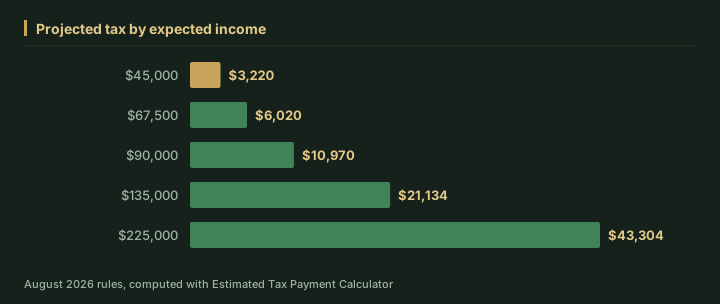
We ran 5 values of expected income through the calculator and left every other input at its default. As of August 2026, the output was:
| Expected income ($) | Projected tax ($) | Required annual ($) | Quarterly ($) |
|---|---|---|---|
| 45,000 | 3,220 | 2,898 | 724.5 |
| 67,500 | 6,020 | 5,418 | 1,354.5 |
| 90,000 | 10,970 | 9,873 | 2,468.25 |
| 135,000 | 21,134 | 19,020.6 | 4,755.15 |
| 225,000 | 43,304 | 38,973.6 | 9,743.4 |
Running expected income from $45,000 up to $225,000 moves projected tax from $3,220 to $43,304 — a spread of $40,084. That gap is the part a single headline rate never shows.
The same runs seen through required annual
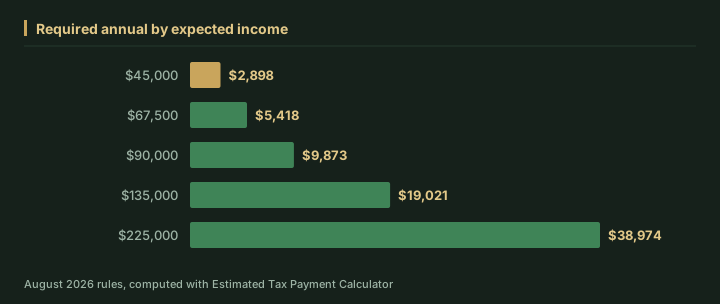
At $45,000, required annual works out to $2,898; at $225,000 it is $38,974. Looking only at projected tax tends to understate how much the outcome shifts across that range.
Assumptions behind these figures
| Input | Value |
|---|---|
| Expected income | $90,000 |
| Status | Single |
| Prior year tax | $0 |
| Withholding | $0 |
| Year | 2026 |
| As of | August 2026 |
| Method | identical to /tools/estimated-tax-payment-calculator |
Brackets, thresholds and rates change from year to year, so treat these as August 2026 figures for the 2026 tax year. For your own situation, open the Estimated Tax Payment Calculator and enter your real numbers — the calculator runs the same code that produced every figure on this page.
Frequently Asked Questions
What happens if I file a tax extension — do I get more time to pay too?
No, this is one of the most costly misunderstandings — a filing extension only extends the deadline to submit your paperwork, not the deadline to pay any tax you owe. If you owe money and pay it later under an extension, you'll generally still owe failure-to-pay penalties and interest calculated from the original filing deadline.
What's the difference between the failure-to-file and failure-to-pay penalties?
The failure-to-file penalty, triggered by not filing or requesting an extension by the deadline, is generally the larger of the two and accrues faster per month; the failure-to-pay penalty, triggered by not paying tax owed by the deadline, is generally smaller with a lower monthly rate plus interest. Because of this, it's almost always better to file on time, or file for an extension, even if you can't pay in full.
When are estimated tax payments due if they don't align with regular calendar quarters?
Estimated tax payments are generally due four times a year, but the periods are uneven rather than even three-month quarters — one gap is shorter, around two months, and the final period stretches into January of the following year. It's best to confirm the exact current-year due dates with the IRS rather than assuming standard quarterly spacing.
I can't afford to pay my full tax bill by the deadline — what should I do?
The generally recommended approach is to file your return, or file for an extension, on time regardless, pay as much as you can toward the balance, and set up a payment plan with the IRS for the remainder, since not filing at all triggers the larger failure-to-file penalty on top of what you already owe. Staying silent and not filing is generally the most expensive choice available; consider consulting a tax professional if you're unsure how to proceed.