"How to Calculate Quarterly Estimated Taxes"
Table of contents
- Who this is for
- Method A — The safe harbor (use this one)
- Method B — The current-year projection (more accurate, more work)
- Which method to use
- The deadlines are the other half
- The mixed case: a W-2 job plus side income
- A full-year worked plan
- What a missed quarter actually costs
- Quick answers
- Can I just pay 25% of my income each quarter?
- What if my income is uneven across the year?
- Do estimated payments cover state tax too?
- I underpaid one quarter — can I fix it by overpaying the next?
- Is the safe harbor 100% or 110%?
- How we keep this accurate
- Run the numbers
- How the result moves with expected income
- The same runs seen through required annual
- Assumptions behind these figures
How much should a quarterly estimated payment actually be? Ask ten freelancers and you will get ten guesses, several of them a flat "25% of whatever I made." A guess is how penalties happen. There are exactly two correct ways to size estimated payments — one based on this year's projected tax, one based on last year's actual tax — and the second is so close to foolproof that it is the one to learn first. This walkthrough does both, in order, with the 2026 numbers, using the Estimated Tax Payment Calculator. For the deadlines and the why, pair it with estimated tax payments: when and how.
Who this is for
If income arrives without federal tax withheld — self-employment, freelance, investment, rental, large capital gains — the IRS still wants the tax during the year, in four installments, not in one lump at filing. Generally you must pay estimates if you expect to owe $1,000 or more after withholding and credits. Employees with only W-2 wages usually do not need to; their withholding handles it.
Method A — The safe harbor (use this one)
The safe harbor is a rule that says: pay in enough relative to last year's tax and no underpayment penalty applies, regardless of how this year turns out. That last clause is why it is powerful — it works even in a year your income explodes, because it is anchored to a number that is already known and final.
The required total for the year is the smaller of:
- 90% of the current year's total tax, or
- 100% of last year's total tax — 110% if last year's adjusted gross income was over $150,000.
Pick the prior-year figure and you are sizing payments off a fact, not a forecast. Divide that total by four; that is each quarterly payment.
Worked example. Last year's total tax was $14,000, prior-year AGI under $150,000:
| Step | Amount |
|---|---|
| Prior-year total tax | $14,000 |
| Safe-harbor target (100%) | $14,000 |
| ÷ 4 quarters | $3,500 per quarter |
Pay $3,500 each quarter and no underpayment penalty applies even if this year's income — and this year's actual tax — comes in far higher. You would still owe the extra real tax at filing, but penalty-free. That is the trade the safe harbor offers: certainty now, settle the remainder in April.
Method B — The current-year projection (more accurate, more work)
The safe harbor protects you from penalties; it does not guarantee you are paying the right amount this year. If income dropped, prior-year safe harbor overpays. If you want each payment to track reality, project the current year:
- Estimate annual net self-employment profit and any other untaxed income.
- Compute self-employment tax with the Self-Employment Tax Calculator (15.3% of 92.35% of net profit, capped at the 2026 wage base).
- Compute federal income tax on taxable income with the Federal Income Tax Calculator — and remember to subtract the half-SE-tax deduction first.
- Add them, subtract expected credits and any withholding, divide by four.
Worked example. Freelancer, $70,000 projected net profit, single, 2026:
| Step | Amount |
|---|---|
| Net profit | $70,000 |
| SE tax (≈15.3% of 92.35%) | ≈ $9,890 |
| ½ SE tax deduction | −$4,945 |
| Standard deduction (single, 2026) | −$16,100 |
| Taxable income | ≈ $48,955 |
| Federal income tax (10%/12% bands) | ≈ $5,627 |
| Total estimated tax | ≈ $15,517 |
| Per quarter (÷4) | ≈ $3,879 |
The Estimated Tax Payment Calculator runs this stack end to end so you are not chaining tools by hand.
Which method to use
| Situation | Better method |
|---|---|
| Income similar to or higher than last year | Safe harbor (Method A) — simplest, penalty-proof |
| Income clearly lower than last year | Current-year projection (Method B) — avoids overpaying |
| First year of self-employment (no prior-year tax) | Method B — there is no prior year to anchor to |
| You want zero risk of a penalty and don't mind a true-up in April | Safe harbor (Method A) |
A common, sensible default for an established freelancer: size payments on the prior-year safe harbor for penalty protection, and if this year is clearly bigger, set aside the extra real tax separately so April's true-up is funded.
The deadlines are the other half
Sizing the payment correctly and paying it late still triggers a penalty, because the penalty is calculated per-period. The four 2026 federal due dates fall in April, June, September, and January of the following year — the exact dates are listed in 2026 tax filing deadlines, and the period structure is explained in estimated tax payments: when and how. The note worth internalizing: the four "quarters" are not equal calendar quarters, so do not assume even three-month spacing.
The mixed case: a W-2 job plus side income
Many people are not pure freelancers — they have a W-2 job and untaxed side income. There is a cleaner fix here than four estimated payments, and most people miss it: increase W-2 withholding to cover the side income, using Step 4(c) of the W-4. Withholding is treated as paid evenly across the year regardless of when it actually happened, which means a December withholding bump can retroactively cure an earlier-quarter shortfall in a way a late estimated payment cannot. For someone with a steady paycheck and modest side income, raising withholding is simpler and more forgiving than managing a separate quarterly schedule. Reserve formal estimated payments for when side income is large relative to wages, or when there is no W-2 to adjust. The W-4 lever is detailed in how to adjust your W-4 for maximum take-home pay.
A full-year worked plan
Tie the methods together for the $70,000 freelancer, single, 2026, whose prior-year total tax was $12,000 (AGI under $150,000):
| Decision point | Choice | Figure |
|---|---|---|
| Penalty protection floor | Safe harbor, 100% of prior year | $12,000 |
| This year's projected actual tax (Method B) | Higher than prior year | ≈ $15,517 |
| Quarterly payment to stay penalty-safe | Safe harbor ÷ 4 | $3,000 / quarter |
| Extra real tax owed at filing | Projected − safe harbor | ≈ $3,517 |
| Action | Pay $3,000 each quarter; set aside the ~$3,517 separately for April | — |
This is the practical synthesis: size payments on the prior-year safe harbor so a penalty is impossible, and reserve the difference between projected and safe-harbor tax in a separate account so April's true-up is funded rather than a shock. Penalty-proof and cash-ready is the goal, not a single perfect number.
What a missed quarter actually costs
The underpayment penalty is effectively interest, charged per period from the date the payment was due until it is paid. It is not catastrophic on a small shortfall, but it is pure waste — there is no deduction for it and no upside. More importantly, an early-quarter miss compounds: the shortfall accrues across every subsequent period until covered, so a Q1 miss discovered in Q4 has been running the whole year. The lesson is not "panic over a small slip" but "the safe harbor exists precisely so this never has to be calculated" — anchor to it and the penalty question disappears.
Quick answers
Can I just pay 25% of my income each quarter?
No. That ignores the standard deduction, the bracket structure, and the SE-tax base, and it has no relationship to the safe harbor. It will be wrong in one direction or the other — usually overpaying low earners and underpaying higher ones.
What if my income is uneven across the year?
Either keep payments level on the prior-year safe harbor (simplest), or use the annualized income method, which sizes each payment to income actually earned by that point — useful for seasonal work. The annualized method is more paperwork; the safe harbor sidesteps the problem entirely.
Do estimated payments cover state tax too?
No. States with income tax run their own estimated-payment systems and deadlines. Check the state income tax guide for all 50 states and your state Department of Revenue.
I underpaid one quarter — can I fix it by overpaying the next?
It helps but does not fully erase it. The penalty is computed per period, so a shortfall in an early quarter accrues until covered. Catching up sooner reduces it; it does not retroactively undo it.
Is the safe harbor 100% or 110%?
100% of last year's total tax, or 110% if last year's AGI exceeded $150,000. Use the higher figure if you are over that threshold.
How we keep this accurate
The 90% / 100% / 110% safe-harbor thresholds, the $1,000 filing trigger, and the period structure follow current IRS rules for estimated tax (Form 1040-ES). The 2026 brackets, the $16,100 standard deduction, the 15.3% SE rate, the 92.35% factor, and the $184,500 Social Security wage base are the projected 2026 figures used across the Estimated Tax Payment Calculator and Self-Employment Tax Calculator, reconciled to the official IRS and Social Security Administration releases at year-end. Every figure here is a planning projection, not a filed certainty; a CPA or Enrolled Agent should confirm the right method and amount for your specific income pattern.
Run the numbers
Everything below came out of this site's own Estimated Tax Payment Calculator. The figures are not quoted from anywhere else: each row is one run of the same calculation the tool page performs, using August 2026 rules. Put the same inputs in and you will get the same output.
How the result moves with expected income
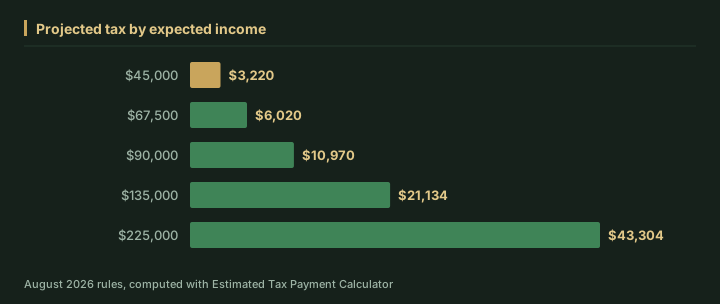
We ran 5 values of expected income through the calculator and left every other input at its default. As of August 2026, the output was:
| Expected income ($) | Projected tax ($) | Required annual ($) | Quarterly ($) |
|---|---|---|---|
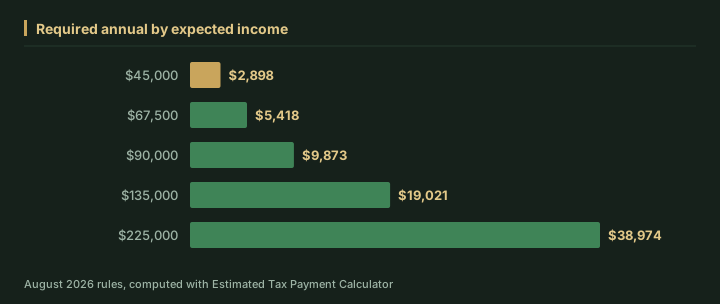
| 45,000 | 3,220 | 2,898 | 724.5 |
| 67,500 | 6,020 | 5,418 | 1,354.5 |
| 90,000 | 10,970 | 9,873 | 2,468.25 |
| 135,000 | 21,134 | 19,020.6 | 4,755.15 |
| 225,000 | 43,304 | 38,973.6 | 9,743.4 |
Running expected income from $45,000 up to $225,000 moves projected tax from $3,220 to $43,304 — a spread of $40,084. That gap is the part a single headline rate never shows.
The same runs seen through required annual
At $45,000, required annual works out to $2,898; at $225,000 it is $38,974. Looking only at projected tax tends to understate how much the outcome shifts across that range.
Assumptions behind these figures
| Input | Value |
|---|---|
| Expected income | $90,000 |
| Status | Single |
| Prior year tax | $0 |
| Withholding | $0 |
| Year | 2026 |
| As of | August 2026 |
| Method | identical to /tools/estimated-tax-payment-calculator |
Brackets, thresholds and rates change from year to year, so treat these as August 2026 figures for the 2026 tax year. For your own situation, open the Estimated Tax Payment Calculator and enter your real numbers — the calculator runs the same code that produced every figure on this page.
Frequently Asked Questions
How do I calculate how much to pay in quarterly estimated taxes?
There are two standard methods: the safe harbor approach, where you pay based on 100% (or 110% for higher earners) of last year's total tax divided into four payments, or the current-year projection approach, where you estimate this year's actual income and tax and divide that total by four. The safe harbor method is simpler and protects you from penalties regardless of how the current year turns out.
What is the safe harbor rule and why is it useful?
The safe harbor rule says that if you pay in at least the required percentage of last year's tax through withholding and estimated payments, you generally avoid an underpayment penalty no matter how much your current-year tax liability ends up being. It's useful because it lets you size payments off an already-known number instead of forecasting an uncertain current year.
What happens if I have a W-2 job plus untaxed side income — do I need to make estimated payments?
Not necessarily; a simpler alternative is often to increase withholding from your regular paycheck using the extra-withholding line on your W-4 to cover the side income, since withholding is generally treated as paid evenly throughout the year regardless of when it's actually withheld. This can be easier to manage than a separate quarterly estimated payment schedule, especially if the side income is modest relative to your wages.
Try the related calculators
Related guides
"How to Determine Your Tax Bracket"
"\"I'm in the 24% bracket\" is almost always either wrong or misunderstood. Here is how to find the bracket yo...
"How to Estimate Your Tax Refund Before Filing"
A married couple expected a $3,000 refund and owed $1,900 instead. The number was knowable in October. Here is...
"How to Use Our Federal Income Tax Calculator"
A one-minute walkthrough of the federal income tax calculator — what each input means, why the result has thre...