"How to Determine Your Tax Bracket"
Table of contents
- Your bracket is set by taxable income, not salary
- Step 1 — Compute taxable income
- Step 2 — Find the band it lands in
- A worked determination
- Step 3 — Understand what the bracket means (this is the real lesson)
- What the bracket is good for
- The "bracket creep" most people walk into
- A worked edge case: income that straddles two bands
- Frequently asked
- Sources
- Run the numbers
- How the result moves with income
- The same runs seen through after-tax income
- Where the total comes from
- Assumptions behind these figures
"I'm in the 24% bracket" is one of the most confidently repeated and most frequently wrong statements in personal finance. Sometimes the bracket is misidentified because the speaker used gross income instead of taxable income. More often the bracket is right but the conclusion drawn from it — "so I pay 24% of my income" — is flatly false. Determining your tax bracket is two separate questions: which bracket, and what it actually means. This walkthrough answers both, with 2026 numbers, using the Tax Bracket Calculator. The full theory is in how federal tax brackets work in 2026.
Your bracket is set by taxable income, not salary
The single most common error is finding the bracket from gross salary. Brackets apply to taxable income — gross income minus adjustments minus the standard or itemized deduction. The 2026 standard deduction is $16,100 (single), $32,200 (married filing jointly), $24,150 (head of household). A $95,000 salary is not a $95,000 bracket lookup; it is roughly a $79,000 (single) lookup after the standard deduction. Skipping that subtraction overstates the bracket for almost everyone.
Step 1 — Compute taxable income
Start with gross income. Subtract above-the-line adjustments (traditional retirement contributions, the deductible half of self-employment tax, HSA contributions, and similar). Subtract the standard deduction for your filing status, or itemized deductions if they are larger — which is the question in standard vs itemized deductions. The result is taxable income, and only this number determines the bracket.
Step 2 — Find the band it lands in
Match taxable income to the 2026 schedule for your filing status. Head of household, 2026:
| Rate | Head of household taxable income |
|---|---|
| 10% | $0 – $17,700 |
| 12% | $17,700 – $67,450 |
| 22% | $67,450 – $105,700 |
| 24% | $105,700 – $201,775 |
| 32% | $201,775 – $256,200 |
| 35% | $256,200 – $640,600 |
| 37% | $640,600+ |
Your marginal bracket is the band your highest dollar of taxable income reaches. The Tax Bracket Calculator does the match for any income and filing status, and reports the marginal and effective rates together so the next section's mistake is impossible to make.
A worked determination
Head of household, $95,000 gross income, 2026, standard deduction:
| Step | Amount |
|---|---|
| Gross income | $95,000 |
| Standard deduction (HoH, 2026) | −$24,150 |
| Taxable income | $70,850 |
| Band it lands in | 22% ($67,450 – $105,700) |
This person is "in the 22% bracket." But determining the bracket is only useful once you know what that sentence does and does not mean.
Step 3 — Understand what the bracket means (this is the real lesson)
Being "in the 22% bracket" does not mean 22% of income goes to tax. It means:
- Only taxable income above $67,450 is taxed at 22% — here, just the slice from $67,450 to $70,850.
- Everything below is still taxed at 10% and 12%, exactly as if you earned less.
- Your next dollar is taxed at 22% — that is what the bracket prices.
- Your average (effective) rate is far lower — total tax ÷ income, which for this person is closer to 9%.
So the bracket is the rate on the next dollar, not the rate on all dollars. The gap between the two is the entire subject of marginal vs effective tax rate explained, and the Tax Bracket Calculator shows both numbers precisely so you never conflate them.
What the bracket is good for
Knowing your marginal bracket answers real questions the effective rate cannot:
- Is a raise worth it? A $5,000 raise for the person above is taxed at 22%, netting $3,900 federally. (Still worth taking — you simply keep less than 100% of the new dollars.)
- What is a deduction worth? A deduction saves at your marginal rate: $1,000 deducted saves $220 at 22%. This is why deductions favor higher earners; the contrast with credits is in tax credits vs tax deductions.
- Traditional or Roth? You compare today's marginal bracket against your expected bracket in retirement — the core decision in traditional vs Roth IRA tax.
- Should I defer income to next year? Only worth it if your marginal bracket differs between the years; the mechanics are in how to reduce taxable income legally.
The "bracket creep" most people walk into
There is a quieter way to misjudge your bracket: assuming this year's bracket equals last year's because your salary did not change. Two things move the bracket without a raise. First, the thresholds index for inflation every year, so a flat salary can drift into a lower effective position over time — a small gift the Tax Bracket Calculator makes visible if you run the same income across two years. Second, the opposite: a one-off event — a bonus, a Roth conversion, a large capital gain, a retirement withdrawal — stacks on top of ordinary income and can push your top dollars into the next band for that year only. Your bracket is a property of a specific year's taxable income, not a fixed label you keep. Re-determine it whenever income changes shape, not just size.
A worked edge case: income that straddles two bands
The most useful thing the bracket tells you is what happens at the edge. Take the head-of-household filer from earlier at $70,850 taxable income — $3,400 into the 22% band. Suppose a $6,000 bonus arrives:
| Before bonus | After $6,000 bonus | |
|---|---|---|
| Taxable income | $70,850 | $76,850 |
| Band of the top dollar | 22% | 22% |
| Tax on the new $6,000 | — | $6,000 × 22% = $1,320 |
| Bonus kept after federal income tax | — | $4,680 |
The whole $6,000 is taxed at 22% because it all lands inside the 22% band ($67,450–$105,700). Nothing below $67,450 is re-taxed — the bonus did not "bump my whole income up a bracket," it was simply taxed at the marginal rate. Had the bonus been large enough to cross $105,700, only the portion above that line would hit 24%. This is the single calculation that dissolves the most damaging bracket myth, and it is exactly what the Tax Bracket Calculator shows when you change the income input.
Frequently asked
Does a raise push all my income into a higher bracket? No. This is the most damaging bracket myth. Only the dollars above the next threshold are taxed at the higher rate; everything below keeps its old, lower rates. You never take home less by earning more.
Which income do I use — gross or taxable? Taxable income, always: gross minus adjustments minus the standard or itemized deduction. Using gross overstates the bracket.
Is my bracket the rate I actually pay? No — that is the effective rate, which is materially lower. The bracket is the rate on your next dollar only.
Can I be in two brackets? In a sense you are in all of them up to your top one — income is taxed band by band. "Your bracket" is shorthand for the highest band you reach.
Do state taxes change my federal bracket? No. State tax is computed separately on its own brackets; see how to calculate state income tax for your state. It does add to your total burden, just not to the federal bracket.
Does the bracket include Social Security and Medicare tax? No. FICA is separate from income tax brackets, so your total federal rate on a dollar is higher than the bracket alone.
Sources
The 2026 bracket thresholds and the $16,100 / $32,200 / $24,150 standard deductions are projected figures: the permanent statutory rate schedule with the IRS annual inflation adjustment applied, reconciled to the official IRS Revenue Procedure once released, and matching the values used by the Tax Bracket Calculator. Every figure here is a planning projection rather than a filed certainty. This is general educational information, not tax advice; a CPA or Enrolled Agent can confirm the adjustments that set your taxable income and therefore your bracket.
Run the numbers
Everything below came out of this site's own Tax Bracket Calculator. The figures are not quoted from anywhere else: each row is one run of the same calculation the tool page performs, using August 2026 rules. Put the same inputs in and you will get the same output.
How the result moves with income
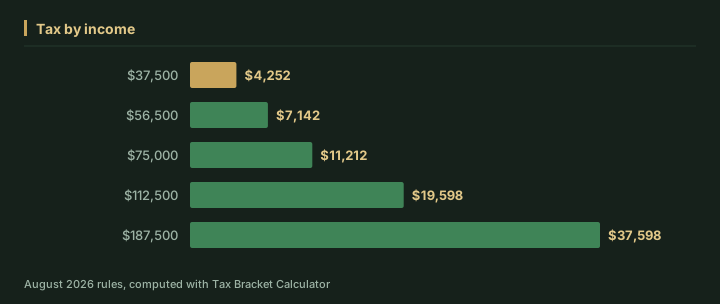
We ran 5 values of income through the calculator and left every other input at its default. As of August 2026, the output was:
| Income ($) | Tax ($) | After-tax income ($) | Marginal tax rate (%) |
|---|---|---|---|
| 37,500 | 4,252 | 33,248 | 12% |
| 56,500 | 7,142 | 49,358 | 22% |
| 75,000 | 11,212 | 63,788 | 22% |
| 112,500 | 19,598 | 92,902 | 24% |
| 187,500 | 37,598 | 149,902 | 24% |
Running income from $37,500 up to $187,500 moves tax from $4,252 to $37,598 — a spread of $33,346. That gap is the part a single headline rate never shows.
The same runs seen through after-tax income
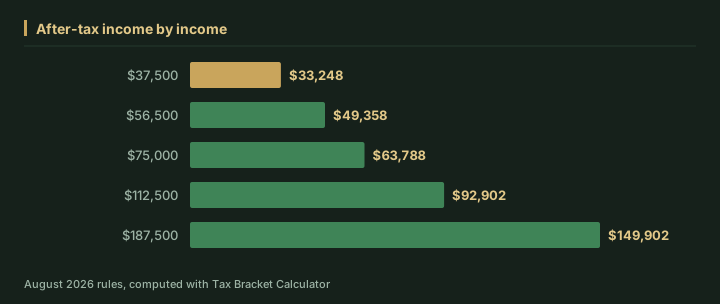
At $37,500, after-tax income works out to $33,248; at $187,500 it is $149,902. Looking only at tax tends to understate how much the outcome shifts across that range.
Where the total comes from
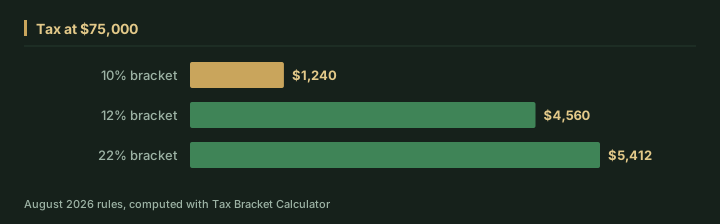
Holding income at $75,000, we ran the same calculation again and kept the breakdown it returns. The total is not one rate applied once — for the 2026 tax year it is built from 3 parts:
| Part | Tax |
|---|---|
| 10% bracket | $1,240 |
| 12% bracket | $4,560 |
| 22% bracket | $5,412 |
Assumptions behind these figures
| Input | Value |
|---|---|
| Income | $75,000 |
| Status | Single |
| Year | 2026 |
| As of | August 2026 |
| Method | identical to /tools/tax-bracket-calculator |
Brackets, thresholds and rates change from year to year, so treat these as August 2026 figures for the 2026 tax year. For your own situation, open the Tax Bracket Calculator and enter your real numbers — the calculator runs the same code that produced every figure on this page.
Frequently Asked Questions
How do I find out what tax bracket I'm in?
Start with your gross income, subtract above-the-line adjustments and then your standard or itemized deduction to get your taxable income, and match that taxable income figure against the bracket table for your filing status. The bracket your highest dollar of taxable income falls into is your marginal tax bracket — using gross salary instead of taxable income is the most common way people get this wrong.
Does being in the 24% tax bracket mean I pay 24% of my income in tax?
No, this is one of the most common misunderstandings in personal finance — being in a bracket only means that your last dollars of taxable income are taxed at that rate, not that all of your income is taxed at that rate. Because of the progressive system, your actual average, or effective, rate is typically much lower than your marginal bracket rate.
Can my tax bracket change even if my salary stays the same?
Yes, two things can shift your bracket without a raise: bracket thresholds are adjusted for inflation each year, which can effectively lower your position, and a one-time event like a bonus, large capital gain, or retirement withdrawal can push your top dollars into a higher bracket for that year only. Your bracket is a property of a specific year's taxable income, not a permanent label.
How does knowing my tax bracket help with financial decisions?
Your marginal bracket tells you the actual tax cost of a raise, the real dollar value of a deduction, and is central to decisions like choosing between a traditional or Roth retirement account, since a deduction generally saves you exactly your marginal rate per dollar. It's a more useful number than your effective rate for evaluating changes to your income going forward.
Try the related calculators
Related guides
"How to Estimate Your Tax Refund Before Filing"
A married couple expected a $3,000 refund and owed $1,900 instead. The number was knowable in October. Here is...
"How to Use Our Federal Income Tax Calculator"
A one-minute walkthrough of the federal income tax calculator — what each input means, why the result has thre...
"How to Calculate State Income Tax for Your State"
"Federal tax is one rulebook. State income tax is up to 51 of them — flat, progressive, or none at all. Here i...