"How to Estimate Your Tax Refund Before Filing"
Table of contents
- The one equation behind every refund
- Step 1 — Estimate total tax owed
- Step 2 — Total what you have paid in
- Step 3 — Subtract
- A worked estimate
- When to run it — and why timing is the whole point
- Why a big refund is not the win it feels like
- The four things that move the estimate most
- A worked correction: the mid-year job change
- Frequently asked
- Sources
- Run the numbers
- How the result moves with income
- The same runs seen through taxable income
- Assumptions behind these figures
A married couple filed in April expecting a $3,000 refund. The return came back showing they owed $1,900 — a $4,900 swing they had no warning about and no cash set aside for. Nothing exotic happened: one spouse changed jobs mid-year, withholding reset, and nobody checked. The painful part is that the answer was fully knowable the previous October. A refund is not a reward and a balance due is not a penalty — both are just the difference between what was withheld and what was actually owed, and that difference can be estimated months ahead. This walkthrough shows how, using the Tax Refund Estimator.
The one equation behind every refund
Strip away the forms and a refund or balance due is a single subtraction:
Refund (or balance due) = Total tax owed − Total paid in during the year
If you paid in more than you owed, the difference is refunded. If you paid in less, you owe it. "Total paid in" is mostly paycheck withholding for employees and quarterly estimated payments for the self-employed, plus refundable credits. That is the entire model the Tax Refund Estimator runs — there is no magic, only those two quantities.
Step 1 — Estimate total tax owed
This is the harder half. Start from projected annual gross income, subtract the 2026 standard deduction for your filing status ($16,100 single, $32,200 married filing jointly, $24,150 head of household), and apply the brackets — the Federal Income Tax Calculator does exactly this, and the logic is in how federal tax brackets work in 2026. Add any self-employment tax if relevant, and subtract credits you reasonably expect. The result is your projected total tax.
Step 2 — Total what you have paid in
For an employee, this is year-to-date federal income tax withheld from pay stubs, projected to year-end. A recent pay stub shows the running total; multiply the per-period amount by remaining periods and add it on. For the self-employed, it is the sum of quarterly estimated payments made and planned. Include any refundable credits you qualify for.
Step 3 — Subtract
Owed minus paid-in. Positive paid-in-over-owed is a refund; negative is a balance due. The Tax Refund Estimator performs all three steps once you enter income, filing status, and withholding to date.
A worked estimate
Married filing jointly, $120,000 combined gross income, $11,500 federal income tax withheld year-to-date and on track to reach about $13,800 by year-end, 2026, standard deduction:
| Step | Amount |
|---|---|
| Gross income | $120,000 |
| Standard deduction (MFJ, 2026) | −$32,200 |
| Taxable income | $87,800 |
| Tax: 10% / 12% / 22% bands | ≈ $10,896 |
| Projected withholding (year-end) | $13,800 |
| Estimated refund | ≈ $2,904 |
Had withholding been on track for only $9,000 — the realistic outcome after an untracked mid-year job change — the same couple would owe roughly $1,900 instead. Same income, same tax; the entire swing is the paid-in side. That is the scenario the estimator exists to catch before April, not after.
When to run it — and why timing is the whole point
The value of the estimate is inversely proportional to how late you run it.
- Early in the year: rough, but enough to set expectations.
- Mid-year: the highest-value moment. There is still time to adjust a W-4 and change the outcome — raise withholding to avoid owing, or stop massively overwithholding and reclaim that cash now instead of lending it interest-free until spring.
- Late in the year (Oct–Dec): the most accurate, because most of the year's income and withholding is known. Last chance to fix withholding before the year closes.
- At filing: too late to change anything; the number is now fixed.
If the estimate shows a large refund or a large balance due, the lever is your W-4 — how to fill out a W-4 form (2026) and how to adjust your W-4 for maximum take-home pay show exactly which line to change.
Why a big refund is not the win it feels like
A $4,000 refund means roughly $330 a month was withheld beyond what was owed and handed to the government interest-free until spring. The estimator's quieter purpose is to surface chronic overwithholding so the W-4 can be tuned toward a small refund or a small balance due — keeping that money in each paycheck instead of as a once-a-year lump that inflation has already eroded.
The four things that move the estimate most
When an estimate turns out wrong, it is almost always one of four inputs that drifted — and three of them are knowable mid-year:
- A job change. New employers restart withholding from a fresh W-4 with no knowledge of pay already earned, which routinely under-withholds the higher earner. This is the single most common cause of an unexpected balance due.
- A second income. A spouse starting work, or a side gig with no withholding, adds tax the original W-4 never anticipated.
- A big one-off. A bonus (often under-withheld), a stock sale, or a retirement withdrawal lands tax that paycheck withholding never saw.
- A life change. Marriage, a new child, a home purchase — each shifts the deduction or credit picture, and therefore the gap.
Re-running the Tax Refund Estimator after any of these, rather than once in January, is what separates a controlled outcome from an April surprise.
A worked correction: the mid-year job change
Take the $120,000 couple again, but one spouse switched jobs in July. The new employer withheld as if the year started in July, so projected withholding lands at $9,000 instead of $13,800.
| On-track withholding | After untracked job change | |
|---|---|---|
| Total tax owed | $10,896 | $10,896 |
| Total withheld | $13,800 | $9,000 |
| Outcome | +$2,904 refund | −$1,896 owed |
The tax never changed. A $4,800 swing — from a comfortable refund to a four-figure bill — came entirely from the paid-in side, and it was visible in August on a single pay stub. Catching it then means raising Step 4(c) extra withholding for the rest of the year to close the gap before December; catching it in April means writing a check with no warning. The estimate's whole value is that it converts an invisible drift into a number you can still act on.
Frequently asked
Why is this only an estimate? It models federal income tax, the standard deduction, and withholding. A filed return can include items it does not — every credit, the Alternative Minimum Tax, the Net Investment Income Tax, capital gains, and state tax. It is a planning tool, deliberately, not a substitute for preparing the return.
My estimate and my filed refund differ. Why? Usually income or withholding came in different from the projection, or a credit or deduction the estimate did not model applied. Re-run it with year-end pay-stub actuals and the gap usually closes.
Does it include state refunds? No — federal only. State refunds follow separate state rules; see the state income tax guide for all 50 states.
I'm self-employed — can I still use it? Yes. Treat your quarterly estimated payments as the "paid-in" figure instead of withholding, and add self-employment tax to the owed side via the Self-Employment Tax Calculator. Sizing those quarterlies is covered in estimated tax payments: when and how.
Should I aim for a zero refund? Aiming for a small refund or small balance due is the efficient target — it means your withholding tracked your real tax and your money stayed in your paychecks during the year.
Sources
The 2026 brackets and standard deductions are projected inflation-adjusted figures applied to the permanent statutory rate schedule and reconciled to the official IRS Revenue Procedure at year-end, so estimates are well-grounded planning numbers rather than filed figures. Withholding mechanics follow IRS Form W-4 and Publication 15-T. This is general educational information, not tax advice; a CPA or Enrolled Agent can confirm a number that affects a real decision.
Run the numbers
Everything below came out of this site's own Tax Refund Estimator. The figures are not quoted from anywhere else: each row is one run of the same calculation the tool page performs, using August 2026 rules. Put the same inputs in and you will get the same output.
How the result moves with income
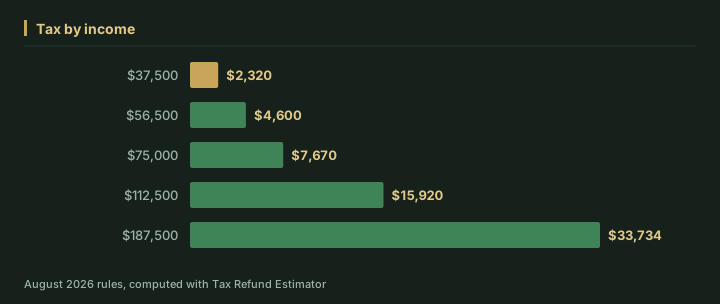
We ran 5 values of income through the calculator and left every other input at its default. As of August 2026, the output was:
| Income ($) | Tax ($) | Taxable income ($) | Balance ($) |
|---|---|---|---|
| 37,500 | 2,320 | 21,400 | 6,680 |
| 56,500 | 4,600 | 40,400 | 4,400 |
| 75,000 | 7,670 | 58,900 | 1,330 |
| 112,500 | 15,920 | 96,400 | 6,920 |
| 187,500 | 33,734 | 171,400 | 24,734 |
Running income from $37,500 up to $187,500 moves tax from $2,320 to $33,734 — a spread of $31,414. That gap is the part a single headline rate never shows.
The same runs seen through taxable income
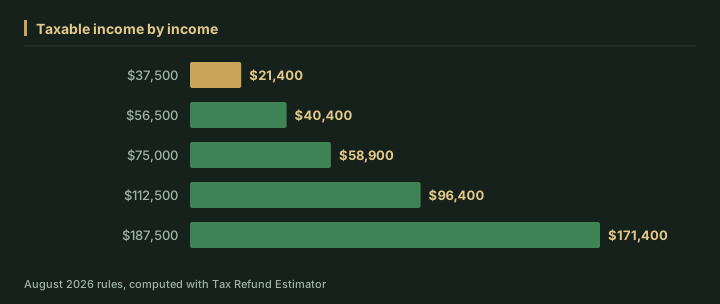
At $37,500, taxable income works out to $21,400; at $187,500 it is $171,400. Looking only at tax tends to understate how much the outcome shifts across that range.
Assumptions behind these figures
| Input | Value |
|---|---|
| Income | $75,000 |
| Status | Single |
| Withholding | $9,000 |
| Deduction type | Standard |
| Itemized | $0 |
| Credits | $0 |
| Year | 2026 |
| As of | August 2026 |
| Method | identical to /tools/tax-refund-estimator |
Brackets, thresholds and rates change from year to year, so treat these as August 2026 figures for the 2026 tax year. For your own situation, open the Tax Refund Estimator and enter your real numbers — the calculator runs the same code that produced every figure on this page.
Frequently Asked Questions
How can I estimate my tax refund before I actually file?
You can estimate it by projecting your total tax liability for the year, based on income, filing status, and deductions, and subtracting your total payments made so far, including withholding and estimated payments — the difference tells you whether you're on track for a refund or a balance due. Running this check mid-year, when there's still time to adjust withholding, is generally the most useful point to do it.
Why might my actual refund differ from what I expected?
The most common causes are a job change that reset withholding partway through the year, a second income such as a spouse's job or side gig with no or insufficient withholding, a large one-time event like a bonus or stock sale, or a life change like marriage or a new child that shifted your deductions and credits. Any of these can create a meaningful gap between an early-year estimate and your actual outcome.
Is getting a big tax refund actually a good thing?
Not necessarily — a large refund generally means you had more tax withheld from your paychecks than you actually owed throughout the year, effectively giving the government an interest-free loan of your own money. Many people prefer adjusting their withholding toward a smaller refund so they keep more of their pay in each paycheck instead of waiting for a lump sum at filing.
Try the related calculators
Related guides
"How to Determine Your Tax Bracket"
"\"I'm in the 24% bracket\" is almost always either wrong or misunderstood. Here is how to find the bracket yo...
"How to Use Our Federal Income Tax Calculator"
A one-minute walkthrough of the federal income tax calculator — what each input means, why the result has thre...
"How to Calculate State Income Tax for Your State"
"Federal tax is one rulebook. State income tax is up to 51 of them — flat, progressive, or none at all. Here i...