"How to Adjust Your W-4 for Maximum Take-Home Pay"
Table of contents
- What a refund actually is
- Step 1 — Find the size and direction of the gap
- Step 2 — Identify the lever on the form
- A worked adjustment
- Step 3 — Submit and verify
- The discipline that keeps it safe
- The two-earner trap
- A two-earner worked correction
- Where this connects
- Run the numbers
- How the result moves with income
- The same runs seen through projected tax
- Assumptions behind these figures
A married couple looked forward to their tax refund every spring — about $4,800, reliably. What they did not see was the other side of it: roughly $400 a month withheld from their paychecks beyond what they actually owed, handed to the Treasury interest-free, and returned a year later eroded by inflation. They were not getting a bonus. They were running a zero-interest loan, with themselves as the lender. One line on the W-4 closed the gap. This walkthrough shows how to tune withholding toward maximum legitimate take-home pay without tipping into owing at filing, using the W-4 Calculator. The form itself is decoded in how to fill out a W-4 form (2026).
What a refund actually is
A refund is not a reward and not free money. It is the return of your own over-withheld pay:
Refund = What was withheld − What you actually owed
A large refund means withholding ran well above your real tax all year. The cash existed the whole time; it was simply parked with the government instead of in your account. Adjusting the W-4 does not change the tax you owe by a cent — it changes when you receive your own money: spread across 26 paychecks, or in one lump every spring.
Step 1 — Find the size and direction of the gap
Before touching the form, estimate the year's outcome with the Tax Refund Estimator: projected total tax versus projected withholding. Three cases:
- Large refund → over-withholding. There is room to increase take-home pay.
- Roughly even → the W-4 is already well tuned; leave it.
- Balance due → under-withholding. The fix is the opposite — withhold more now to avoid an April bill and a possible penalty.
The goal is not the biggest possible paycheck; it is the W-4 setting that lands you near zero — a small refund or small balance due — so your money stays in your paychecks and April holds no shock.
Step 2 — Identify the lever on the form
The 2026 W-4 has no "allowances." It has dollar-based lines, and these are the ones that move take-home pay:
| W-4 line | Effect on each paycheck | Use when |
|---|---|---|
| Step 3: Dependents / credits | Increases take-home (lowers withholding) | You have qualifying children or other credits |
| Step 4(b): Deductions over the standard | Increases take-home | You itemize above the standard deduction |
| Step 4(a): Other income | Decreases take-home | You have untaxed income (interest, gig work) |
| Step 4(c): Extra withholding | Decreases take-home | You need to cover a known shortfall |
To raise take-home when you are over-withholding, the honest levers are claiming the dependent credits you are entitled to in Step 3 and entering legitimate excess deductions in Step 4(b). To reduce a refund you are deliberately over-funding, lower or remove any extra amount in Step 4(c) first.
A worked adjustment
Married filing jointly, $4,800 annual refund, paid every two weeks (26 periods). The refund means about $4,800 ÷ 26 ≈ $185 per paycheck was over-withheld.
| Before | After tuning the W-4 | |
|---|---|---|
| Refund target | $4,800 | ~$300 |
| Over-withheld per paycheck | ~$185 | ~$12 |
| Extra take-home per paycheck | — | ≈ $173 |
Reflecting the couple's qualifying child in Step 3 (worth a credit the prior W-4 ignored) and removing a stale extra-withholding entry brings withholding down to roughly match the real tax. Same annual tax, same total income — about $173 more in every paycheck and a refund deliberately kept small as a buffer. The W-4 Calculator turns a target outcome into the specific Step 3 / Step 4 entries to write on the form.
Step 3 — Submit and verify
Give the revised W-4 to the employer's payroll. Then check the next pay stub: confirm the federal withholding line moved in the intended direction and by roughly the expected amount. The most common failure is not a wrong form — it is a correct form that payroll has not processed yet, or processed differently than expected. Verify on the stub; do not assume.
The discipline that keeps it safe
Maximizing take-home is only smart if it does not turn into an April balance due plus an underpayment penalty. Two rules keep it on the right side:
- Re-estimate after any change. New job, marriage, a child, a spouse starting or stopping work, a big raise — each shifts the math. Re-run the Tax Refund Estimator and re-tune. A W-4 set correctly in January can be wrong by September.
- Aim for a small cushion, not exact zero. Targeting a modest refund rather than a precise $0 leaves a margin against estimate error — the efficient target is "small refund," not "biggest paycheck possible."
Under-withholding to inflate paychecks beyond your real tax is not a strategy; it is a deferred bill with a penalty attached. The objective is accurate withholding, which by definition maximizes legitimate take-home — not minimal withholding.
The two-earner trap
The most common reason a couple over- or under-withholds is not a single bad form — it is two correct forms that do not know about each other. Each spouse's payroll system withholds as if its salary is the household's only income, applying a full standard deduction and the low brackets to each job independently. Stack two incomes and the household's real tax is computed on the combined figure, which sits in higher bands than either job withheld for. The result is chronic under-withholding for two-earner couples who each filed a "normal" W-4.
The 2026 W-4 addresses this in Step 2, which has three options: use the IRS estimator, the form's worksheet, or the simple checkbox both spouses tick when the two jobs pay roughly similarly. The checkbox is the underrated fix — it tells both payroll systems to withhold at the rate appropriate to the combined income, eliminating most of the surprise. Couples who skip Step 2 entirely are the textbook "we both claimed standard and still owed $3,000" case.
A two-earner worked correction
Married couple, two jobs at $70,000 and $65,000, each filed a default single-job W-4, projected to owe about $2,600 at filing.
| Default W-4s (no Step 2) | Step 2 checkbox ticked | |
|---|---|---|
| Combined income | $135,000 | $135,000 |
| Tax owed | ≈ $15,200 | ≈ $15,200 |
| Total withheld | ≈ $12,600 | ≈ $15,400 |
| Outcome | −$2,600 owed | +$200 refund |
The tax never changed. Ticking one box on both forms moved withholding by roughly $2,800 across the year and turned a balance due into a tiny refund. This is the highest-value W-4 adjustment most dual-income households never make — and unlike chasing extra take-home, it protects against a penalty rather than risking one. Verify it the same way: check the next pay stub on both jobs and confirm withholding rose.
Where this connects
Withholding is one side of the refund equation; the tax owed is the other, computed from the brackets in how federal tax brackets work in 2026 and modeled in the Federal Income Tax Calculator. If your real goal is to lower the tax itself rather than just re-time it, that is a different lever entirely — pre-tax retirement contributions and other moves in how to reduce taxable income legally and retirement account tax benefits. The W-4 only decides the timing of cash you were always going to keep or owe; tune it so the timing works for you instead of the Treasury, re-check it whenever life changes, and keep a small cushion so the optimization never costs you a penalty. The 2026 figures behind the W-4 Calculator are projected inflation-adjusted values reconciled to the official IRS release at year-end, and a CPA or Enrolled Agent can confirm the right entries if your situation is unusual.
Run the numbers
Everything below came out of this site's own W-4 Calculator. The figures are not quoted from anywhere else: each row is one run of the same calculation the tool page performs, using August 2026 rules. Put the same inputs in and you will get the same output.
How the result moves with income
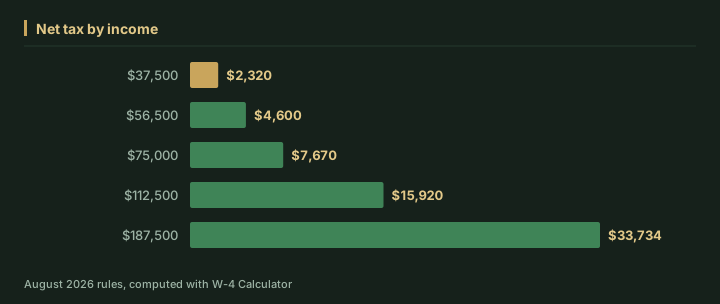
We ran 5 values of income through the calculator and left every other input at its default. As of August 2026, the output was:
| Income ($) | Net tax ($) | Projected tax ($) | Per paycheck ($) |
|---|---|---|---|
| 37,500 | 2,320 | 2,320 | 89.23 |
| 56,500 | 4,600 | 4,600 | 176.92 |
| 75,000 | 7,670 | 7,670 | 295 |
| 112,500 | 15,920 | 15,920 | 612.31 |
| 187,500 | 33,734 | 33,734 | 1,297.46 |
Running income from $37,500 up to $187,500 moves net tax from $2,320 to $33,734 — a spread of $31,414. That gap is the part a single headline rate never shows.
The same runs seen through projected tax
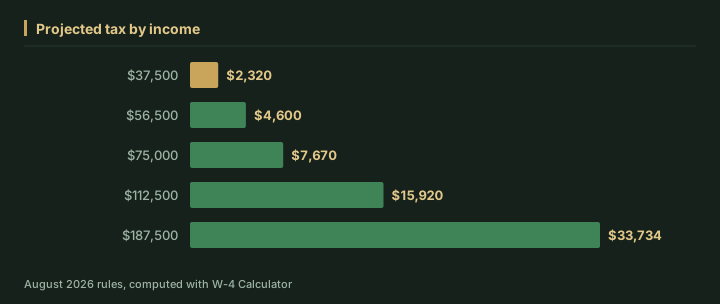
At $37,500, projected tax works out to $2,320; at $187,500 it is $33,734. Looking only at net tax tends to understate how much the outcome shifts across that range.
Assumptions behind these figures
| Input | Value |
|---|---|
| Income | $75,000 |
| Status | Single |
| Pay periods | $26 |
| Dependents under 17 | $0 |
| Other dependents | $0 |
| Extra | $0 |
| Year | 2026 |
| As of | August 2026 |
| Method | identical to /tools/w-4-calculator |
Brackets, thresholds and rates change from year to year, so treat these as August 2026 figures for the 2026 tax year. For your own situation, open the W-4 Calculator and enter your real numbers — the calculator runs the same code that produced every figure on this page.
Frequently Asked Questions
How can I get more money in each paycheck without owing taxes in April?
You can generally increase take-home pay by claiming dependents and credits you're actually entitled to in Step 3 of the W-4 and entering legitimate excess itemized deductions in Step 4(b), or by removing any unnecessary extra withholding in Step 4(c). The goal is accurate withholding that lands close to zero refund or balance due, not simply minimizing withholding below what you actually owe.
Is a big tax refund actually free money?
No, a large refund is simply the return of your own money that was over-withheld from your paychecks throughout the year, interest-free, rather than a bonus or reward. Adjusting your W-4 doesn't change how much tax you owe overall — it only changes whether you receive that money spread across your paychecks or as one lump sum the following spring.
How do I know if I should increase or decrease my withholding?
Generally, if you consistently receive a large refund, you're over-withholding and have room to reduce it; if you consistently owe money at filing, you're under-withholding and should increase it; and if the amount is roughly even, your current W-4 is likely well-tuned. Projecting your expected refund or balance due partway through the year, using a refund estimator, is a good way to check before making changes.
What should I do after submitting an updated W-4?
You should check your next pay stub to confirm the federal withholding line changed in the direction and roughly the amount you expected, since a correctly filled-out form that hasn't been processed yet, or was processed differently than intended, is a common source of confusion. Don't assume the change took effect — verify it directly on the pay stub.
Try the related calculators
Related guides
"How to Determine Your Tax Bracket"
"\"I'm in the 24% bracket\" is almost always either wrong or misunderstood. Here is how to find the bracket yo...
"How to Estimate Your Tax Refund Before Filing"
A married couple expected a $3,000 refund and owed $1,900 instead. The number was knowable in October. Here is...
"How to Use Our Federal Income Tax Calculator"
A one-minute walkthrough of the federal income tax calculator — what each input means, why the result has thre...