"How to Calculate State Income Tax for Your State"
Table of contents
- Step 1 — Find out which kind of state you are in
- Step 2 — Find the state taxable income
- Step 3 — Apply the rate
- A worked comparison
- What the calculator does and does not cover
- Why this matters beyond the single number
- A progressive state, worked band by band
- Two-state and part-year situations
- Questions people ask
- About these numbers
- Run the numbers
- How the result moves with income
- The same runs seen through marginal tax rate
- Where the total comes from
- Assumptions behind these figures
Federal income tax is one rulebook used by everyone. State income tax is up to fifty-one separate ones — some progressive like the federal system, some a single flat rate, and nine that do not tax wage income at all. That is why "what's my state tax?" has no general answer until you know which of those three worlds your state lives in. This walkthrough sorts that out and computes the tax in a few steps with the State Income Tax Calculator. The state-by-state landscape is mapped in the state income tax guide for all 50 states.
Step 1 — Find out which kind of state you are in
Before any arithmetic, classify your state:
| State type | How tax is figured | Examples |
|---|---|---|
| No income tax | Wage income is not taxed by the state at all | Texas, Florida, and seven others |
| Flat rate | One rate on (roughly) all taxable income | Illinois — 4.95% |
| Progressive | Bracketed rates that rise with income, like the federal system | California, New York |
Identifying the type tells you what to expect: a no-tax state means the state line of your calculation is zero; a flat state is one multiplication; a progressive state is a band-by-band computation like the federal one in how federal tax brackets work in 2026.
Step 2 — Find the state taxable income
States do not all start from the same number. Many begin from federal adjusted gross income or federal taxable income, then apply their own standard deduction or exemptions, which differ from the federal $16,100 / $32,200 figures. Some states tax capital gains and retirement income differently from the federal treatment. The practical rule: do not assume your federal taxable income is your state taxable income — the state base is usually related but rarely identical.
Step 3 — Apply the rate
Flat-rate state. One step. Illinois at 4.95% on $80,000 of state taxable income is $80,000 × 0.0495 = $3,960. No bands, no status table.
Progressive state. Band by band, exactly like the federal method: each slice of income taxed at its own rate, summed. The State Income Tax Calculator holds the 2026 brackets for the states that levy income tax and does this for you.
No-tax state. Zero. The calculator returns no state income tax for Texas, Florida, and the others — the value is in confirming it, then reading the trade-off, because no-income-tax states usually recover the revenue through higher sales and property taxes (see property tax basics and sales tax in the U.S.: a state-by-state overview).
A worked comparison
Single filer, $80,000 of state taxable income, 2026, same income in two states:
| State | Type | Calculation | State income tax |
|---|---|---|---|
| Illinois | Flat 4.95% | $80,000 × 0.0495 | $3,960 |
| Texas | None | — | $0 |
| California | Progressive | Band-by-band, 1% → 9.3% top band reached | ≈ $3,800 (varies with exact base) |
Same paycheck, a roughly $4,000 swing purely from the state. That is the figure the State Income Tax Calculator isolates so it can sit alongside your federal number rather than being buried in it. Note the California figure depends on the precise state taxable income after California's own deduction, which is why the calculator asks for inputs rather than quoting a flat percentage.
What the calculator does and does not cover
It computes state income tax for the states with brackets seeded for 2026 — the major progressive states and flat states — and returns zero for no-tax states. It is a planning estimate of the state income line, not a state return.
It does not compute every state's unique credits, local city or county income taxes (some cities levy their own — a real cost in parts of New York, Ohio, and Pennsylvania), or the precise state-specific adjustments to the income base. For states whose brackets are not individually seeded, treat the result as indicative and confirm the rate with that state's Department of Revenue.
Why this matters beyond the single number
State income tax stacks on top of federal and FICA, so it is part of your true marginal cost on the next dollar — the combined-rate logic in marginal vs effective tax rate explained. It is also one of the largest variables in any relocation or remote-work decision, and the headline "no income tax" is only half the comparison until sales and property taxes are added — the full version is worked through in California vs Texas state tax for 2026.
A progressive state, worked band by band
Flat states are one multiplication; progressive states deserve a full walkthrough because that is where people guess wrong. Take California-style brackets on $80,000 of state taxable income, single — the same band-by-band logic the State Income Tax Calculator applies:
| Band (illustrative CA-style) | Rate | Income taxed | Tax |
|---|---|---|---|
| $0 – $10,800 | 1% | $10,800 | $108 |
| $10,800 – $25,600 | 2% | $14,800 | $296 |
| $25,600 – $40,400 | 4% | $14,800 | $592 |
| $40,400 – $56,100 | 6% | $15,700 | $942 |
| $56,100 – $70,900 | 8% | $14,800 | $1,184 |
| $70,900 – $80,000 | 9.3% | $9,100 | $846 |
| Total | ≈ $3,968 |
The headline "9.3% bracket" would suggest $7,440 of tax; the real figure is about $3,968 because the lower bands are taxed at their own lower rates — the identical progressive logic as the federal system in marginal vs effective tax rate explained. Quoting the top band as your state rate overstates the bill by nearly double, exactly as it does federally.
Two-state and part-year situations
The hardest state calculations are not arithmetic — they are which state. Three common cases:
- Moved mid-year. You generally file a part-year return in each state, allocating income to the period you were a resident of each. Done correctly this is not double taxation; it is one income split across two returns.
- Live in one state, work in another. Many states tax non-resident income earned within their borders, and your home state then gives a credit for tax paid to the other — so you usually do not pay twice, but you do file twice.
- Remote work across state lines. A handful of states apply a "convenience of the employer" rule that can tax you where the employer sits even if you never set foot there. This is the costliest state-tax trap for remote workers and the one most worth professional confirmation.
The State Income Tax Calculator computes the rate within a state; it does not resolve residency or sourcing disputes, which depend on facts a calculator cannot see. The wider map of which states tax what is in the state income tax guide for all 50 states.
Questions people ask
If I work remotely for an out-of-state company, which state taxes me? Generally the state where you physically work or reside, but several states have aggressive sourcing rules and a few use a "convenience of the employer" test that can tax you where the employer is. This is one to confirm with a professional — it is a frequent and costly mistake.
Does my state tax Social Security or retirement income? It varies widely; many states exempt some or all retirement income, others tax it like wages. The interaction with account choice is in retirement account tax benefits.
Why is my state taxable income different from my federal? Because states apply their own deductions, exemptions, and add-backs to a federal starting point. Related but not identical is the rule.
Do I owe tax in two states if I moved mid-year? Usually yes — a part-year return in each, allocating income to the period of residency. Not double taxation if done correctly, but two filings.
Are city income taxes included here? No. Some localities levy a separate income tax on top of the state's; confirm locally if you live in one of those areas.
About these numbers
The 2026 state brackets used by the State Income Tax Calculator are projected figures reconciled to each state's Department of Revenue at year-end; flat rates like Illinois's 4.95% are statutory and stable, while progressive brackets are inflation-adjusted in some states and fixed in others. Local income taxes and state-specific credits are outside the model. This is general educational information, not tax advice — your state Department of Revenue or a CPA can confirm residency, sourcing, and credits for your situation.
Run the numbers
Everything below came out of this site's own State Income Tax Calculator. The figures are not quoted from anywhere else: each row is one run of the same calculation the tool page performs, using August 2026 rules. Put the same inputs in and you will get the same output.
How the result moves with income
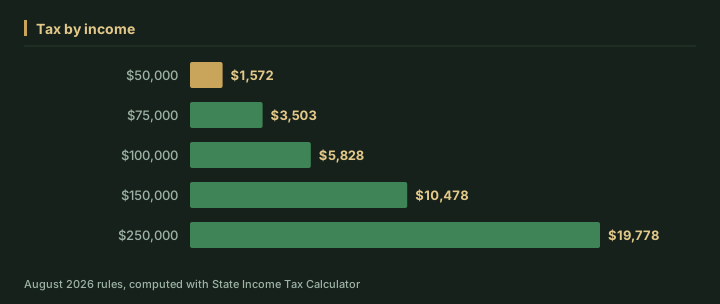
We ran 5 values of income through the calculator and left every other input at its default. As of August 2026, the output was:
| Income ($) | Tax ($) | Marginal tax rate (%) | Effective tax rate (%) |
|---|---|---|---|
| 50,000 | 1,572 | 6% | 3.14% |
| 75,000 | 3,503.3 | 9.3% | 4.67% |
| 100,000 | 5,828.3 | 9.3% | 5.83% |
| 150,000 | 10,478.3 | 9.3% | 6.99% |
| 250,000 | 19,778.3 | 9.3% | 7.91% |
Running income from $50,000 up to $250,000 moves tax from $1,572 to $19,778 — a spread of $18,206. That gap is the part a single headline rate never shows.
The same runs seen through marginal tax rate
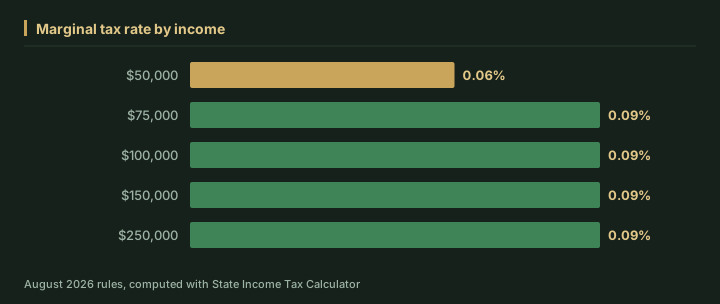
At $50,000, marginal tax rate works out to 6%; at $250,000 it is 9.3%. Looking only at tax tends to understate how much the outcome shifts across that range.
Where the total comes from
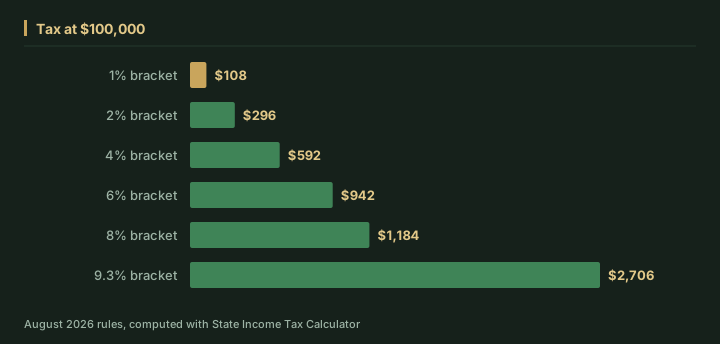
Holding income at $100,000, we ran the same calculation again and kept the breakdown it returns. The total is not one rate applied once — for the 2026 tax year it is built from 6 parts:
| Part | Tax |
|---|---|
| 1% bracket | $108 |
| 2% bracket | $296 |
| 4% bracket | $592 |
| 6% bracket | $942 |
| 8% bracket | $1,184 |
| 9.3% bracket | $2,706 |
Assumptions behind these figures
| Input | Value |
|---|---|
| Income | $100,000 |
| State | California |
| Status | Single |
| Year | 2026 |
| As of | August 2026 |
| Method | identical to /tools/state-income-tax-calculator |
Brackets, thresholds and rates change from year to year, so treat these as August 2026 figures for the 2026 tax year. For your own situation, open the State Income Tax Calculator and enter your real numbers — the calculator runs the same code that produced every figure on this page.
Frequently Asked Questions
How do I figure out my state income tax?
First identify what type of state tax system you're in — no income tax, a single flat rate, or a progressive bracket system similar to the federal one — since that determines the calculation method. Then determine your state taxable income, which often starts from your federal AGI or taxable income but applies the state's own deduction rules, and apply the appropriate flat rate or band-by-band bracket calculation.
Does my state taxable income equal my federal taxable income?
Not necessarily — while many states start their calculation from your federal adjusted gross income or federal taxable income, they generally apply their own deductions, exemptions, and adjustments on top, which can differ meaningfully from the federal standard deduction amounts. It's generally unsafe to assume the two figures are identical.
Do any U.S. cities charge their own local income tax in addition to state tax?
Yes, in some states certain cities or counties levy their own local income tax on top of the state tax, which is a real added cost in parts of states like New York, Ohio, and Pennsylvania. A general state-level calculator typically won't capture these local taxes, so it's worth checking with your specific city or county if you live in one of these areas.
Try the related calculators
Related guides
"How to Determine Your Tax Bracket"
"\"I'm in the 24% bracket\" is almost always either wrong or misunderstood. Here is how to find the bracket yo...
"How to Estimate Your Tax Refund Before Filing"
A married couple expected a $3,000 refund and owed $1,900 instead. The number was knowable in October. Here is...
"How to Use Our Federal Income Tax Calculator"
A one-minute walkthrough of the federal income tax calculator — what each input means, why the result has thre...