"Property Tax Basics: Understanding Your Tax Bill"
Table of contents
- The bill is one multiplication
- Assessed value is not market value
- What a "mill" actually means
- Why the same house costs wildly different amounts
- Exemptions: the third term most people leave on the table
- Why your bill changed when "nothing changed"
- Appeals and escrow: the two practical levers
- Where property tax sits in the federal picture
- How to actually read your assessment notice
- A worked appeal
- Why two identical houses pay different tax
- Common questions
- Run the numbers
- How the result moves with amount
- The same runs seen through total
- Assumptions behind these figures
Why does a $400,000 house generate a $1,400 annual tax bill in one state and close to $9,000 in another, for what is essentially the same house? And why did your bill jump when the county insists it did not raise the rate? Property tax confuses people because the bill hides the only two numbers that actually drive it, and because, unlike federal income tax, there is no single national rule — the tax is set and spent within a few miles of your front door, mostly to fund local schools.
This guide takes the bill apart: how the assessed value is set, what a mill rate or millage actually means, why your effective rate can be six times your neighbor-state's, how exemptions and escrow change what you feel, and where property tax fits against the rest of your tax picture. It pairs with the state income tax guide for all 50 states, because the states that lean hardest on property tax are often the ones that lean lightest on income tax.
The bill is one multiplication
Strip away the paperwork and almost every property tax bill is a single equation:
Tax = Assessed value × Tax rate − Exemptions
Everything that makes property tax feel arbitrary is really just disagreement, complexity, or change in one of those three terms. Master them and the bill stops being mysterious.
| Term | What it is | Who controls it |
|---|---|---|
| Assessed value | The taxable value the assessor assigns the property | County / local assessor |
| Tax rate (mill rate) | The rate applied to assessed value | Local taxing bodies (schools, county, city) |
| Exemptions | Reductions that lower the taxable base | State law + local programs |
Assessed value is not market value
The first trap is assuming the tax is calculated on what your home would sell for. It usually is not. The assessor assigns an assessed value, and many jurisdictions then apply an assessment ratio so the taxable value is only a fraction of market value. A home worth $400,000 in a place that assesses at 40% of market value has an assessed value of $160,000, and the rate is applied to the $160,000.
Two consequences follow. First, comparing raw tax rates between jurisdictions is meaningless without knowing each one's assessment ratio — a high rate on a low assessed fraction can be cheaper than a low rate on full market value. Second, assessments often lag the market. After a sharp price rise, assessed values catch up gradually (and in some states are capped in how fast they can rise per year), which is why your bill can climb for years even in a flat market — the assessment is still closing the gap to where prices already went.
What a "mill" actually means
The rate is frequently quoted in mills (millage). One mill is one dollar of tax per $1,000 of assessed value, i.e. 0.1%. A 25-mill levy is 2.5%.
The number that matters is the total mill rate — the sum of every overlapping taxing body. A single parcel is typically taxed by the school district, the county, the city or township, and sometimes special districts (fire, library, community college, water). Each sets its own millage; you pay the total. This is the property-tax echo of how sales tax stacks state on county on city, and it is why "the county didn't raise the rate" can be true while your bill still rose: the school district's levy or your assessed value moved.
A worked bill, $160,000 assessed value, total levy of 22 mills:
| Taxing body | Mills | Tax |
|---|---|---|
| School district | 13 | $2,080 |
| County | 5 | $800 |
| City | 3 | $480 |
| Special district | 1 | $160 |
| Total | 22 | $3,520 |
Schools are usually the largest single line, often more than half the bill. That is the core reason property tax is so local and so variable: it is mostly the price of the local public school system, decided by local voters and boards.
Why the same house costs wildly different amounts
The number worth comparing across places is the effective property tax rate — annual tax divided by the home's market value, which folds assessment ratios and exemptions into one honest figure. On that measure the spread across the country is enormous: the highest-tax states (New Jersey, Illinois, and several in the Northeast and Midwest) run effective rates north of 2% of market value, while the lowest (Hawaii, Alabama, and parts of the Mountain West and Deep South) sit near 0.3%–0.4%.
Run that through a $400,000 home:
| Effective rate | Annual property tax on a $400,000 home |
|---|---|
| 0.35% (low-tax states) | ~$1,400 |
| 1.00% (national middle) | ~$4,000 |
| 2.20% (high-tax states) | ~$8,800 |
That is the $1,400-versus-$9,000 gap from the opening, and it is almost entirely a function of how the local jurisdiction chooses to fund schools and services, plus whether the state also has an income tax to share the load. States with no income tax frequently carry heavier property and sales taxes instead — the full trade-off is the point of comparisons like California vs Texas state tax for 2026, and the income half is in the state income tax guide for all 50 states.
Exemptions: the third term most people leave on the table
Exemptions reduce the taxable base before the rate is applied, and many are not automatic — you have to claim them. The common ones:
- Homestead exemption. Reduces the taxable value of a primary residence. Often the single biggest reduction available, and frequently forfeited simply because a new owner never filed.
- Senior, veteran, and disability exemptions. Additional reductions or rate freezes for qualifying owners.
- Assessment caps. Some states limit how much assessed value can rise per year for an owner-occupied home, which protects long-time owners from price-driven spikes.
A homestead exemption that removes $40,000 of taxable value at a 22-mill rate is worth $880 a year, every year. Confirming you are receiving every exemption you qualify for is the highest-return five minutes available in property tax, and it is the term in the equation owners most often ignore.
Why your bill changed when "nothing changed"
Three independent levers move the bill, and only one of them is the visible "rate":
- Reassessment. Your assessed value rose toward market value — the most common cause of a surprise increase.
- A levy change by one body. The school district or county raised its millage even if the city did not.
- A lost exemption. A homestead or senior exemption lapsed after a sale, refinance, or eligibility change.
If a bill jumps, work the equation backward: pull the new assessed value, the new total millage, and the exemptions actually applied, and compare each line to last year. The culprit is almost always reassessment or a single body's levy — not a mystery.
Appeals and escrow: the two practical levers
You generally cannot argue the rate — that is set by elected bodies — but you can challenge the assessed value if it overstates what the property is worth. A successful appeal lowers the base every future year, not just once, which is what makes it worth the effort. Appeals run on tight statutory deadlines after the assessment notice; missing the window usually forfeits the year.
Most owners with a mortgage never write a property tax check directly because it is paid from an escrow account: the lender collects roughly one-twelfth of the annual bill with each payment and pays the county. This smooths the cost but also hides it — and it is why a reassessment can raise a monthly mortgage payment even when the loan's principal and interest never changed. The escrow simply adjusted to a higher tax.
Where property tax sits in the federal picture
Property tax on a primary residence is deductible on a federal return only if you itemize, and only within the SALT cap — the combined limit on deducting state and local income, sales, and property taxes. For owners in high-property-tax states, that cap often means a chunk of the bill delivers no federal benefit at all. Whether itemizing helps you in the first place is the subject of standard vs itemized deductions, and the broader menu of legitimate ways to lower a federal bill is in how to reduce taxable income legally.
How to actually read your assessment notice
The notice that arrives once a year is the only document that lets you check the equation, and most owners file it unread. Three lines decide everything:
- The assessed value (and assessment ratio). Compare it to what the home would realistically sell for, adjusted by the local ratio. If the implied market value is clearly above what you could sell for, that is your appeal.
- The total millage by taxing body. Year over year, which body's levy rose? If the bill jumped and the assessed value did not, a levy did — usually the school district.
- The exemptions actually applied. Confirm every one you qualify for is listed. A missing homestead exemption is the single most common silent overpayment, and it persists every year until you notice.
Working those three lines for ten minutes a year is the entire homeowner playbook. Everything else is detail.
A worked appeal
Appeals are worth modeling because the payoff repeats every year, not once. Suppose your assessed value is $180,000, the ratio implies a market value of $450,000, but comparable homes are selling for $400,000. The over-assessment is roughly 12.5%.
| Before appeal | After successful appeal | |
|---|---|---|
| Implied market value | $450,000 | $400,000 |
| Assessed value | $180,000 | $160,000 |
| Total millage | 22 | 22 |
| Annual tax | $3,960 | $3,520 |
| Annual saving | $440 |
A successful appeal here saves $440 every year the lower assessment holds — often several thousand dollars over a typical ownership period, for one filing made before the statutory deadline. That deadline is the catch: it runs from the assessment notice date and is unforgiving, which is why diarizing it the day the notice arrives matters more than any clever argument.
Why two identical houses pay different tax
The most common source of confusion is two near-identical homes with different bills. The usual culprits, in order of frequency: one owner has a homestead or senior exemption the other does not; one was reassessed recently after a sale or improvement while the other was not; or an assessment cap is protecting a long-time owner while the recent buyer is taxed at current value. None of these is an error — they are the equation's three terms differing parcel by parcel. The lesson is that "my neighbor pays less" is rarely grounds for an appeal by itself; an over-assessment relative to market value is.
Common questions
Is property tax based on what I paid for the house? Not directly. It is based on the assessor's assigned value, often a fraction of market value via an assessment ratio. A recent purchase price can influence the next assessment but is not automatically the taxable value.
Can I lower my property tax? You can appeal the assessed value if it is too high, and you can claim every exemption you qualify for (homestead, senior, veteran, disability). You generally cannot change the rate, which is set by elected taxing bodies.
Why is my bill higher than my neighbor's for a similar house? Likely a different assessed value, a different mix of exemptions (one of you may have a homestead exemption the other does not), or a recent reassessment on one property and not the other.
Why did my mortgage payment go up without a rate change? Almost always escrow adjusting to a higher property tax bill, usually after a reassessment raised your assessed value.
Do renters pay property tax? Not directly, but it is embedded in rent — landlords price the tax into what they charge, so renters bear it indirectly.
Property tax rewards the owner who treats the bill as an equation rather than a verdict. Pull your assessment notice when it arrives, check the assessed value against what the home would really sell for, confirm every exemption is applied, and diary the appeal deadline before it passes. Those three habits, repeated yearly, are worth more than any single clever maneuver — and they turn the most opaque tax most households pay into the most predictable one. Figures and rules here vary by jurisdiction and are general education, not advice; your county assessor's office and a local property tax professional can confirm the specifics for your parcel.
Run the numbers
Everything below came out of this site's own Sales Tax Calculator. The figures are not quoted from anywhere else: each row is one run of the same calculation the tool page performs, using August 2026 rules. Put the same inputs in and you will get the same output.
How the result moves with amount
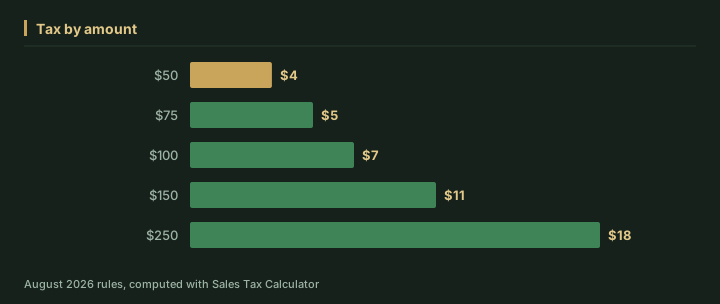
We ran 5 values of amount through the calculator and left every other input at its default. As of August 2026, the output was:
| Amount ($) | Tax ($) | Total ($) |
|---|---|---|
| 50 | 3.63 | 53.63 |
| 75 | 5.44 | 80.44 |
| 100 | 7.25 | 107.25 |
| 150 | 10.88 | 160.88 |
| 250 | 18.13 | 268.13 |
Running amount from $50 up to $250 moves tax from $4 to $18 — a spread of $15. That gap is the part a single headline rate never shows.
The same runs seen through total
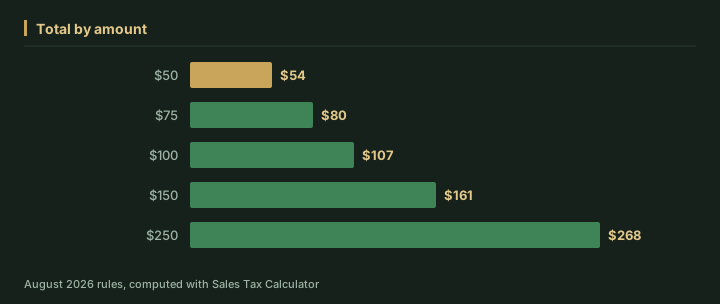
At $50, total works out to $54; at $250 it is $268. Looking only at tax tends to understate how much the outcome shifts across that range.
Assumptions behind these figures
| Input | Value |
|---|---|
| Amount | $100 |
| State | California |
| Local rate | 0% |
| As of | August 2026 |
| Method | identical to /tools/sales-tax-calculator |
Brackets, thresholds and rates change from year to year, so treat these as August 2026 figures for the 2026 tax year. For your own situation, open the Sales Tax Calculator and enter your real numbers — the calculator runs the same code that produced every figure on this page.
Frequently Asked Questions
How is property tax actually calculated?
Property tax is generally calculated as assessed value multiplied by the local tax rate, often expressed in mills, minus any exemptions you qualify for. Each of these three components — assessed value, tax rate, and exemptions — is set by a different local authority, which is why bills can vary so much even for similar homes.
Is my property tax based on my home's market value?
Not exactly — most jurisdictions apply an assessed value that may only be a fraction of your home's actual market value, using an assessment ratio, and the tax rate is applied to that assessed figure rather than to the sale price. Assessed values also often lag behind rising market prices, which is one reason your bill can keep climbing for years even without a rate increase.
What does a mill rate mean on my property tax bill?
A mill represents one dollar of tax per $1,000 of assessed value, so a 25-mill rate equals 2.5% of assessed value. Your total bill usually reflects the combined mill rate from multiple overlapping taxing bodies — typically the school district, county, city, and sometimes special districts — each of which sets its own portion of the total rate.
Why does the same house cost so much more in property tax in one state than another?
This comes down to the effective property tax rate — the actual annual tax as a percentage of market value — which varies enormously across the country, generally driven by how heavily local governments rely on property tax to fund schools and services versus other tax types like income tax. States that skip a broad income tax often lean more heavily on property tax to make up the difference.
What is a homestead exemption and do I have to apply for it?
A homestead exemption reduces the taxable assessed value of your primary residence, and in many places it's one of the largest available reductions on a property tax bill. Importantly, it's often not automatic — you may need to actively file for it with your local assessor, and new homeowners sometimes miss out simply because they never applied.
Try the related calculators
Related guides
Retirement Account Tax Benefits: 401(k), IRA, and Roth (2026)
Whether a retirement account saves you tax now or later depends on which type you pick — here is how 401(k)s,...
The Tax Refund Process: How Long Does It Take? (2026)
You filed and the money still has not landed. Here is the realistic 2026 timeline, what the tracker stages act...
How to Fill Out a W-4 Form: 2026 Edition
A practical 2026 walkthrough of the IRS Form W-4 — filing status, the multiple-jobs step people skip, dependen...