"California vs Texas: State Tax Comparison for 2026"
Table of contents
- The three taxes that actually decide it
- Worked household: $150,000, married, owns a $500,000 home
- When each state wins
- The factors the tax tables miss
- Three more households, three different winners
- How the federal SALT cap quietly changes the math
- Quick answers
- Is Texas always cheaper than California on tax?
- Does California really take 12.3%?
- Why is Texas property tax so high?
- What about sales tax?
- Does federal tax change between the two states?
- How we keep this accurate
- Run the numbers
- How the result moves with income
- The same runs seen through marginal tax rate
- Where the total comes from
- Assumptions behind these figures
Texas levies no state income tax. California's top marginal income rate is 12.3%. That single contrast drives a remarkable number of relocation decisions — and it is simultaneously true and the most misleading figure in the entire comparison. A state does not stop needing revenue because it skips the income tax; it collects it elsewhere, and "elsewhere" lands on the same household through sales and property taxes. This comparison runs the whole 2026 ledger for a household that actually moves, not just the headline. It uses the State Income Tax Calculator and Sales Tax Calculator, and sits alongside the national picture in the state income tax guide for all 50 states.
The three taxes that actually decide it
Comparing only income tax is how people get this wrong. A real comparison needs all three state-level burdens, because a state light on one is usually heavy on another:
| Tax | California | Texas |
|---|---|---|
| State income tax | Progressive, ~1% to 12.3% (2026 brackets) | None |
| State sales tax (base) | 7.25% (highest state base in the U.S.); combined often 9%+ | 6.25% base; combined commonly 8%+ |
| Property tax (effective) | Moderate effective rate; high home values inflate the dollar bill | Among the higher effective rates in the country |
California front-loads the income tax. Texas shifts the weight onto sales and especially property tax. Neither state is "cheap" — they collect comparable revenue through different doors, and which door costs you more depends entirely on your income, your spending, and whether you own an expensive home.
Worked household: $150,000, married, owns a $500,000 home
A married couple, $150,000 combined income, filing jointly, owning a $500,000 home, 2026. Approximate, illustrative, and exactly the profile that agonizes over this move.
Income tax
| California | Texas | |
|---|---|---|
| State taxable income (after CA's own deduction, roughly) | ~$140,000 | n/a |
| State income tax | ≈ $7,000–$8,500 (band-by-band, top band reached ~9.3%) | $0 |
California's progressive schedule means this couple does not pay 12.3% — that top rate applies only to income in the millions. Most of their income is taxed in the 1%–9.3% bands, producing an effective state income rate far below the headline. Even so, the income-tax line alone is several thousand dollars that simply does not exist in Texas. Confirm the California figure with the State Income Tax Calculator for your exact income.
Property tax
| California | Texas | |
|---|---|---|
| Effective property rate (illustrative) | ~0.7% | ~1.6% |
| Annual property tax on $500,000 home | ≈ $3,500 | ≈ $8,000 |
This is where Texas takes the money back. The property-tax line can swing by $4,000+ a year on a mid-priced home — often enough to erase a large part of the income-tax saving by itself. The mechanics of why are in property tax basics.
Sales tax
On, say, $50,000 of annual taxable spending, California's higher combined rate costs a few hundred dollars more than Texas's per year — real, but the smallest of the three lines for most households. Model your own combined rate with the Sales Tax Calculator; the state-by-state context is in sales tax in the U.S.: a state-by-state overview.
Rough combined state-tax picture
| California | Texas | |
|---|---|---|
| Income tax | ~$7,500 | $0 |
| Property tax ($500k home) | ~$3,500 | ~$8,000 |
| Sales tax (~$50k spend) | ~$3,800 | ~$3,400 |
| Rough total | ~$14,800 | ~$11,400 |
Texas comes out ahead for this household — but by far less than "no income tax versus 12.3%" implies, and the ranking flips with the inputs.
When each state wins
The comparison has no universal answer; it has a break-even that moves with your profile:
- High income, modest or rented home → Texas wins clearly. No income tax on a large income, and limited property-tax exposure because the expensive lever (a high-value owned home) is not pulled.
- Modest income, expensive home → California can win. A low income tax bill on modest earnings, paired with California's lower effective property rate on a high-value house, can beat Texas's heavy property tax on the same house.
- Very high earners → Texas's advantage widens. California's upper bands (9.3% and above) bite hardest here, and there is no Texas equivalent.
- Retirees living off savings → nuanced. Less wage income blunts California's income tax; property tax then often becomes the deciding line, favoring California's lower effective rate on a paid-off home.
The factors the tax tables miss
Tax is one input into a relocation, not the whole decision, and pretending otherwise is its own mistake. Housing cost itself usually dwarfs the tax difference — a smaller mortgage or rent can swamp any state-tax saving in either direction. Income levels, insurance, and the value of what the taxes fund all sit outside these tables. The honest framing: use the tax comparison to size one real input precisely, then weigh it against the larger financial picture rather than letting "no income tax" decide on its own.
Three more households, three different winners
The $150,000 homeowner is one profile. Change it and the answer flips, which is the whole point:
The high-earning renter — $300,000, rents an apartment. California income tax on $300,000 reaches the upper bands and runs well into the tens of thousands. Texas charges $0, and renting removes the property-tax lever that usually claws money back. Texas wins decisively — this is the profile where "no income tax" actually delivers what the headline promises.
The modest earner with an expensive home — $80,000 income, $700,000 home. California's income tax on $80,000 is modest, and its lower effective property rate on a $700,000 house (~$4,900) is far below Texas's (~$11,200 on the same home). California can win outright here — the property-tax line swamps the income-tax line, the exact reverse of the headline intuition.
The retiree living on $60,000 of savings withdrawals, paid-off $450,000 home. Little wage income blunts California's income tax; the deciding line becomes property tax, where California's lower effective rate on the paid-off home (~$3,150) beats Texas (~$7,200). California often wins for retirees — which surprises nearly everyone who only knows the income-tax headline.
| Household | Income tax favors | Property tax favors | Likely overall winner |
|---|---|---|---|
| $300k renter | Texas (huge) | neutral (renter) | Texas |
| $80k, $700k home | Texas (small) | California (large) | California |
| Retiree, $450k home | ~neutral | California (large) | California |
| $150k, $500k home | Texas | California | Texas, narrowly |
The pattern: Texas wins on high income with little owned real estate; California wins on modest income with an expensive home. The income-tax headline only tells the first story.
How the federal SALT cap quietly changes the math
There is a federal twist that narrows California's disadvantage. Californians who itemize can deduct state income tax — but only up to the SALT cap, and Texans (with no state income tax) instead deduct sales tax, also capped. For high earners the cap is binding either way, so the federal benefit of California's higher state tax is limited rather than proportional. The practical effect: do not assume every dollar of California state income tax is "softened" by a federal deduction — past the cap, it is not. Whether you itemize at all is the prior question, worked in standard deduction vs itemized: real examples, and the cap's role in keeping filers on the standard deduction is in standard vs itemized deductions.
Quick answers
Is Texas always cheaper than California on tax?
No. For high earners with modest housing, usually yes. For modest earners with an expensive home, California's lower effective property tax can win. The "no income tax" headline overstates Texas's edge for most middle-income homeowners once property tax is included.
Does California really take 12.3%?
Only on income in the millions. California is progressive; a $150,000 household pays an effective state income rate far below the top band. Use the State Income Tax Calculator for your real figure rather than the headline rate.
Why is Texas property tax so high?
With no income tax, Texas funds schools and local services largely through property tax, producing one of the higher effective property-tax rates in the country. The structure is explained in property tax basics.
What about sales tax?
California has the higher combined rate, but for most households the annual difference is the smallest of the three lines — a few hundred dollars, not thousands. Model it with the Sales Tax Calculator.
Does federal tax change between the two states?
No. Federal income tax is identical in every state; only the state and local layers differ. The federal side is the Federal Income Tax Calculator and how federal tax brackets work in 2026.
How we keep this accurate
California's 2026 progressive brackets and Texas's absence of a state income tax are reflected in the State Income Tax Calculator; California figures are projected and reconciled to the California Franchise Tax Board at year-end. Sales tax base rates are statutory (CA 7.25%, TX 6.25%) with locally set combined rates that vary by address — confirm via the Sales Tax Calculator and each state's Department of Revenue. Property-tax effective rates are illustrative ranges; the actual bill depends on local assessment and millage as described in property tax basics. All household figures are rounded planning estimates, not filed results — a CPA familiar with both states should confirm a real relocation decision.
Run the numbers
Everything below came out of this site's own State Income Tax Calculator. The figures are not quoted from anywhere else: each row is one run of the same calculation the tool page performs, using August 2026 rules. Put the same inputs in and you will get the same output.
How the result moves with income
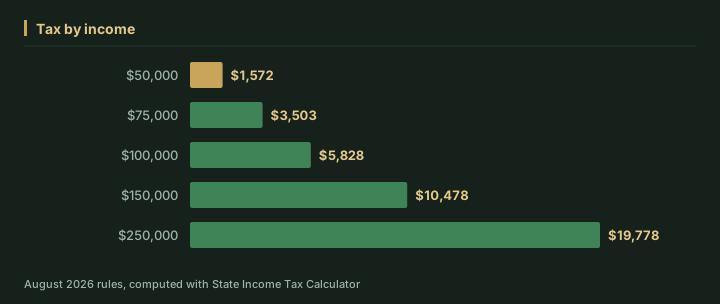
We ran 5 values of income through the calculator and left every other input at its default. As of August 2026, the output was:
| Income ($) | Tax ($) | Marginal tax rate (%) | Effective tax rate (%) |
|---|---|---|---|
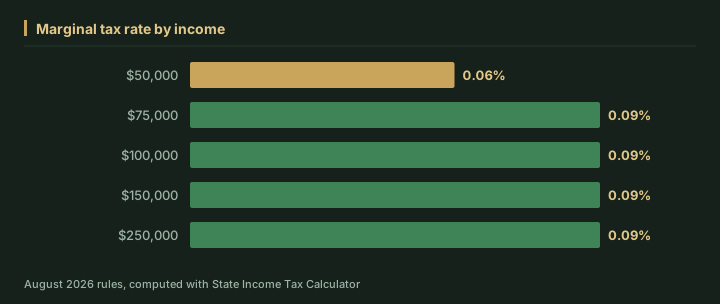
| 50,000 | 1,572 | 6% | 3.14% |
| 75,000 | 3,503.3 | 9.3% | 4.67% |
| 100,000 | 5,828.3 | 9.3% | 5.83% |
| 150,000 | 10,478.3 | 9.3% | 6.99% |
| 250,000 | 19,778.3 | 9.3% | 7.91% |
Running income from $50,000 up to $250,000 moves tax from $1,572 to $19,778 — a spread of $18,206. That gap is the part a single headline rate never shows.
The same runs seen through marginal tax rate
At $50,000, marginal tax rate works out to 6%; at $250,000 it is 9.3%. Looking only at tax tends to understate how much the outcome shifts across that range.
Where the total comes from
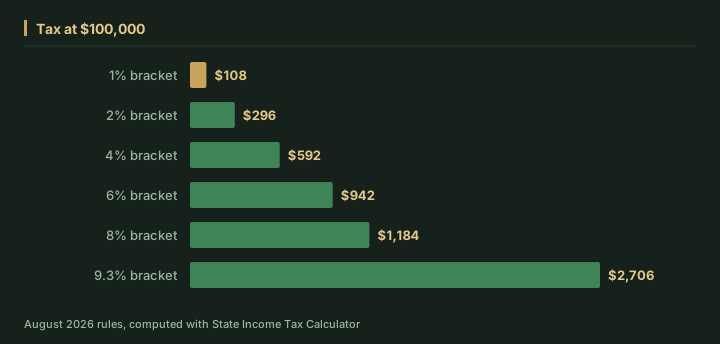
Holding income at $100,000, we ran the same calculation again and kept the breakdown it returns. The total is not one rate applied once — for the 2026 tax year it is built from 6 parts:
| Part | Tax |
|---|---|
| 1% bracket | $108 |
| 2% bracket | $296 |
| 4% bracket | $592 |
| 6% bracket | $942 |
| 8% bracket | $1,184 |
| 9.3% bracket | $2,706 |
Assumptions behind these figures
| Input | Value |
|---|---|
| Income | $100,000 |
| State | California |
| Status | Single |
| Year | 2026 |
| As of | August 2026 |
| Method | identical to /tools/state-income-tax-calculator |
Brackets, thresholds and rates change from year to year, so treat these as August 2026 figures for the 2026 tax year. For your own situation, open the State Income Tax Calculator and enter your real numbers — the calculator runs the same code that produced every figure on this page.
Frequently Asked Questions
Is it cheaper to live in Texas than California because Texas has no income tax?
Not necessarily for everyone — while Texas has no state income tax and California's top marginal rate exceeds 12%, Texas generally makes up for it with higher property taxes and, in many areas, higher sales taxes. The actual outcome depends heavily on your income level, whether you own or rent, and how expensive your home is, so a full comparison should include property and sales tax, not just income tax.
For what kind of household does Texas clearly beat California on taxes?
Texas tends to come out clearly ahead for high earners who rent rather than own a home, since a large income avoids California's steep upper income tax brackets entirely while renting sidesteps Texas's relatively high property tax burden. The advantage narrows, or can even reverse, for households with modest income and an expensive, owned home.
Can California ever have lower overall taxes than Texas for a homeowner?
Yes, it's possible in certain profiles — for example, a household with modest income but a very expensive home, since California's income tax on modest earnings is relatively low and its effective property tax rate can be lower than Texas's, even though its income tax rate structure is generally higher overall. The comparison depends on the specific mix of income and home value, not a single blanket answer.
Try the related calculators
Related guides
Traditional vs Roth IRA: Tax Implications Compared (2026)
Same $7,000, same growth, wildly different outcomes — Traditional and Roth IRAs only diverge when your tax rat...
"Standard Deduction vs Itemized: Real Examples"
"Four real households, four different right answers. Instead of explaining the rule again, this walks the actu...