"Sales Tax in the U.S.: A State-by-State Overview"
Table of contents
- Sales tax is layered, not single
- The five states with no statewide sales tax
- The states at the high end
- What is taxed is not uniform either
- Use tax: the half nobody pays
- Online sales: why your cart now shows tax
- A worked receipt
- How sales tax interacts with the rest of your tax picture
- Origin versus destination: why the same sale is taxed differently
- Sales tax holidays: small, loud, and narrow
- Why this tax is regressive — and what that means for you
- Frequently asked
- Sources
- Run the numbers
- How the result moves with amount
- The same runs seen through total
- Assumptions behind these figures
Buy a $1,000 laptop in Portland, Oregon and you hand over $1,000. Carry the same laptop to a checkout in Chicago and the register asks for roughly $1,103. Nothing about the product changed. What changed is that the United States has no national sales tax — it has a patchwork of state, county, city, and special-district taxes that stack on top of one another, and the total at the bottom of your receipt depends entirely on the few square miles you happen to be standing in.
That patchwork is the single most misunderstood part of everyday American taxation. This guide walks through how the layers fit together, which states sit at the extremes, why the rate your neighbor pays can differ from yours, and how to get a reliable number for any purchase with the Sales Tax Calculator. It is the consumption-tax companion to the income-side state income tax guide for all 50 states.
Sales tax is layered, not single
When a cashier rings up "8.25% tax," that figure is almost never one rate. It is usually three or four rates added together:
| Layer | Set by | Typical range |
|---|---|---|
| State base rate | The state legislature | 0% – 7.25% |
| County rate | The county | 0% – ~2% |
| City / municipal rate | The city | 0% – ~3% |
| Special district | Transit, stadium, hospital districts | 0% – ~2% |
The number printed on your receipt is the combined rate — every applicable layer summed. This is why two stores ten minutes apart can charge different tax on the identical item, and why "what is the sales tax in [state]?" is never a complete question. The honest answer is always "the state portion is X; your local portion depends on the exact address."
That structure is exactly how the Sales Tax Calculator is built: you enter the price, the state, and your known local rate, and it returns the combined tax and total separately so you can see each layer rather than a single blurred percentage.
The five states with no statewide sales tax
A useful memory aid is the acronym NOMAD — New Hampshire, Oregon, Montana, Alaska, Delaware. These five levy no statewide general sales tax in 2026.
The catch is Alaska. It has no state-level sales tax, but Alaska law lets boroughs and municipalities impose their own, and many do — local rates in parts of the state run to roughly 7%. So "Alaska has no sales tax" is true at the state line and false at a lot of cash registers. New Hampshire, Oregon, Montana, and Delaware are the genuinely clean cases: no state tax, no general local sales tax layered underneath.
This is why retail clusters on certain borders. A New Hampshire shopping center a short drive from Massachusetts is not an accident — one side of the line adds tax to electronics and the other does not.
The states at the high end
At the other extreme, the statewide base rate alone reaches 7.25% in California — the highest state-level rate in the country in 2026. But the base rate is a poor guide to what you actually pay, because local add-ons reshuffle the ranking entirely. Several states with moderate base rates allow aggressive local taxation, so their combined rates routinely land among the steepest in the nation once city and district layers are added.
These figures are the statewide base only, and they are statutory rates that do not move with inflation the way income brackets do:
| State | Statewide base rate (2026) | Notes |
|---|---|---|
| California | 7.25% | Highest state base; locals push combined well above 9% in many cities |
| Indiana, Mississippi, Rhode Island, Tennessee | 7.00% | High base, but local add-ons vary widely |
| Minnesota, Nevada | ~6.875% | Substantial local layers in metro areas |
| Texas, Florida, Illinois | 6.25% | Heavy local stacking — combined often 8%–10%+ |
| Colorado | 2.90% | Lowest non-zero state base, but among the most aggressive local add-ons |
Colorado is the instructive case: the lowest non-zero state base in the country sits underneath some of the highest local rates, so the combined rate a Denver-area shopper pays can exceed what someone pays in a state with double Colorado's base rate. Read the base rate as a floor, never as the answer. For any real purchase, take the state figure as a starting point and add your verified local rate in the Sales Tax Calculator — guessing the local portion is where almost every wrong total comes from.
What is taxed is not uniform either
The rate is only half the story. States disagree sharply about what the rate applies to, and these exemptions move more money than people expect.
- Groceries. Many states exempt unprepared food entirely; some tax it at a reduced rate; a few tax it at the full rate. A prepared deli sandwich is frequently taxable even where raw groceries are not.
- Prescription drugs. Almost universally exempt. Over-the-counter medicine is treated inconsistently.
- Clothing. A handful of states exempt clothing below a price threshold; most tax it normally.
- Digital goods. Streaming subscriptions, e-books, and downloaded software are taxed in a growing number of states and exempt in others — one of the fastest-shifting areas of sales tax law.
- Services. Traditionally untaxed, but states have steadily extended the tax to specific services, so "services are exempt" is no longer a safe assumption.
Because of these category rules, two carts of identical dollar value can carry different tax. A cart of raw groceries in a grocery-exempt state may be taxed at effectively 0% while a cart of electronics at the same store is taxed at the full combined rate. The single combined percentage is an approximation that holds for general taxable goods and breaks down for food, medicine, and digital products.
Use tax: the half nobody pays
Sales tax has a quiet twin called use tax. If you buy something in a no-tax or low-tax state and bring it home to a taxing state for use there, you generally owe your home state's use tax on it at the same rate sales tax would have been. Drive to New Hampshire, buy a television, bring it back to Massachusetts — Massachusetts use tax is technically due.
Compliance by individuals is famously low, and many states now include a use-tax line on the income tax return to nudge it along. The practical takeaways: large cross-border purchases (vehicles especially — registration usually forces the issue) are where this actually gets enforced, and "I bought it tax-free out of state" is not the loophole it appears to be on paper.
Online sales: why your cart now shows tax
For years, online retailers without a physical store in your state did not collect sales tax. That ended after a 2018 Supreme Court decision (South Dakota v. Wayfair) let states require collection based on economic nexus — typically once a seller exceeds a sales or transaction threshold into the state, regardless of physical presence. By 2026 essentially every state with a sales tax enforces economic nexus, and the large marketplaces collect and remit automatically.
The effect for shoppers: online and in-store purchases are now taxed on essentially the same basis. The "buy online to avoid tax" era is over. The remaining nuance is the rate sourcing — most states tax remote sales at the destination (your delivery address), so an online order is taxed at the combined rate where it ships, which is exactly the figure the Sales Tax Calculator is designed to reconstruct.
A worked receipt
Take a $1,500 furniture purchase, picked up in a city with a 6.25% state base, a 1.75% county rate, and a 1% city rate.
| Component | Rate | Tax on $1,500 |
|---|---|---|
| State base | 6.25% | $93.75 |
| County | 1.75% | $26.25 |
| City | 1.00% | $15.00 |
| Combined | 9.00% | $135.00 |
| Total paid | $1,635.00 |
The same $1,500 of furniture delivered instead to a NOMAD address — Oregon, say — carries $0 sales tax. Same product, same price, a $135 swing driven entirely by geography. Reproduce either scenario with your own price and local rate in the Sales Tax Calculator.
How sales tax interacts with the rest of your tax picture
Sales tax is regressive in structure — it takes a larger share of income from people who spend most of what they earn — which is part of why states with no income tax (Texas, Florida) lean harder on sales and property taxes to raise revenue. If you are comparing where to live or operate, the headline "no income tax" is incomplete without the sales-and-property side of the ledger; the state income tax guide for all 50 states covers the income half, and the trade-off is the whole point of comparisons like California vs Texas state tax for 2026.
One narrow but real intersection with federal tax: if you itemize deductions, the SALT deduction lets you choose to deduct state and local sales tax instead of state income tax — usually the better choice precisely for residents of no-income-tax states. Whether itemizing helps you at all is the subject of standard vs itemized deductions.
Origin versus destination: why the same sale is taxed differently
Two states with identical combined rates can still tax the same transaction differently because of sourcing — the rule for which location's rate applies.
- Destination sourcing (the majority rule, and the rule for essentially all interstate online sales): tax is charged at the rate where the buyer takes delivery. Order a $1,000 item online and the rate is your home address's combined rate, not the seller's.
- Origin sourcing (a minority of states, mostly for in-state sales): tax is charged at the seller's location for transactions within the state.
For a consumer the practical takeaway is simple: for almost anything bought online or shipped, the rate that matters is yours, at your delivery address — which is exactly the figure the Sales Tax Calculator reconstructs when you enter your state and known local rate. For businesses the stakes are higher, because collecting at the wrong jurisdiction's rate is a compliance liability, not a rounding error.
Sales tax holidays: small, loud, and narrow
Many states run sales tax holidays — short windows, often before the school year or hurricane season, when specific categories (clothing under a price cap, school supplies, emergency equipment, sometimes energy-efficient appliances) are temporarily exempt. They generate disproportionate attention for their actual size: the savings are real but narrow, capped by item price and category, and limited to a few days. They do not change the structural picture in this guide; treat them as a minor timing optimization for planned purchases of qualifying goods, not a reason to reorganize spending. The categories and dates differ by state every year, so confirm with your state Department of Revenue rather than assuming last year's list still applies.
Why this tax is regressive — and what that means for you
Sales tax takes the same percentage from every buyer, but lower-income households spend a larger share of income on taxable goods, so the effective burden falls hardest on them. States lean on this differently: a no-income-tax state like Texas or Florida recovers revenue through heavier sales and property taxes, shifting more of the load onto consumption. That is why a state-to-state comparison based on income tax alone is misleading — the consumption side can more than reverse the ranking. The full trade-off is worked through in California vs Texas state tax for 2026, the income half is in the state income tax guide for all 50 states, and the third leg, property tax, is in property tax basics. Read all three together before drawing any "this state is cheaper" conclusion.
Frequently asked
Which state has the highest sales tax? It depends on whether you mean the state base rate or the combined rate a shopper actually pays. California has the highest state base at 7.25%. On a combined basis, several cities in Louisiana, Tennessee, Arkansas, and Alabama regularly top the list once local layers are added — combined rates above 10% are not unusual.
Which states have no sales tax? New Hampshire, Oregon, Montana, Alaska, and Delaware have no statewide sales tax. Alaska is the asterisk: it allows local sales taxes, and many municipalities impose them.
Is online shopping taxed now? Yes. Since the 2018 Wayfair decision, states require remote sellers to collect once they exceed an economic-nexus threshold, and by 2026 this is the norm nationwide. Most remote sales are taxed at the buyer's delivery address.
Why did two stores charge me different tax on the same item? Because the combined rate is the sum of state, county, city, and special-district rates, and at least one of those layers differs between the two locations.
Do I really owe use tax on out-of-state purchases? Legally, generally yes — at your home state's rate, when you bring the item back for use there. Enforcement is strongest on big-ticket items like vehicles; many states now include a use-tax line on the income tax return.
Are groceries taxed? It varies by state. Many exempt unprepared food, some apply a reduced rate, a few tax it fully — and prepared food is usually taxable even where raw groceries are not.
Sources
State base rates reflect each state's published 2026 statutory general sales tax rate; combined rates depend on county, municipal, and special-district rates set locally and change more often than state rates. Confirm the exact rate for any address with that state's Department of Revenue or its official rate lookup before relying on a figure. Economic-nexus rules follow South Dakota v. Wayfair (2018) and subsequent state legislation. This article is general educational information, not tax advice; a sales tax professional or your state Department of Revenue can resolve situations specific to your business or purchase.
Run the numbers
Everything below came out of this site's own Sales Tax Calculator. The figures are not quoted from anywhere else: each row is one run of the same calculation the tool page performs, using August 2026 rules. Put the same inputs in and you will get the same output.
How the result moves with amount
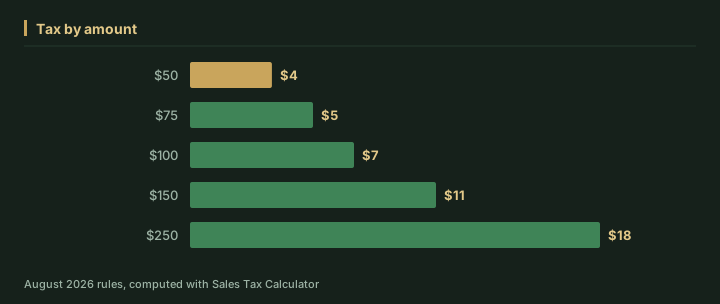
We ran 5 values of amount through the calculator and left every other input at its default. As of August 2026, the output was:
| Amount ($) | Tax ($) | Total ($) |
|---|---|---|
| 50 | 3.63 | 53.63 |
| 75 | 5.44 | 80.44 |
| 100 | 7.25 | 107.25 |
| 150 | 10.88 | 160.88 |
| 250 | 18.13 | 268.13 |
Running amount from $50 up to $250 moves tax from $4 to $18 — a spread of $15. That gap is the part a single headline rate never shows.
The same runs seen through total
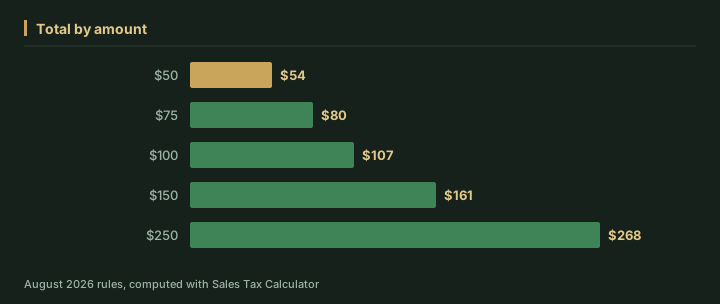
At $50, total works out to $54; at $250 it is $268. Looking only at tax tends to understate how much the outcome shifts across that range.
Assumptions behind these figures
| Input | Value |
|---|---|
| Amount | $100 |
| State | California |
| Local rate | 0% |
| As of | August 2026 |
| Method | identical to /tools/sales-tax-calculator |
Brackets, thresholds and rates change from year to year, so treat these as August 2026 figures for the 2026 tax year. For your own situation, open the Sales Tax Calculator and enter your real numbers — the calculator runs the same code that produced every figure on this page.
Frequently Asked Questions
Is sales tax the same everywhere in the U.S.?
No, the United States has no national sales tax — instead, sales tax is a patchwork of state, county, city, and sometimes special-district taxes that stack on top of each other, so the total rate on a purchase depends heavily on the specific location where you buy it. The same item can cost noticeably different amounts in different cities, even within the same state.
Why do some states have no sales tax at all while others charge over 9%?
States set their own sales tax policy independently, and some choose not to levy a state-level sales tax at all, relying more on other tax types, while others combine a state rate with additional county and city rates that push the total well above 9% in some areas. There's no federal rule requiring a particular rate, so it varies purely by state and local government decisions.
How can I find the exact sales tax rate for a specific purchase?
Because sales tax combines state, county, and sometimes city or special-district rates, the most reliable way to get an exact figure is to use a dedicated sales tax calculator for the specific location of the purchase rather than relying on a state's general headline rate, which often doesn't reflect the full combined local rate.
Try the related calculators
Related guides
Retirement Account Tax Benefits: 401(k), IRA, and Roth (2026)
Whether a retirement account saves you tax now or later depends on which type you pick — here is how 401(k)s,...
The Tax Refund Process: How Long Does It Take? (2026)
You filed and the money still has not landed. Here is the realistic 2026 timeline, what the tracker stages act...
How to Fill Out a W-4 Form: 2026 Edition
A practical 2026 walkthrough of the IRS Form W-4 — filing status, the multiple-jobs step people skip, dependen...