"Tax Planning Strategies for Self-Employed Individuals"
Table of contents
- First, see the real starting point
- Strategy 1: Take the deductions you have already earned
- Strategy 2: The QBI deduction
- Strategy 3: Retirement accounts — the largest lever most people skip
- Strategy 4: Consider, carefully, an S-corporation election
- Strategy 5: Manage timing and quarterly cash
- Putting it together on the $95,000 freelancer
- The S-corp break-even, with real numbers
- Sequencing the strategies across the year
- Quick answers
- What is the single biggest tax saver for the self-employed?
- Does an S-corp always save money?
- Do retirement contributions reduce self-employment tax?
- How much should I set aside from each payment?
- Can I deduct health insurance if I don't itemize?
- How we keep this accurate
- Run the numbers
- How the result moves with net profit
- The same runs seen through net self-employment earnings
- Assumptions behind these figures
Two people earn $95,000 this year. One is a W-2 employee; the other freelances. They are not in the same tax position — not close. The employee's payroll tax is quietly split with an employer and capped in visibility. The freelancer owes self-employment tax on roughly $13,400 of their profit before income tax even enters the conversation, and no employer is covering half of it. That gap is not a punishment for being self-employed. It is the default outcome when nobody actively manages it — and almost all of it is recoverable through deductions and structure choices that are entirely legal and largely ignored.
This guide is the planning playbook: the moves that shrink the self-employed tax bill, in rough order of how much they typically return, with the 2026 numbers behind each. It builds on the mechanics in self-employment tax explained for 2026 and the cash-flow discipline in estimated tax payments: when and how — read those for the rules; read this for what to do with them.
First, see the real starting point
The self-employed pay two layers: self-employment (SE) tax (Social Security + Medicare, both halves) and federal income tax on top. SE tax for 2026 is 15.3% — 12.4% Social Security up to a wage base of $184,500 and 2.9% Medicare with no ceiling — but it is charged on only 92.35% of net profit, not the whole figure.
Take $95,000 of net self-employment profit, single filer, 2026:
| Step | Amount |
|---|---|
| Net profit | $95,000 |
| SE tax base (× 0.9235) | $87,732.50 |
| SE tax (15.3%) | $13,423 |
| Deduction for ½ of SE tax | $6,712 |
| Standard deduction (single, 2026) | $16,100 |
| Taxable income before any planning | ~$72,188 |
That ~$13,423 of SE tax is the number every strategy below is fighting. Confirm your own figure with the Self-Employment Tax Calculator before planning around it — the rest of this guide assumes you know your real SE tax, not a guess.
Strategy 1: Take the deductions you have already earned
The cheapest tax savings are the ones requiring no new spending — deductions for money you were going to spend anyway.
- Half of SE tax, automatically: $6,712 in the example above comes off income, no action required beyond filing correctly. It is built into the Self-Employment Tax Calculator result.
- Self-employed health insurance. Premiums for you, a spouse, and dependents are generally an above-the-line deduction — it reduces income tax even if you do not itemize. For many freelancers this is the single largest line after retirement.
- Home office, if a space is used regularly and exclusively for the business. The simplified method gives a flat rate per square foot up to a cap; the actual-expense method prorates rent or mortgage interest, utilities, and insurance.
- The ordinary cost of doing business — software, equipment, mileage or vehicle expense, professional fees, a portion of phone and internet. Each dollar correctly deducted is a dollar that escapes both income tax and, because it lowers net profit, the 15.3% SE tax. That double effect is what makes self-employed deductions more valuable per dollar than an employee's.
The discipline that makes this real is bookkeeping. Deductions you cannot substantiate are deductions you will not keep in an audit, so the contemporaneous record is the strategy, not an afterthought.
Strategy 2: The QBI deduction
The Qualified Business Income deduction lets many self-employed people deduct up to 20% of qualified business income — a deduction for simply having the income, on top of every expense deduction. On $70,000 of qualified income that is a $14,000 deduction.
It phases out for higher earners in specified service fields (consulting, law, health, and similar) above income thresholds, and the calculation has real edges. But for a large share of sole proprietors below the thresholds it is straightforward and substantial, and it stacks with everything in Strategy 1. Treat it as a headline item to confirm you are claiming, not a footnote.
Strategy 3: Retirement accounts — the largest lever most people skip
For an employee, a 401(k) caps employee deferrals. The self-employed have access to accounts with far higher ceilings, and contributions are deductible — this is usually the biggest single tax reduction available to a profitable freelancer.
| Account | Roughly who it suits | Contribution character |
|---|---|---|
| SEP-IRA | Simple to run; contribution scales with profit | Employer-side, percentage of net SE income |
| Solo 401(k) | One-person business, want maximum contribution | Employee deferral plus employer contribution — highest total at moderate profit |
| Defined benefit / cash balance | High, stable profit, older owner | Largest deductible contributions of all |
The Solo 401(k) is the workhorse: because it allows both an employee deferral and an employer contribution, it lets a one-person business shelter far more at a given profit level than a SEP at the same profit. A meaningful contribution at a 22% marginal rate saves 22 cents of income tax per dollar contributed and the money compounds tax-deferred. The mechanics of traditional-versus-Roth treatment, and why a freelancer might deliberately use both, are covered in retirement account tax benefits and traditional vs Roth IRA tax.
One subtlety worth stating plainly: retirement contributions reduce income tax but not SE tax — SE tax is computed on net profit before the retirement deduction. So retirement accounts are a powerful income-tax lever and not an SE-tax lever. Expense deductions are the SE-tax lever. You want both.
Strategy 4: Consider, carefully, an S-corporation election
This is the most oversold idea in self-employed tax planning, so here is the honest version. An LLC taxed as an S-corp lets the owner split income into a reasonable W-2 salary plus distributions. Payroll taxes (the SE-tax equivalent) apply to the salary; the distribution portion is not subject to them. On high, stable profit that can save real money.
The costs and conditions are equally real: you must run actual payroll, file a separate business return, pay for the added accounting, and — the non-negotiable part — pay yourself a reasonable salary, not an artificially tiny one. The savings come only from the portion above a genuine market salary. Below roughly the mid five figures of profit the added compliance cost often eats the benefit, and an unreasonably low salary is exactly what gets the structure unwound on audit. This is the one strategy here that genuinely needs a professional to model against your numbers before you act. The W-2-versus-self-employed trade-off it sits inside is laid out in 1099 vs W-2: tax implications.
Strategy 5: Manage timing and quarterly cash
Two timing levers, both legal, both routinely missed:
- Year-end income and expense timing. A cash-basis sole proprietor can, within limits, defer late-year invoicing into January or pull a planned deductible purchase into December to shift profit between tax years — useful when you expect a different marginal rate next year. The general principle and its limits are in how to reduce taxable income legally.
- Quarterly estimated payments. This one does not lower the tax — it prevents the penalty that turns a manageable bill into a worse one. The self-employed have no withholding, so the IRS expects four payments a year. Size them with the Estimated Tax Payment Calculator and follow the safe-harbor rules in estimated tax payments: when and how. Missing this is the most common, most avoidable self-employed tax mistake.
Putting it together on the $95,000 freelancer
Stacking the realistic, low-friction moves — not the aggressive ones — on the single filer from earlier:
| Before planning | After planning | |
|---|---|---|
| Net profit | $95,000 | $95,000 |
| Business expenses captured | $0 | −$8,000 |
| Net profit after expenses | $95,000 | $87,000 |
| SE tax (≈15.3% of 92.35%) | ~$13,423 | ~$12,293 |
| ½ SE tax deduction | $6,712 | $6,147 |
| Solo 401(k) contribution | $0 | −$20,000 |
| Health insurance deduction | $0 | −$6,000 |
| QBI (≈20%) | applied | applied (larger base reduction) |
| Standard deduction (single 2026) | $16,100 | $16,100 |
| Taxable income, roughly | ~$72,000 | ~$39,000 |
The expense and retirement layers cut taxable income by tens of thousands and trimmed SE tax through lower net profit, without a single aggressive position. The exact income-tax saving depends on the brackets in how federal tax brackets work in 2026, but moving from a ~$72,000 to a ~$39,000 taxable base drops you out of the 22% band's reach for most of the income — a four-figure income-tax saving on top of the SE-tax reduction.
The S-corp break-even, with real numbers
Because the S-corp question generates more bad advice than any other, here is the arithmetic that should drive it rather than a rule of thumb. The saving is the payroll-tax-equivalent rate (~15.3%, capped at the Social Security wage base) applied to the distribution portion — profit above a reasonable salary — minus the added compliance cost.
| Net profit | Reasonable salary | Distribution | Approx. payroll-tax saving | Typical added cost | Net benefit |
|---|---|---|---|---|---|
| $60,000 | $50,000 | $10,000 | ~$1,530 | ~$1,500–$2,500 | ≈ break-even or negative |
| $120,000 | $70,000 | $50,000 | ~$7,650 | ~$2,000–$3,000 | clearly positive |
| $200,000 | $90,000 | $110,000 | Medicare-portion only above the SS base | ~$3,000 | positive, but smaller per dollar |
Two things fall out of this. Below roughly $60,000–$80,000 of profit the added payroll, separate return, and accounting often eat the benefit — the election is premature. And the saving is bounded by the reasonable salary requirement: pay yourself an artificially low salary to inflate the distribution and the structure is exactly what gets unwound on audit, with back payroll tax and penalties. The election is a genuine tool on high, stable profit and a trap when adopted too early or too aggressively, which is why it is the one move here that warrants modeling with a CPA against your actual numbers.
Sequencing the strategies across the year
The strategies are not a menu to graze — they have an order that maximizes the result:
- All year: capture every business expense contemporaneously. This is the only lever that lowers SE tax, and it compounds with everything below.
- Quarterly: pay safe-harbor estimates with the Estimated Tax Payment Calculator so penalties never enter the picture — see estimated tax payments: when and how.
- By year-end: fund the retirement account. Solo 401(k) employee deferrals generally must be elected by December 31, even though the employer-side contribution can be funded later — miss the election window and the single biggest income-tax lever is gone for the year.
- At tax time: confirm QBI and the self-employed health insurance deduction are claimed; these are easy to leave on the table.
Most self-employed overpayment is not from missing an exotic strategy — it is from doing the ordinary ones late or out of order. The calendar is itself a strategy.
Quick answers
What is the single biggest tax saver for the self-employed?
Usually a Solo 401(k) for a profitable one-person business — it shelters more at a given profit than any other account and directly cuts income tax. Capturing every legitimate business expense is a close second because it cuts SE tax and income tax.
Does an S-corp always save money?
No. It saves only on profit above a reasonable salary, and the added payroll, filing, and accounting costs can exceed the benefit at lower profit. It needs to be modeled against your real numbers first.
Do retirement contributions reduce self-employment tax?
No. SE tax is computed on net profit before retirement contributions. They reduce income tax. Business expenses are what reduce SE tax.
How much should I set aside from each payment?
A common working figure is 25–30% of profit for combined SE and federal income tax, adjusted to your bracket and state. Size it precisely with the Estimated Tax Payment Calculator rather than guessing.
Can I deduct health insurance if I don't itemize?
Generally yes — the self-employed health insurance deduction is above-the-line, so it reduces income even when you take the standard deduction.
How we keep this accurate
The 15.3% combined rate, the 92.35% net-earnings factor, the $184,500 Social Security wage base, and the half-SE-tax deduction follow the 2026 Social Security Administration figures and IRS Schedule SE rules used throughout the Self-Employment Tax Calculator. The 2026 standard deduction and bracket thresholds apply the IRS annual inflation-adjusted Revenue Procedure to the permanent statutory rate schedule and are reconciled to the official IRS release at year-end, so every 2026 figure here is a planning projection rather than a filed-return certainty. QBI, the self-employed health insurance deduction, retirement contribution limits, and the S-corp reasonable-compensation standard follow current IRC provisions and IRS guidance, each of which has thresholds and limits a general article cannot fully resolve for one taxpayer. This is educational material, not advice — the S-corp decision in particular should be run past a CPA or Enrolled Agent against your actual numbers before you act.
Run the numbers
Everything below came out of this site's own Self-Employment Tax Calculator. The figures are not quoted from anywhere else: each row is one run of the same calculation the tool page performs, using August 2026 rules. Put the same inputs in and you will get the same output.
How the result moves with net profit
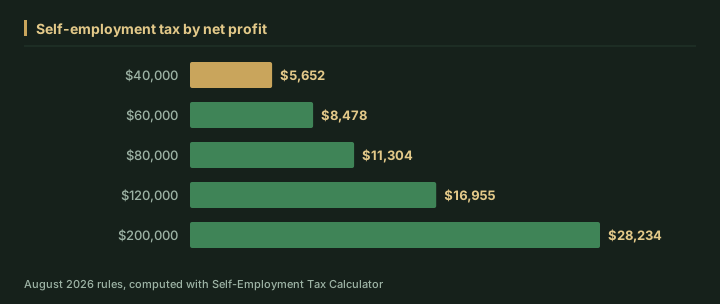
We ran 5 values of net profit through the calculator and left every other input at its default. As of August 2026, the output was:
| Net profit ($) | Self-employment tax ($) | Net self-employment earnings ($) | Social Security taxable ($) |
|---|---|---|---|
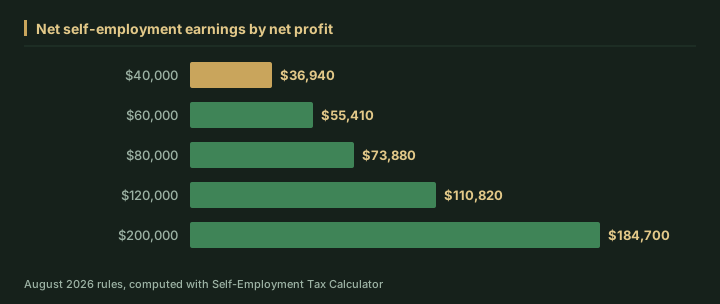
| 40,000 | 5,651.82 | 36,940 | 36,940 |
| 60,000 | 8,477.73 | 55,410 | 55,410 |
| 80,000 | 11,303.64 | 73,880 | 73,880 |
| 120,000 | 16,955.46 | 110,820 | 110,820 |
| 200,000 | 28,234.3 | 184,700 | 184,500 |
Running net profit from $40,000 up to $200,000 moves self-employment tax from $5,652 to $28,234 — a spread of $22,582. That gap is the part a single headline rate never shows.
The same runs seen through net self-employment earnings
At $40,000, net self-employment earnings works out to $36,940; at $200,000 it is $184,700. Looking only at self-employment tax tends to understate how much the outcome shifts across that range.
Assumptions behind these figures
| Input | Value |
|---|---|
| Net profit | $80,000 |
| Status | Single |
| W-2 wages | $0 |
| Year | 2026 |
| As of | August 2026 |
| Method | identical to /tools/self-employment-tax-calculator |
Brackets, thresholds and rates change from year to year, so treat these as August 2026 figures for the 2026 tax year. For your own situation, open the Self-Employment Tax Calculator and enter your real numbers — the calculator runs the same code that produced every figure on this page.
Frequently Asked Questions
Why do self-employed people pay so much more tax than employees on the same income?
The core reason is self-employment tax — self-employed individuals must pay both the employee and employer portions of Social Security and Medicare tax (15.3% combined on a reduced base), whereas a W-2 employee only pays the employee half while the employer covers the rest. This gap exists before federal income tax is even calculated, and it's largely offset only through active deductions and planning.
What is the single biggest tax-saving move for a self-employed person?
Contributing to a tax-advantaged retirement account, such as a SEP-IRA or Solo 401(k), is generally considered the largest available lever, since the self-employed have access to much higher contribution limits than a typical employee 401(k) and the contributions are deductible against income tax. Retirement contributions reduce income tax but generally not self-employment tax, since SE tax is computed on net profit before that deduction.
What is the Qualified Business Income (QBI) deduction?
The QBI deduction generally allows many self-employed people and small business owners to deduct up to 20% of their qualified business income, in addition to their regular expense deductions, though it phases out for higher earners in certain service-based fields and has other eligibility rules. It's a substantial deduction for many sole proprietors below the applicable income thresholds, but eligibility should be confirmed rather than assumed.
Is forming an S-corporation a good way to reduce self-employment tax?
It can reduce self-employment tax in some situations by allowing part of business profit to be paid as a distribution not subject to self-employment tax, but it also adds real complexity, payroll requirements, and administrative costs, and it isn't automatically beneficial for every self-employed person. It's generally worth evaluating with a tax professional based on your specific profit level rather than assuming it's always the right move.
Try the related calculators
Related guides
Retirement Account Tax Benefits: 401(k), IRA, and Roth (2026)
Whether a retirement account saves you tax now or later depends on which type you pick — here is how 401(k)s,...
The Tax Refund Process: How Long Does It Take? (2026)
You filed and the money still has not landed. Here is the realistic 2026 timeline, what the tracker stages act...
How to Fill Out a W-4 Form: 2026 Edition
A practical 2026 walkthrough of the IRS Form W-4 — filing status, the multiple-jobs step people skip, dependen...