"How to Calculate Self-Employment Tax Step-by-Step"
Table of contents
- The five steps
- A worked example: $60,000 net profit
- The 92.35% rule, made intuitive
- Where the wage base changes the answer
- A second example: above the Social Security wage base
- Coordinating with a W-2 job
- What this changes downstream
- Run the numbers
- How the result moves with net profit
- The same runs seen through net self-employment earnings
- Assumptions behind these figures
Almost everyone's first attempt at self-employment tax is wrong in the same way: they take net profit, multiply by 15.3%, and write down a number that is too high. Self-employment (SE) tax is not 15.3% of profit. It is 15.3% of 92.35% of profit, the Social Security portion stops at a wage base, and half of whatever you owe comes back as an income-tax deduction. Skip any of those three and the figure is wrong. This walkthrough does the calculation the correct way, one step at a time, and explains the 92.35% rule that trips up nearly everyone. The concepts behind it are in self-employment tax explained for 2026; this is the arithmetic.
The five steps
SE tax for 2026 is the combined Social Security rate (12.4%) plus the combined Medicare rate (2.9%) — 15.3% — applied to a reduced base.
Step 1 — Net profit. Business income minus business expenses. This is Schedule C net profit, not gross receipts. Every legitimate expense you capture lowers this number and therefore the tax.
Step 2 — Multiply by 92.35%. This is the step everyone misses. You only pay SE tax on 0.9235 of net profit. The reason is fairness, not a trick: an employee's employer-side payroll tax is not counted as the employee's taxable wage, so the law removes the equivalent slice (the 7.65% employer-half analogue) before applying SE tax. The result is your net earnings from self-employment.
Step 3 — Apply the rates. On the net earnings: 12.4% Social Security, but only up to the 2026 wage base of $184,500 of combined wages-plus-SE earnings; and 2.9% Medicare with no ceiling. An extra 0.9% Additional Medicare Tax applies above $200,000 (single) or $250,000 (married filing jointly).
Step 4 — That is your SE tax. Reported on Schedule SE.
Step 5 — Deduct half. One-half of the SE tax is an above-the-line deduction against income tax. It does not reduce the SE tax itself; it reduces the income tax that stacks on top.
A worked example: $60,000 net profit
Sole proprietor, $60,000 Schedule C net profit, 2026, well under the wage base:
| Step | Calculation | Result |
|---|---|---|
| 1. Net profit | — | $60,000.00 |
| 2. × 92.35% | $60,000 × 0.9235 | $55,410.00 |
| 3a. Social Security 12.4% | $55,410 × 0.124 | $6,870.84 |
| 3b. Medicare 2.9% | $55,410 × 0.029 | $1,606.89 |
| 4. Total SE tax | $6,870.84 + $1,606.89 | $8,477.73 |
| 5. Deduction for ½ | $8,477.73 ÷ 2 | $4,238.87 |
The naive "15.3% of $60,000" gives $9,180 — overstated by about $700 purely from skipping the 92.35% step. The Self-Employment Tax Calculator runs all five steps, including the wage-base cap and the Additional Medicare Tax, so the figure is right without doing the arithmetic by hand.
The 92.35% rule, made intuitive
Here is the cleanest way to see why 92.35% exists. An employee and their employer each pay 7.65% payroll tax. The employer's 7.65% is a business cost — it is not part of the employee's taxable wage. A self-employed person is both employee and employer, so the law lets them remove the equivalent employer-side slice before computing the tax, to keep the two situations comparable. Mechanically, 1 − 0.0765 ≈ 0.9235, which is exactly the factor. It is an equalizer, not a discount, and the Self-Employment Tax Calculator applies it automatically — the only thing you need from this section is to never multiply raw profit by 15.3% again.
Where the wage base changes the answer
Below roughly $184,500 of combined earnings the full 15.3% applies. Above it, the 12.4% Social Security portion stops while the 2.9% Medicare portion continues. So a $250,000-profit consultant does not pay 15.3% on the whole amount — Social Security caps out partway up, and only Medicare (plus the 0.9% surtax over $200,000 single) runs the rest of the way. The calculator handles the cap; the takeaway is that very high earners have a lower effective SE rate than the 15.3% headline because the larger Social Security portion is capped.
A second example: above the Social Security wage base
The $60,000 case never touches the cap. Change the profit to $220,000 and the calculation bends, because the 12.4% Social Security portion stops at the 2026 wage base while the 2.9% Medicare portion does not. Single filer, $220,000 net profit, 2026:
| Step | Calculation | Result |
|---|---|---|
| 1. Net profit | — | $220,000.00 |
| 2. × 92.35% | $220,000 × 0.9235 | $203,170.00 |
| 3a. Social Security 12.4% | capped at $184,500 base → $184,500 × 0.124 | $22,878.00 |
| 3b. Medicare 2.9% | on full $203,170 | $5,891.93 |
| 3c. Additional Medicare 0.9% | on net earnings over $200,000 (single) | ≈ $28.53 |
| 4. Total SE tax | sum | ≈ $28,798 |
| Effective SE rate | $28,798 ÷ $220,000 | ≈ 13.1% |
Note the headline "15.3%" is wrong here in the other direction: because Social Security is capped, the effective SE rate on a high earner falls below 15.3%, not above it. The naive "15.3% of $220,000" overstates this bill by roughly $5,000. The wage-base cap is the single reason high-profit SE tax is not linear, and it is the most common error after the 92.35% step.
Coordinating with a W-2 job
If you have wages and a side business, the Social Security wage base is shared across both. Your employer already withheld Social Security tax up to the base on your W-2 wages; SE tax does not re-charge the Social Security portion on income the wage base already covered. So a $40,000 side profit on top of $170,000 of W-2 wages pays the full 12.4% on only the sliver of base remaining, then 2.9% Medicare on the rest. Skipping this coordination double-counts Social Security and overstates the tax — enter your W-2 wages in the Self-Employment Tax Calculator so the shared base is handled correctly rather than computing the side gig in isolation.
What this changes downstream
SE tax is not the whole self-employed bill — it is the layer before income tax. The half-SE-tax deduction from Step 5 then reduces taxable income, which feeds the federal income tax in the Federal Income Tax Calculator. Because no employer withholds for you, that combined bill is paid through quarterly estimates: size them with the Estimated Tax Payment Calculator and follow the safe-harbor rules in estimated tax payments: when and how. And because every captured business expense lowers net profit before Step 2, expense tracking reduces SE tax and income tax at once — the planning consequences of that are the heart of tax planning strategies for self-employed individuals. If you are weighing contractor versus employee income in the first place, 1099 vs W-2: tax implications puts the SE-tax cost in context.
Run the steps once by hand so the structure is no longer a black box, then let the Self-Employment Tax Calculator do it every time after — entering net profit, filing status, and any W-2 wages so the wage-base coordination is handled correctly. The number you walk away with is a 2026 projection built on Social Security Administration figures and IRS Schedule SE rules, reconciled to official releases at year-end; it is a solid planning estimate, and a CPA or Enrolled Agent should confirm anything unusual on the actual return.
Run the numbers
Everything below came out of this site's own Self-Employment Tax Calculator. The figures are not quoted from anywhere else: each row is one run of the same calculation the tool page performs, using August 2026 rules. Put the same inputs in and you will get the same output.
How the result moves with net profit
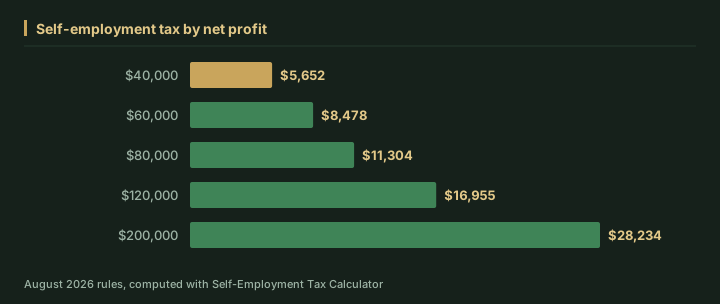
We ran 5 values of net profit through the calculator and left every other input at its default. As of August 2026, the output was:
| Net profit ($) | Self-employment tax ($) | Net self-employment earnings ($) | Social Security taxable ($) |
|---|---|---|---|
| 40,000 | 5,651.82 | 36,940 | 36,940 |
| 60,000 | 8,477.73 | 55,410 | 55,410 |
| 80,000 | 11,303.64 | 73,880 | 73,880 |
| 120,000 | 16,955.46 | 110,820 | 110,820 |
| 200,000 | 28,234.3 | 184,700 | 184,500 |
Running net profit from $40,000 up to $200,000 moves self-employment tax from $5,652 to $28,234 — a spread of $22,582. That gap is the part a single headline rate never shows.
The same runs seen through net self-employment earnings
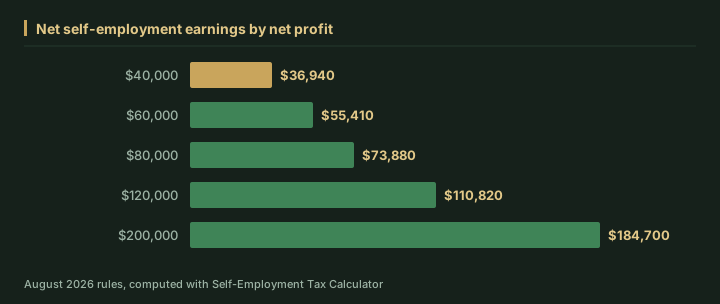
At $40,000, net self-employment earnings works out to $36,940; at $200,000 it is $184,700. Looking only at self-employment tax tends to understate how much the outcome shifts across that range.
Assumptions behind these figures
| Input | Value |
|---|---|
| Net profit | $80,000 |
| Status | Single |
| W-2 wages | $0 |
| Year | 2026 |
| As of | August 2026 |
| Method | identical to /tools/self-employment-tax-calculator |
Brackets, thresholds and rates change from year to year, so treat these as August 2026 figures for the 2026 tax year. For your own situation, open the Self-Employment Tax Calculator and enter your real numbers — the calculator runs the same code that produced every figure on this page.
Frequently Asked Questions
Is self-employment tax simply 15.3% of my net profit?
No, that's a common misconception — self-employment tax is 15.3% of 92.35% of your net profit, not the full profit amount. The 92.35% adjustment roughly mirrors the fact that an employer's share of payroll tax isn't counted as part of an employee's taxable wages, so applying the full 15.3% to 100% of profit overstates the tax.
How do I calculate my self-employment tax step by step?
Start with your net business profit, revenue minus expenses, multiply it by 92.35% to get your net earnings from self-employment, then apply 12.4% for Social Security, up to the annual wage base cap, and 2.9% for Medicare, with no cap, to get your total self-employment tax. Half of that total is then deductible against your income tax.
Does self-employment tax stop once I earn a certain amount?
Only partially — the 12.4% Social Security portion stops once your combined wages and self-employment earnings reach the annual Social Security wage base, but the 2.9% Medicare portion continues on all earnings with no ceiling, and an additional 0.9% Medicare surtax applies above certain higher income thresholds. This means very high earners have a lower effective self-employment tax rate than the 15.3% headline figure suggests.
If I have a W-2 job and self-employment income, do I pay Social Security tax twice?
No, the Social Security wage base is shared across both your W-2 wages and your self-employment earnings — if your employer has already withheld Social Security tax up to the annual cap on your wages, your self-employment income generally only owes the uncapped Medicare portion, not the full combined rate again.
Try the related calculators
Related guides
"How to Determine Your Tax Bracket"
"\"I'm in the 24% bracket\" is almost always either wrong or misunderstood. Here is how to find the bracket yo...
"How to Estimate Your Tax Refund Before Filing"
A married couple expected a $3,000 refund and owed $1,900 instead. The number was knowable in October. Here is...
"How to Use Our Federal Income Tax Calculator"
A one-minute walkthrough of the federal income tax calculator — what each input means, why the result has thre...