"How to Calculate Capital Gains on Stock Sales"
Table of contents
- The three quantities and one date
- Step 1 — Cost basis
- Step 2 — Proceeds
- Step 3 — Holding period (the one that matters)
- Step 4 — Apply the right rate
- A worked sale
- The traps that produce a wrong number
- A multi-lot example: where basis really bites
- Netting gains and losses in the right order
- Common questions
- Run the numbers
- How the result moves with purchase
- The same runs seen through after-tax income
- Assumptions behind these figures
The same $12,000 stock gain cost one investor $2,640 in tax and another $1,800 — a $840 difference created by a single day on the calendar. The first sold at the 364-day mark; the second waited to day 366. Capital gains tax on a stock sale turns on three quantities and one date, and the date does more than the other three combined. This walkthrough computes each piece in order, with 2026 numbers, using the Capital Gains Tax Calculator. The strategy behind the holding-period line is in capital gains tax: short-term vs long-term.
The three quantities and one date
Every stock-sale tax calculation needs:
- Cost basis — what you paid, including commissions, plus reinvested dividends that were already taxed.
- Proceeds — what you sold for, net of selling costs.
- Holding period — the date that decides which rate schedule applies.
Gain is proceeds minus basis. The holding period decides whether that gain is taxed as ordinary income or at the preferential long-term rates. Get the basis wrong and you overpay (or underpay and invite a notice); get the holding period wrong and the rate can nearly double.
Step 1 — Cost basis
Basis is not just the share price you paid. It includes purchase commissions and, critically, reinvested dividends: every time a dividend was automatically used to buy more shares, that dividend was already taxed as income, and it added to your basis. Investors who forget reinvested dividends systematically overstate their gain and overpay. For partial sales, the lot-identification method (FIFO, specific identification) determines which shares' basis is used — specific identification can materially lower the gain by selling the highest-basis lots first.
Step 2 — Proceeds
Proceeds are the sale price minus selling commissions or fees. The figure on your broker's 1099-B is usually net already, but confirm whether basis is reported alongside it — for older or transferred lots, the broker may not have basis, and reconstructing it correctly is your responsibility.
Step 3 — Holding period (the one that matters)
Count from the day after purchase through the day of sale.
- Held one year or less → short-term → taxed as ordinary income at your marginal bracket rate.
- Held more than one year → long-term → taxed at the preferential 0% / 15% / 20% rates.
"More than one year" means one year and a day. Selling on the 365th day is short-term; the 366th is long-term. That one day is the highest-leverage decision in the entire calculation.
Step 4 — Apply the right rate
Short-term: the gain stacks on top of your other income and is taxed at your ordinary marginal rate — run it through the Federal Income Tax Calculator, because a large short-term gain can push part of itself into a higher bracket.
Long-term: the rate depends on total taxable income against the 2026 long-term breakpoints:
| Filing status | 0% up to | 15% up to | 20% above |
|---|---|---|---|
| Single | $49,450 | $545,000 | $545,000 |
| Married filing jointly | $98,900 | $613,700 | $613,700 |
| Head of household | $66,200 | $579,650 | $579,650 |
A worked sale
You bought stock for $8,000 and sold for $20,000. Gain = $12,000. You are single with $90,000 of other taxable income in 2026.
If short-term: the $12,000 is ordinary income stacked on $90,000. At that income level it falls in the 22% federal band, so the tax is roughly $2,640.
If long-term: $90,000 taxable income is above the single 0% breakpoint ($49,450) and well below the 20% breakpoint ($545,000), so the rate is 15%: $12,000 × 15% = $1,800.
Same shares, same $12,000 gain, same investor — $840 saved by crossing from day 365 to day 366. The Capital Gains Tax Calculator runs both outcomes side by side so the holding-period decision is visible before you click sell.
The traps that produce a wrong number
- Forgetting reinvested dividends in basis — the most common error; it inflates the gain and the tax.
- Miscounting the holding period — off by one day flips the entire rate schedule.
- Ignoring that a big short-term gain can climb brackets — it does not all tax at your starting rate; the top of it can spill into the next band.
- Overlooking the 3.8% Net Investment Income Tax — at higher incomes it rides on top of the capital gains rate and the calculator's note flags it; it is not in the headline rate.
- Netting losses incorrectly — capital losses offset capital gains and then up to $3,000 of ordinary income per year, with the rest carried forward. A loss elsewhere in the portfolio can erase the gain entirely.
A multi-lot example: where basis really bites
Single sales are easy; real portfolios are built from many purchases. Suppose you bought the same stock three times and now sell 100 of 300 shares for $9,000:
| Lot | Shares | Cost basis | Holding period |
|---|---|---|---|
| A | 100 | $2,000 | 3 years |
| B | 100 | $5,000 | 2 years |
| C | 100 | $7,000 | 5 months |
Sell "100 shares" with no instruction and the default (usually FIFO) sells Lot A: basis $2,000, gain $7,000, all long-term. Use specific identification and sell Lot B instead: basis $5,000, gain $4,000, still long-term — $3,000 less taxable gain from the same trade. Sell Lot C and the gain is short-term, taxed at your ordinary rate. Same 100 shares, same $9,000 proceeds, three different tax outcomes decided entirely by which lot you tell the broker to sell. This is why lot selection, made before the sale settles, is one of the highest-leverage and most-ignored levers in investing — and why "what's my gain?" is unanswerable without specifying the lot.
Netting gains and losses in the right order
Capital gains and losses do not stand alone — they net in a specific sequence that changes the final number:
- Short-term gains net against short-term losses; long-term against long-term.
- A net loss in one category then offsets a net gain in the other.
- Any remaining net capital loss offsets up to $3,000 of ordinary income per year.
- Whatever is still left carries forward to future years indefinitely.
The practical consequence: a loss harvested elsewhere in the portfolio can erase the tax on the stock sale entirely, and a large short-term loss is especially valuable because it can neutralize a high-rate short-term gain before anything reaches ordinary income. Running the sale in isolation, without the rest of the year's transactions, is how people overpay — the Capital Gains Tax Calculator prices a single sale, but the return nets all of them, so a standalone result is a ceiling, not necessarily the final cost.
Common questions
Do I owe tax if I didn't sell? No. An unsold position with a paper gain is not taxed — only a realized sale triggers capital gains tax. This is the lever behind a lot of legitimate timing strategy in how to reduce taxable income legally.
What if I sold at a loss? No gain, so no gains tax. The loss offsets other capital gains and then up to $3,000 of ordinary income a year, with any excess carried to future years. The Capital Gains Tax Calculator reflects a non-positive gain.
Does my state tax the gain too? Usually yes, and most states tax capital gains as ordinary income with no preferential rate — a real cost the federal figure omits. See the state income tax guide for all 50 states.
How does a wash sale affect this? Selling at a loss and rebuying substantially identical stock within 30 days disallows the loss and rolls it into the replacement shares' basis. It changes basis, not the mechanics above.
Is qualified-dividend income the same? Qualified dividends use the same 0/15/20% rate schedule as long-term gains but are not a sale — they are not computed with this walkthrough, though they share the rate table.
The reliable habit is to know the holding period before selling, not after — that is the only point at which the single most valuable decision in the whole calculation is still yours to make. Compute basis carefully, count from the day after purchase, and let the Capital Gains Tax Calculator price both the short-term and long-term outcomes against your real income so the day-365-versus-366 choice is made with the number in front of you. The 2026 breakpoints here are projected inflation-adjusted figures reconciled to the official IRS release at year-end, and a CPA can confirm basis and wash-sale specifics on a real return.
Run the numbers
Everything below came out of this site's own Capital Gains Tax Calculator. The figures are not quoted from anywhere else: each row is one run of the same calculation the tool page performs, using August 2026 rules. Put the same inputs in and you will get the same output.
How the result moves with purchase
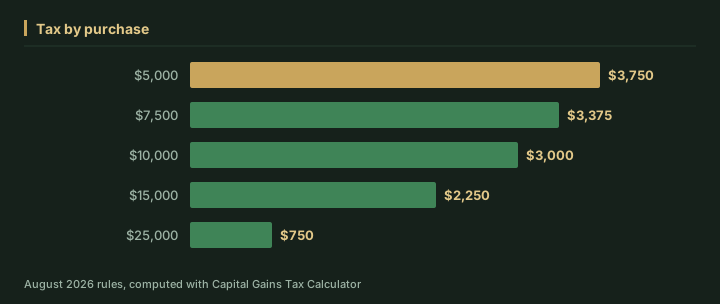
We ran 5 values of purchase through the calculator and left every other input at its default. As of August 2026, the output was:
| Purchase ($) | Tax ($) | After-tax income ($) | Gain ($) |
|---|---|---|---|
| 5,000 | 3,750 | 26,250 | 25,000 |
| 7,500 | 3,375 | 26,625 | 22,500 |
| 10,000 | 3,000 | 27,000 | 20,000 |
| 15,000 | 2,250 | 27,750 | 15,000 |
| 25,000 | 750 | 29,250 | 5,000 |
Running purchase from $5,000 up to $25,000 moves tax from $3,750 to $750 — a spread of $3,000. That gap is the part a single headline rate never shows.
The same runs seen through after-tax income
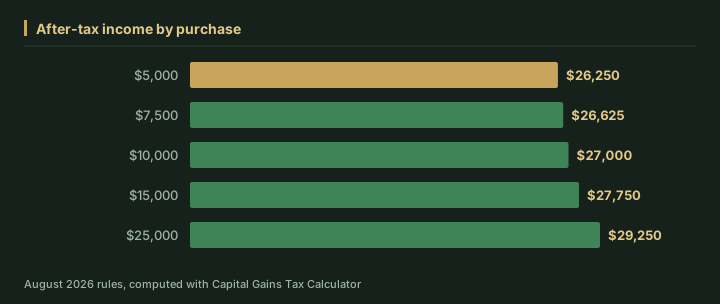
At $5,000, after-tax income works out to $26,250; at $25,000 it is $29,250. Looking only at tax tends to understate how much the outcome shifts across that range.
Assumptions behind these figures
| Input | Value |
|---|---|
| Purchase | $10,000 |
| Sale | $30,000 |
| Long term | 1 |
| Taxable income income | $70,000 |
| Status | Single |
| Year | 2026 |
| As of | August 2026 |
| Method | identical to /tools/capital-gains-tax-calculator |
Brackets, thresholds and rates change from year to year, so treat these as August 2026 figures for the 2026 tax year. For your own situation, open the Capital Gains Tax Calculator and enter your real numbers — the calculator runs the same code that produced every figure on this page.
Frequently Asked Questions
How do I calculate the capital gain on a stock sale?
You subtract your cost basis, what you paid including commissions and any reinvested dividends that were already taxed, from your proceeds, the sale price minus selling costs, to get your gain. The resulting gain is then taxed based on how long you held the stock — one year or less is short-term, taxed at ordinary income rates, and more than one year is long-term, taxed at generally lower preferential rates.
Why does the exact holding period matter so much for capital gains tax?
Because the tax code draws a hard line at exactly one year — held for a year or less, the gain is taxed as ordinary income at your regular bracket rate; held for more than a year, it qualifies for the lower long-term capital gains rates. Selling even one day early can mean paying a noticeably higher tax rate on an identical gain.
Do reinvested dividends affect my cost basis?
Yes, every time a dividend is automatically reinvested to buy more shares, that dividend amount is generally added to your cost basis, because it was already taxed as income in the year it was paid. Forgetting to include reinvested dividends in your basis calculation causes you to overstate your gain and potentially overpay tax.
Can I choose which shares to sell if I bought the same stock at different times?
Often yes — through a method called specific identification, you may be able to choose which purchase lot of shares to sell rather than defaulting to the standard first-in-first-out order, which can meaningfully change your reported gain and whether it qualifies for short-term or long-term treatment. This choice generally needs to be made with your broker before the sale settles.
Try the related calculators
Related guides
"How to Determine Your Tax Bracket"
"\"I'm in the 24% bracket\" is almost always either wrong or misunderstood. Here is how to find the bracket yo...
"How to Estimate Your Tax Refund Before Filing"
A married couple expected a $3,000 refund and owed $1,900 instead. The number was knowable in October. Here is...
"How to Use Our Federal Income Tax Calculator"
A one-minute walkthrough of the federal income tax calculator — what each input means, why the result has thre...